
Researcher’s Expertise, Energy, and Empathy Leave a Legacy
Late MSU researcher Min Chen contributed to new seismic tomography of the magma deposits underneath Yellowstone volcano.
When Ross Maguire was a postdoctoral researcher at Michigan State University (MSU), he wanted to study the volume and distribution of molten magma underneath the Yellowstone volcano. Maguire used a technique called seismic tomography, which uses ground vibrations known as seismic waves to create a 3D image of what is happening below Earth’s surface. Using this method, Maguire was able to create an image of the magma chamber framework showing where the magma was located. But these are not crystal-clear images.
As a result of these new images, with key contributions from Chen, Maguire and his team were able to see that, in fact, twice that amount of magma exists within Yellowstone’s magmatic system.
“I was looking for people who are experts in a particular type of computational-based seismic tomography called waveform tomography,” said Maguire, now an assistant professor at the University of Illinois Urbana-Champaign (UIUC). “Min Chen was really a world expert on this.”
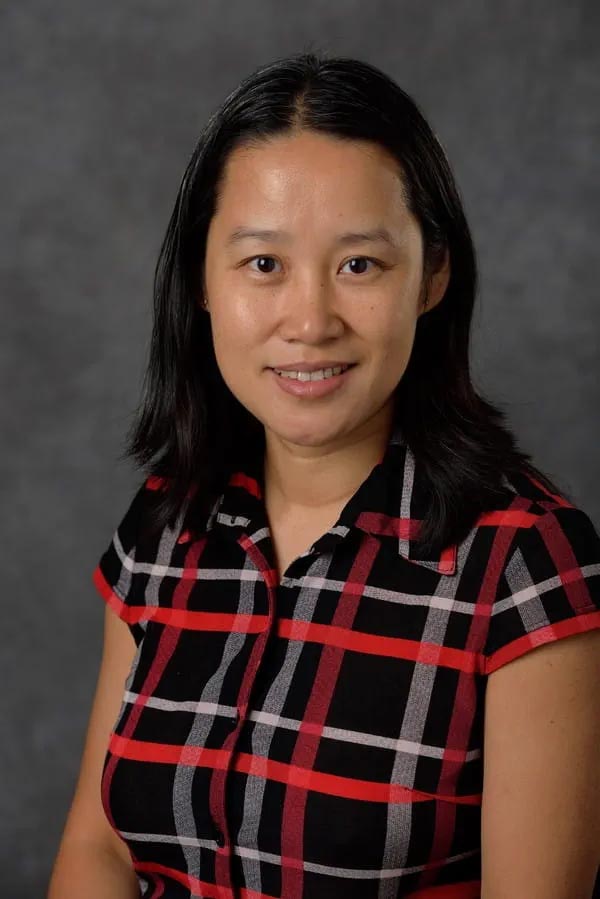
Min Chen was an assistant professor at MSU in the Department of Computational Mathematics, Science and Engineering and the Department of Earth and Environmental Sciences in the College of Natural Science. Using the power of supercomputing, Chen developed the method applied to Maguire’s images to model more accurately how seismic waves propagate through the Earth. Chen’s creativity and skill brought those images into sharper focus, revealing more information about the amount of molten magma under Yellowstone’s volcano.
“We didn’t see an increase in the amount of magma,” Maguire said. “We just saw a clearer picture of what was already there.”
Revealing Double the Molten Magma at Yellowstone
Previous images showed that Yellowstone’s volcano had a low concentration of magma — only 10% — surrounded by a solid crystalline framework. As a result of these new images, with key contributions from Chen, Maguire and his team were able to see that, in fact, twice that amount of magma exists within Yellowstone’s magmatic system.
“To be clear, the new discovery does not indicate a future eruption is likely to occur,” Maguire said. “Any signs of changes to the system would be captured by the network of geophysical instruments that continually monitors Yellowstone.”
A Legacy in Computational Seismology
Unfortunately, Chen never got to see the final results. Her unexpected death in 2021 continues to send shockwaves throughout the earth science community, which mourns the loss of her passion and expertise.
“Computational seismology is still relatively new at MSU,” said Songqiao “Shawn” Wei, an Endowed Assistant Professor of Geological Sciences in MSU’s Department of Earth and Environmental Sciences, who was a colleague of Chen’s. “Once the pandemic hit, Chen made her lectures and research discussions available on Zoom where researchers and students from all over the world could participate. That’s how a lot of seismologists worldwide got to know MSU.”
Her meetings were a place where gifted undergraduate students, postdoctoral candidates, or simply anyone who was interested were welcome to attend. Chen had prospective graduate students as well as seasoned seismologists from around the world join her virtual calls.
Chen cared deeply about her students’ well-being and careers. She fostered an inclusive and multidisciplinary environment in which she encouraged her students and postdoctoral candidates to become well-rounded scientists and to build long-term collaborations. She even held virtual seminars about life outside of academia to help students nurture their careers and hobbies. Chen led by example: She was an avid soccer player and knew how to dance the tango.
Diversity in science was another area about which Chen felt strongly. She advocated and championed research opportunities for women and underrepresented groups. To honor Chen, her colleagues created a memorial fellowship in her name to provide graduate student support for increasing diversity in computational and earth sciences. In another tribute to her life and love of gardening, Chen’s colleagues also planted a memorial tree in the square of the Engineering Building on MSU’s campus.
Chen was truly a leader in her field and was honored as a National Science Foundation Early CAREER Faculty Award recipient in 2020 to conduct detailed seismic imaging of North America to study Earth’s solid outer shell.
“She had so much energy,” Maguire said. “She focused on ensuring that people could be successful while she was incredibly successful.”
Maguire’s research, which showcases a portion of Chen’s legacy, is published in the journal Science.
References:
“Magma accumulation at depths of prior rhyolite storage beneath Yellowstone Caldera” by Ross Maguire, Brandon Schmandt, Jiaqi Li, Chengxin Jiang, Guoliang Li, Justin Wilgus and Min Chen, 1 December 2012, Science.
DOI: 10.1126/science.ade0347
“What lies beneath Yellowstone? There is more magma than previously recognized, but it may not be eruptible” by Kari M. Cooper, 1 December 2012, Science.
DOI: 10.1126/science.ade8435
Never miss a breakthrough: Join the SciTechDaily newsletter.
Follow us on Google and Google News.
4 Comments
What a tragic loss of a brilliant person . My condolences to her family
Whenever Volcanoes Erupt, the Environment gets exposed suddenly to massive pollution. Why not pump sea water into it infrequently and study what happens? Why are we ignoring so much thermal energy? Does that water eventually return back to the sea or as clouds/rain momentarily for the land? It need not be a massive intrusion into the Nature, but a small effort, rather than sitting idle. Otherwise, Future generations will laugh at us.
Luckily, ‘Shoshone Lake’ is ~1 Mile away. Whenever there are no rains in the area, moving water into the lava might help? Need not be a big Exercise…Start with very minimal effort and expand the project slowly as needed !
Don’t be in a hurry to pump water into a magma chamber. Look what happened to Krakatoa in 1883.