

The world’s most advanced solar telescope just unlocked a new level of discovery with the first light from its Visible Tunable Filter—a revolutionary instrument built with atomic precision to capture the Sun in stunning spectral and magnetic detail.
This breakthrough marks the final piece of the Inouye Solar Telescope’s instrument suite, and early results already reveal intricate sunspot structures that hint at game-changing insights into solar flares, space weather, and our Sun’s powerful magnetic field. Scientists believe this will lead to critical advances in predicting solar storms that can disrupt power grids and satellites on Earth.
First Light with the VTF
The Daniel K. Inouye Solar Telescope, the most powerful solar telescope in the world, has reached an important milestone. Located near the summit of Haleakalā in Maui and operated by the National Science Foundation’s (NSF) National Solar Observatory (NSO), the telescope has captured its first light using its most advanced instrument to date: the Visible Tunable Filter (VTF).
The VTF, developed by the Leibniz Institute for Solar Physics (KIS) in Freiburg, Germany, is the largest imaging spectro-polarimeter ever built. This cutting-edge instrument is now a central component of the Inouye Telescope’s scientific toolkit. The first image produced by the VTF highlights the instrument’s potential to revolutionize solar observations.
After arriving at the observatory last year, the VTF was carefully reconstructed and integrated into the telescope’s Coudé Laboratory by the KIS team, working alongside NSO engineers and scientists. This effort completed the telescope’s full suite of five first-generation instruments as originally planned.

Revealing the Sun’s Magnetic Personality
Following detailed optical calibration and alignment, the team successfully conducted the VTF’s first solar observations. The resulting image shows a detailed cluster of sunspots on the Sun’s surface, with a spatial resolution of 10 kilometers (6.2 miles) per pixel. These sunspots—regions of intense magnetic activity—are often linked to powerful solar flares and coronal mass ejections.
Although still in the early stages of deployment, this first image demonstrates the VTF’s promise. The instrument is expected to begin formal science verification and commissioning in 2026.

Scientists Celebrate a Milestone
The Inouye Telescope was designed specifically to support complex instruments like the VTF. It took over ten years to design and build this powerful device. These first successful observations mark a major step forward, showcasing the precision and performance the VTF can deliver—and pointing to new discoveries in solar physics in the years ahead.
“After all these years of work, VTF is a great success for me,” said Dr. Thomas Kentischer, KIS Co-Principal Investigator and key architect behind the instrument’s optical design. “I hope this instrument will become a powerful tool for scientists to answer outstanding questions on solar physics.”
“The significance of the technological achievement is such that one could easily argue the VTF is the Inouye Solar Telescope’s heart, and it is finally beating at its forever place,” added Dr. Matthias Schubert, KIS VTF Project Scientist.

How the VTF Works
The VTF is an imaging spectro-polarimeter that captures two-dimensional snapshots of the Sun at specific wavelengths. Different wavelengths of light appear to our eyes as different colors – and light increases in wavelength as it moves from violet to red in the optical range of the electromagnetic spectrum.
Unlike traditional spectrographs that spread light into a full spectrum like a rainbow, the VTF uses an etalon – a pair of precisely spaced glass plates separated by tens of microns – that allows it to tune through colors. By adjusting this spacing at the nanometer scale (i.e., as tiny as a billionth of a meter), the VTF sequentially scans different wavelengths, similar to taking a series of photographs using different color filters.
It takes several hundred images in just a few seconds with three high-accuracy synchronized cameras, at different colors, and combines these images to build a three-dimensional view of solar structures and analyzes their plasma properties.

Etalons and Spectral Scanning
The VTF features the largest Fabry-Pérot etalons ever built for solar research, with a second etalon expected to arrive from KIS by year’s end.
“Seeing those first spectral scans was a surreal moment. This is something no other instrument in the telescope can achieve in the same way,” said Dr. Stacey Sueoka, Senior Optical Engineer at NSO. “It marked the culmination of months of optical alignment, testing, and cross-continental teamwork. Even with just one etalon in place, we’re already seeing the instrument’s potential. This is only the beginning, and I’m excited to see what’s possible as we complete the system, integrate the second etalon, and move toward science verification and commissioning.”

Capturing Polarized Light
Additionally, light moves in waves that can oscillate in different directions. Polarimetry is the technique of measuring the direction in which these lightwaves oscillate. When you combine spectroscopy and polarimetry, you are not just looking at the colors of the light – you are also figuring out how lightwaves’ oscillations are oriented at each color. Certain features, like solar magnetic fields, are not obvious just by looking at the light’s colors; but if the light is polarized in a particular way, and we are able to measure it, that can reveal hidden details about the solar magnetic field, which is crucial for understanding solar flares, and space weather. The VTF, with its unparalleled combination of imaging, spectral, and polarimetric capabilities, allows us to get an unprecedented full picture from the light we receive from the Sun.
The central mission of the VTF is to spectroscopically isolate narrow-band images of the Sun at the highest possible spectral, spatial and temporal resolution provided by the Inouye – i.e., a spectral resolution able to resolve a range of wavelengths as small as 1/100,000th of the center wavelength; a spatial resolution that requires 10 km sampling to image the finest details on the sun accessible to the Inouye/VTF; and a temporal resolution of a few seconds within which the instrument acquires hundreds of images.
High-Resolution Mapping of the Sun
This means that it can take consecutive images of areas of the Sun by recording just a distinct small range of wavelengths tied to specific properties of solar phenomena. During one single observation, around 12 million spectra are recorded, which can then be used to determine the temperature, pressure, velocity, and magnetic field strength at different altitudes in the solar atmosphere. From this, high-precision velocity and magnetic field maps can be derived to track evolutionary changes of solar phenomena on spatial scales between 20-40,000 km (i.e., 12-25,000 miles).
Finally, it is VTF’s polarimetric capabilities that allow us to measure the polarization of the light coming from the imaged areas, and from it, infer its magnetic properties. By correlating all this information – i.e., spatial, temporal, spectral, and magnetic – we get an unprecedented understanding of the nature of our home star, and the mechanisms driving solar phenomena.
Why Solar Storms Matter
“When powerful solar storms hit Earth, they impact critical infrastructure across the globe and in space. High-resolution observations of the sun are necessary to improve predictions of such damaging storms,” said Carrie Black, NSF program director for the NSF National Solar Observatory. “The NSF Inouye Solar Telescope puts the U.S. at the forefront of worldwide efforts to produce high-resolution solar observations and the Visible Tunable Filter will complete its initial arsenal of scientific instruments.”
The Sun is a plasma laboratory right on our doorstep. Everyone is familiar with aurorae, for instance, which show the influence of solar activity on Earth – a consequence of energy and small particles released by the Sun interacting with our planet’s magnetic field. Similar to weather forecasts on Earth, it should be possible to predict the geomagnetic disturbances caused by energy eruptions on the Sun responsible for these beautiful aurorae – which can also have other unwelcoming implications. Space weather refers to the changing conditions in space, driven by the Sun’s behavior, that affect Earth and space-based technologies. On our increasingly technological Earth, sudden solar storms can cause devastating damage to critical infrastructure, and disable large portions of the electrical power grid, communications networks, or space systems.
The Drive for Space Weather Prediction
“The Inouye Solar Telescope was designed to study the underlying physics of the Sun as the driver of space weather. In pursuing this goal, the Inouye is an ideal platform for an unprecedented and pioneering instrument like the VTF,” said Christoph Keller, NSO Director.
In order to access the necessary measurements to make crucial predictions a reality, we need cutting-edge instruments manufactured with atomic precision. The pioneering image spectro-polarimeter VTF is an example of the necessary technological leaps needed to increase our ability to produce reliable space weather predictions.
Explore Further: Inouye Telescope’s VTF Captures Fiery First Glimpse
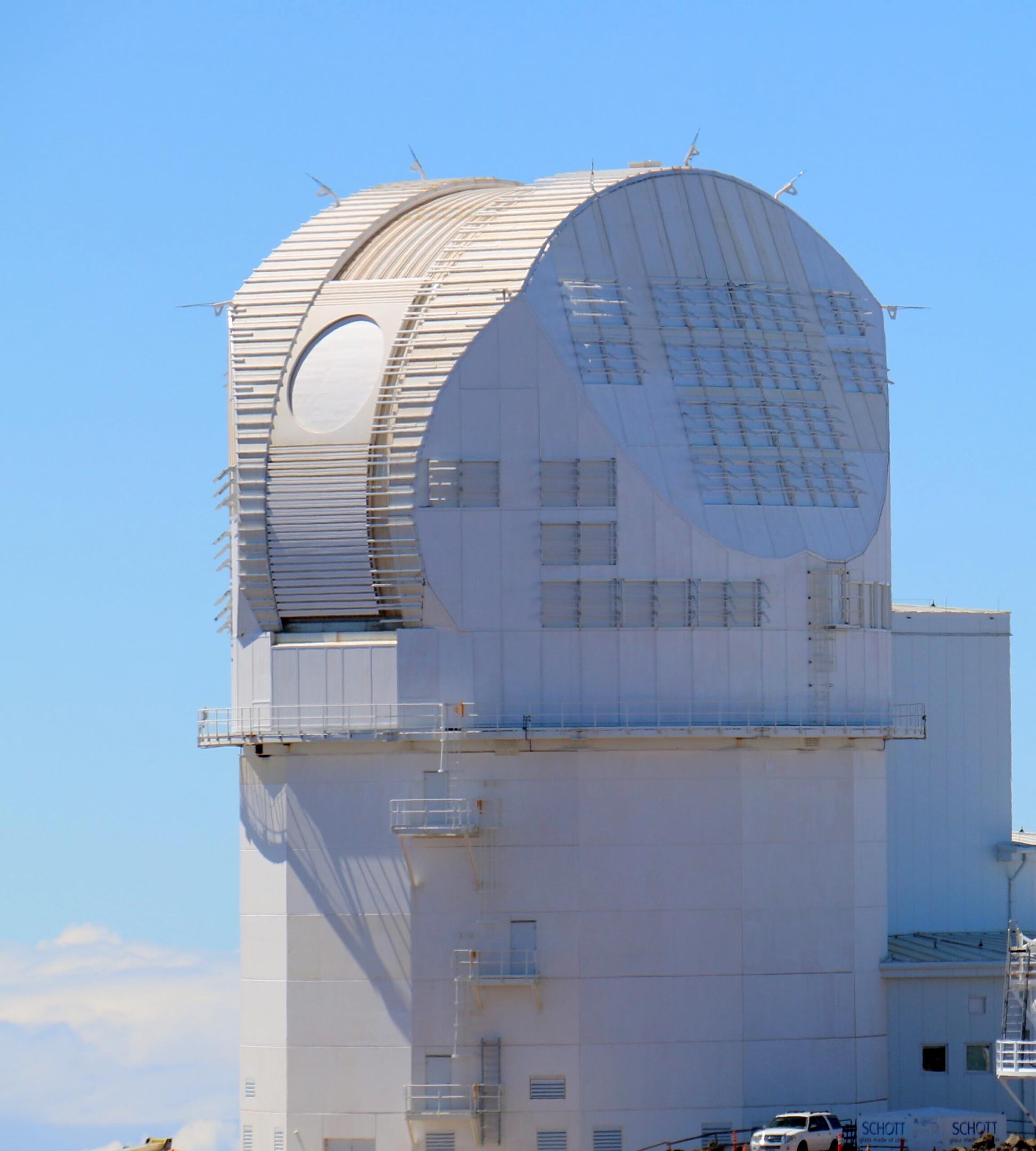
The Daniel K. Inouye Solar Telescope is the world’s most powerful ground-based solar observatory, designed to capture the Sun in unprecedented detail. Located on the summit of Haleakalā in Maui, Hawaii, and operated by the National Solar Observatory (NSO) under the U.S. National Science Foundation (NSF), the telescope began operations in 2020.
Boasting a 4-meter primary mirror, the Inouye is capable of observing solar features as small as 20 kilometers across, allowing scientists to study the Sun’s surface, atmosphere, and magnetic field with extraordinary clarity. Its high-resolution capabilities are essential for advancing our understanding of solar activity, such as sunspots, solar flares, and space weather events that can affect Earth’s infrastructure.
Equipped with a suite of state-of-the-art instruments—including the newly commissioned Visible Tunable Filter (VTF)—the Inouye Telescope enables scientists to analyze the Sun’s light in detail across various wavelengths and polarizations. These observations help decode the complex magnetic processes that drive solar behavior.
In short, the Inouye Solar Telescope represents a major leap forward in solar physics, providing the tools needed to study the Sun’s dynamic behavior and improve predictions of solar storms that impact Earth’s technology and climate.
Never miss a breakthrough: Join the SciTechDaily newsletter.
Follow us on Google and Google News.