
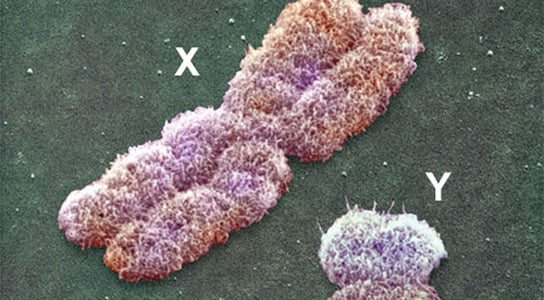
X chromosome alongside a shrunken Y chromosome
The male-sex determining Y chromosome is here to stay, having lost only one gene in the last 25 million years, a new study of human and rhesus monkey states. The study questions the notion that the Y chromosome is shedding genes and doomed to eventually degenerate.
Jennifer Hughes, a geneticist at the Whitehead Institute for Biomedical Research in Cambridge, Massachusetts, and her colleagues published their findings in the journal Nature.
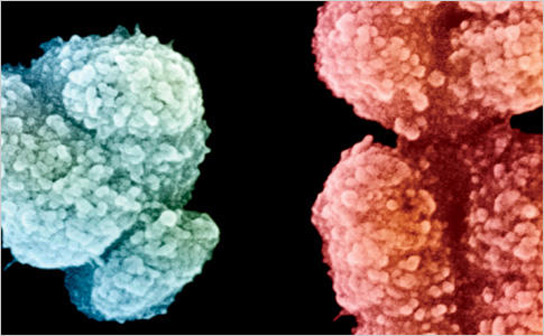
The Y chromosome emerged between 200 and 300 million years ago, and previously sex was determined by environmental factors such as temperature rather than genetics. When the gene SRY evolved from SOX3 (that later became the X chromosome), something which the scientists are still studying, this all changed. SRY, which eventually became the Y chromosome, now determined sex.
The early X and Y chromosomes reshuffled their genetic material in each generation. Gradually, the Y chromosome withered away, losing hundreds of genes and most of its ability to combine with the X chromosome. The chromosomes now only reshuffle the DNA at the tips of their spirals.
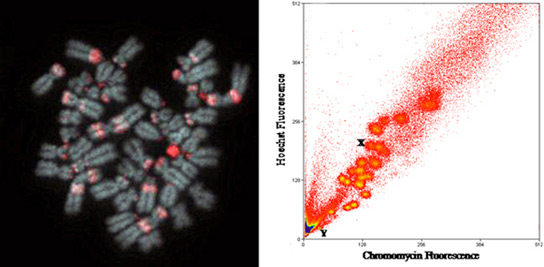
In 2002, it was reported that the Y chromosome will wither away in about 10 million years. Mole voles and spiny rats have already lost their Ys. In 2010, Hughes and her colleagues published a study analyzing the Y of the chimpanzee, and comparing it to the one in humans. The chimp’s Y has shed many protein-coding genes in 6 million years, but parts of it had been duplicated over and over again.
Hughes had theorized that these amplifications endowed chimps with extra copies of the genes used in sperm production, which could have compensated for the loss of the Y chromosome genes.
The rhesus macaque (Macaca mulatta), which had a common ancestor with humans and chimps 25 million years ago, was a different story. The macaque Y contained just one gene that humans have lost and it resides in an unstable portion of the Y. Scott Hawley, a geneticist at the Stowers Institute for Medical Research in Kansas City states that this gives him enough confidence to say that the Y chromosome will still be there in 50 million years.
Reference: “Strict evolutionary conservation followed rapid gene loss on human and rhesus Y chromosomes” by Jennifer F. Hughes, Helen Skaletsky, Laura G. Brown, Tatyana Pyntikova, Tina Graves, Robert S. Fulton, Shannon Dugan, Yan Ding, Christian J. Buhay, Colin Kremitzki, Qiaoyan Wang, Hua Shen, Michael Holder, Donna Villasana, Lynne V. Nazareth, Andrew Cree, Laura Courtney, Joelle Veizer, Holland Kotkiewicz, Ting-Jan Cho, Natalia Koutseva, Steve Rozen, Donna M. Muzny, Wesley C. Warren, Richard A. Gibbs, Richard K. Wilson and David C. Page, 22 February 2012, Nature.
DOI: 10.1038/nature10843








X-chromosome has withered a portion of its one strand above Chiasma to become Y is evident. Of course Eve came first and then Adam since X chromosome is senior to Y. It will make good the loss of these genes by expressing them from the partner X always. If the partner is defective it will reflect only defects like Y chromosome related diseases such as thalasemia, colour blindness, alopacea and so on. Partner X should be hale and healthy. For females both are expressive and one of the better X chromosome will take care of the choice. Reshuffling is common in DNA duplication just like mutation. The article speaks of the balance leftover genes in truncated Y strand. These balance genes will not get lost in another 50 million years is what the research tells about. We are assured that we will not get any Y-related fresh diseases like alopacea. Already men have lost much in life and there is no further to lose. Incidentally women who are senior to men have always got longevity more than men in any part of the world. Thank You.
This perfectly illustrates why men are such beast, in their suppression and oppression of women! –a man