
Close Menu
    Facebook X (Twitter) Instagram
    SciTechDaily
    • Biology
    • Chemistry
    • Earth
    • Health
    • Physics
    • Science
    • Space
    • Technology
    Facebook X (Twitter) Pinterest YouTube RSS
    SciTechDaily
    Home»Space»Study of X-Shaped Radio Galaxy NGC 326 Shows Outburst History and Active Galactic Nucleus Feedback
    Space

    Study of X-Shaped Radio Galaxy NGC 326 Shows Outburst History and Active Galactic Nucleus Feedback

    By SciTechDailyFebruary 6, 2012No Comments2 Mins Read
    Facebook Twitter Pinterest Telegram LinkedIn WhatsApp Email Reddit
    Share
    Facebook Twitter LinkedIn Pinterest Telegram Email Reddit
    ngc-520
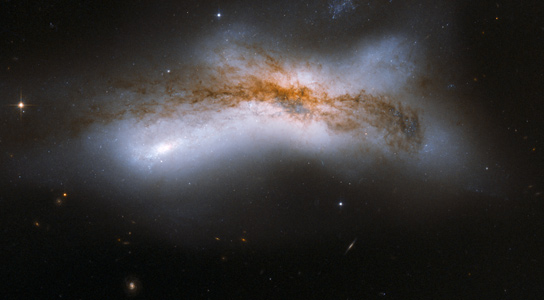
    A pair of colliding spiral galaxies in the Pisces constellation (NGC 520).

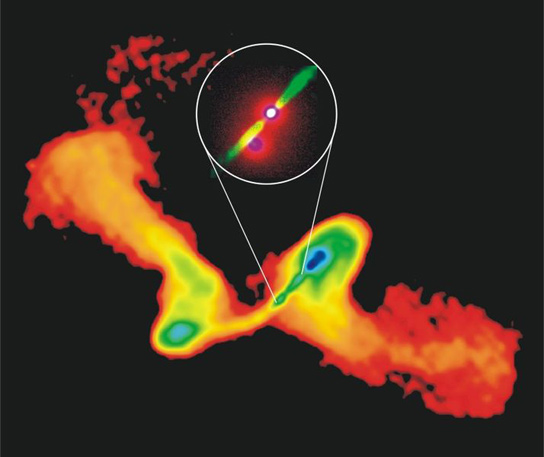
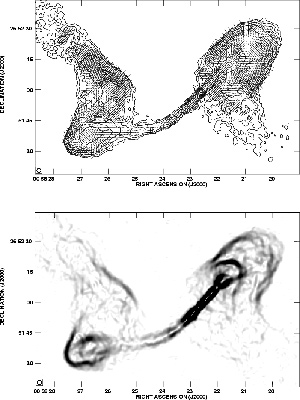
    A new study of the X-shaped radio galaxy NGC 326, which will be published on February 20th in Astrophysics Journal, tries to explain their morphology and some of the features associated with X- or Z-shaped radio galaxies.

    X-shaped galaxies are a class of extragalactic radio source that prominently exhibit two, low-surface brightness radio lobes, referred to as the wings, which are oriented at an angle to the active or high-surface-brightness lobes. Both sets of these lobes symmetrically pass through the center of the elliptical galaxy, which is the source of the lobes, giving the radio galaxy an X-shaped morphology.
    ngc-326

    NGC 326 is one of the most prominent X-shaped galaxies and has been the subject of several studies attempting to find an explanation of its morphology through fluid motion or a reorientation of the jet axis.

    The study used the Chandra X-ray Observatory to examine the emissions of the radio galaxy. Edmund J. Hodges-Kluck, of the Department of Astronomy, University of Michigan, Ann Arbor, and Christopher S. Reynolds, of the Department of Astronomy, University of Maryland, College Park, found several features of the radio galaxy, including a high-temperature front that might indicate a shock, high-temperate knots around the rim of the radio emission, and a cavity associated with the eastern wing.
    ngc-326-morphology

    Some of these features allowed them to reconstruct the history of the active galactic nucleus (AGN) outbursts. The active outburst was most likely once a powerful radio source that has since decayed. Some circumstantial evidence points to a reorientation, which could imply the production of the associated wings of NGC 326.

    There is an interaction between the radio galaxy and the intracluster medium, the superheated plasma present at the center of a galaxy cluster, and because of the wide separation between the active lobes and wings, the astronomers conclude that X-shaped radio galaxies are excellent ways to study the AGN feedback in galaxy groups, by measuring heating rates associated with both active and passive mechanisms.

    Reference: “A Chandra Study of the Radio Galaxy Ngc 326: Wings, Outburst History, and Active Galactic Nucleus Feedback” by Edmund J. Hodges-Kluck and Christopher S. Reynolds, 3 February 2012, The Astrophysics Journal.
    DOI: 10.1088/0004-637X/746/2/167

    Never miss a breakthrough: Join the SciTechDaily newsletter.
    Follow us on Google and Google News.

    Astronomy Astrophysics Chandra X-ray Observatory Galaxy Wings
    Share. Facebook Twitter Pinterest LinkedIn Email Reddit

    Related Articles

    Chandra Reveals Extended Hard X-ray Emission from a Galactic Nucleus

    Chandra Measures Massive Galaxy Cluster in Distant Universe

    Chandra Confirms Active Galactic Nuclei Downsizing

    Astronomers Detect X-rays From the Remains of Supernova SN 1957D

    Origins of Type Ia Supernovae

    Spacecraft to Explore Supermassive Black Holes at Center of Galaxies

    Ancient Galactic Collision Created Stellar Swirls of NGC 5907

    Lasers Mimic Supernova to Explain Cosmic Magnetic Fields

    Hubble Observes Rare Blue Stars in Andromeda’s Core

    Leave A Reply Cancel Reply

    • Facebook
    • Twitter
    • Pinterest
    • YouTube

    Don't Miss a Discovery

    Subscribe for the Latest in Science & Tech!

    Trending News

    The Secret to Healthy Aging May Be More Protein and More Exercise

    These 567-Million-Year-Old Fossils Are Rewriting the Story of Life on Earth

    The Spider-Like Creatures Helping Scientists Decode the Origins of Fatherhood

    Scientists Baffled by a Sudden Reversal Deep Inside Earth’s Core

    This Strange Sea Creature Can Survive Five Years Without Food – Scientists Finally Know Why

    New Quantum Sensor Opens a Window Into the Invisible Universe

    Stanford Scientists Reverse Age-Related Memory Loss by Targeting the Gut

    James Webb Uncovers the Atmosphere of a Hellish Lava World 41 Light-Years Away

    Follow SciTechDaily
    • Facebook
    • Twitter
    • YouTube
    • Pinterest
    • Newsletter
    • RSS
    SciTech News
    • Biology News
    • Chemistry News
    • Earth News
    • Health News
    • Physics News
    • Science News
    • Space News
    • Technology News
    Recent Posts
    • One of Arizona’s Largest Reservoirs Is Less Than 1% Full After Snowpack Collapse
    • Scientists Detect Hundreds of Iceberg Earthquakes at Antarctica’s Crumbling Doomsday Glacier
    • This 400-Year-Old Shark May Hold the Secret to Preserving Human Vision
    • Hip Replacements Are Lasting Far Longer Than Doctors Once Thought
    • Why Swallowing a Fish Bone Can Become a Life-Threatening Medical Emergency
    Copyright © 1998 - 2026 SciTechDaily. All Rights Reserved.
    • Science News
    • About
    • Contact
    • Editorial Board
    • Privacy Policy
    • Terms of Use

    Type above and press Enter to search. Press Esc to cancel.