
Letting an algorithm decide which maintenance holes to test for evidence of coronavirus could improve pandemic containment efforts.
COVID-19 is a respiratory illness that spreads when infected individuals shed the novel coronavirus (SARS-CoV-2) that causes it. While this seems to happen chiefly through close contact and respiratory droplets, evidence has mounted that the disease can also spread through airborne transmission. Distancing, masks, and improved ventilation are all critical interventions to interrupt this spread.
Many suffering from COVID-19 also shed the virus in their stool. With adequate plumbing, this is an unlikely source of virus transmission — but with the right tools, it can also be an unlikely source of virus detection. Viral traces of the novel coronavirus SARS-CoV-2 can be detected in sewage up to a week before physical symptoms occur. This means that wastewater can serve as an early warning signal that COVID is present in a community. In larger communities, however, it can be difficult to further narrow down where infections are occurring.
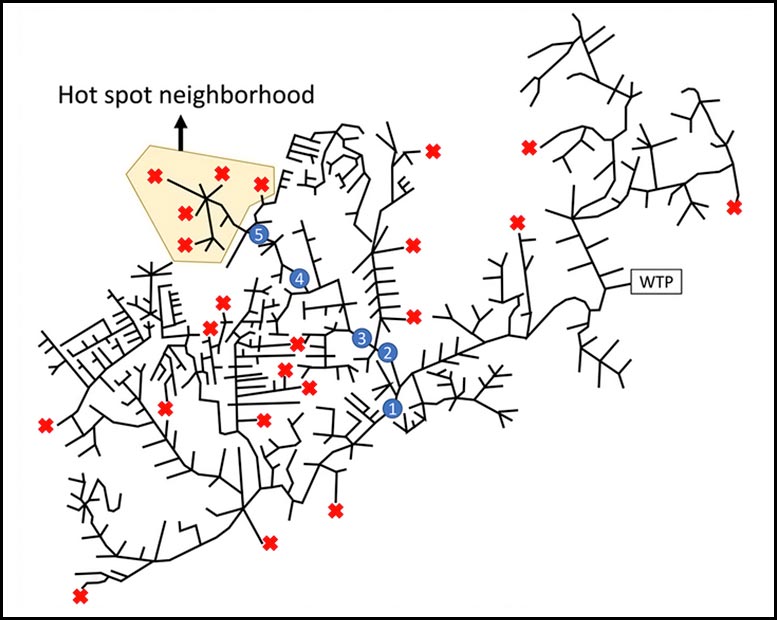
A recent paper co-authored by Richard Larson, a professor with the Institute for Data, Systems, and Society at MIT, details two “tree-searching” algorithms that can dynamically and adaptively select which maintenance holes in a community to test to lead to sources of potential outbreak. “The algorithms rely strongly on the structure of the sewage pipeline network,” says Larson. “It’s a ‘tree network,’ where sewage flows in one direction from its source through a unique path to the wastewater treatment plant.”
Leveraging this tree graph structure, Larson and his co-authors — Oded Berman of the University of Toronto and Mehdi Nourinejad of York University — developed two algorithms. The first is designed for a community that initially has zero infections, and the second for a community known to have many infections.
Several wastewater treatment plants around the world are testing for coronavirus to estimate the extent of community infection. The first algorithm is designed to respond when wastewater at a treatment plant has just revealed traces of SARS-CoV-2, indicating the existence of a new infection in the community. That algorithm usually identifies the city block or even the portion of a city block in which the infected person resides.
In the case of more widespread infection, the second algorithm homes in on the most infected neighborhoods or “hot zones,” usually several city blocks.
MIT has recently begun to test wastewater to help detect COVID-19 on campus, with sampling ports collecting sewage from the exit pipes of several buildings. Dorms house dozens, though, and treatment plants serve thousands. With a dorm, a positive result could mean targeted follow-up measures like individual testing and quarantining. With wastewater treatment plants, results can be a useful indicator of community infection, but are often too broad for localized responses.
Larson thinks the next step could be sequential testing of wastewater from a fraction of a community’s many maintenance holes. “With hundreds of manholes, we could test about six to 10 and find a source area of 100 people or less,” says Larson. “The group to be tested is now the set of individuals resident in the source manhole’s immediate ‘catchment area.’”
Larson’s research could make up for shortfalls in widespread community testing, which continue to be a challenge in many places. Testing thousands of people requires equipment, labor, and other resources, not to mention buy-in from affected communities. Finding newly infected people can be like looking for a needle in a haystack. “Successful implementation of this algorithm could greatly reduce the size of that haystack,” Larson says.
While the mathematics of the algorithm have been developed and tested with numerous datasets, the operational implementation of the method awaits the invention of a fast, accurate, and inexpensive SARS-CoV-2 test to be done at the maintenance holes. Current viral detection research at MIT and elsewhere is close to developing such a test, at which point the method could be tested in the field.
“In-field testing may also identify other issues involving the flows of infected sewage in pipeline systems,” warns Larson, “issues to be worked out before reliable implementation can be achieved.”
Still, the algorithm-driven wastewater testing could provide single neighborhoods with an early warning sign of coronavirus infection, triggering targeted follow-up via testing and distancing. This could help minimize disease spread, ease the strain on health systems — and even save lives.
Reference: “Sampling manholes to home in on SARS-CoV-2 infections” by Richard C. Larson, Oded Berman and Mehdi Nourinejad, 5 October 2020, PLOS ONE.
DOI: 10.1371/journal.pone.0240007
Never miss a breakthrough: Join the SciTechDaily newsletter.
Follow us on Google and Google News.