
An unusual Type Ia supernova has been discovered by Stockholm University astronomers. For the first time, it was detected in radio waves and showed strong helium emissions. The supernova was triggered by a white dwarf star that pulled helium-rich material from a companion star. This novel finding adds to our understanding of Type Ia supernovae, which are pivotal for measuring the universe’s expansion.
A team of astronomers led by Stockholm University has discovered an unusual Type Ia supernova – or thermonuclear supernova – called SN 2020eyj. Not only did they make the first detection of such a supernova in radio waves, but follow-up observations from W. M. Keck Observatory on Maunakea, Hawaiʻi Island also showed strong emission lines of helium.
This marks the first confirmed Type Ia supernova triggered by a white dwarf star that pulled material from a companion star with an outer layer consisting primarily of helium; normally, in the rare cases where the material stripped from the outer layers of the donor star could be detected in spectra, this was mostly hydrogen.
Type Ia supernovae are important for astronomers since they are used to measure the expansion of the universe. However, the origin of these explosions has remained an open question. While it is established that the explosion is caused by a compact white dwarf star that somehow accretes too much matter from a companion star, the exact process and the nature of the progenitor is not known.
The new discovery of supernova SN 2020eyj is evidence the companion star was a helium star that had lost much of its material just prior to the explosion of the white dwarf.
The study, which includes data from Keck Observatory’s Low Resolution Imaging Spectrometer (LRIS), is published in the May 17th issue of the journal Nature.
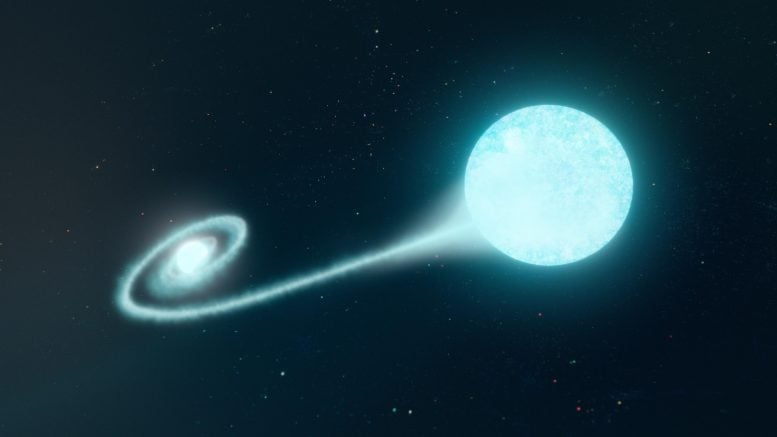
Artist impression of the double star system with a compact white dwarf star accreting matter from a helium-rich donor companion, surrounded by dense and dusty circumstellar material. It was the interaction of the exploded star and the material left over from this companion that gave rise to the strong radio signal and the conspicuous helium lines in the optical spectra of SN 2020eyj. Credit: Adam Makarenko/W. M. Keck Observatory
“Once we saw the signatures of strong interaction with the material from the companion, we tried to also detect it in radio emission,” says Erik Kool, a postdoc at Stockholm University’s Department of Astronomy and lead author of the paper. “The detection in radio is the first one of a Type Ia supernova – something astronomers have tried to do for decades.”
Supernova 2020eyj was first spotted by the Zwicky Transient Facility at Palomar Observatory near San Diego where the Oskar Klein Centre at Stockholm University are members.
“The Nordic Optical Telescope on La Palma was fundamental for following up this supernova,” says Jesper Sollerman, a professor at Stockholm University’s Department of Astronomy and co-author of the paper. “As were spectra from the large Keck telescope in Hawaiʻi that immediately revealed the very unusual helium-dominated material around the exploded star.”
“This is clearly a very unusual Type Ia supernova, but still related to the ones we use to measure the expansion of the universe,” adds co-author Joel Johansson from the Department of Physics at Stockholm University. “While normal Type Ia supernovae appear to always explode with the same brightness, this supernova tells us that there are many different pathways to a white dwarf star explosion.”
For more on this research, see Radio Signal Reveals Origin of Thermonuclear Supernova Explosion.
Reference: “A radio-detected type Ia supernova with helium-rich circumstellar material” by Erik C. Kool, Joel Johansson, Jesper Sollerman, Javier Moldón, Takashi J. Moriya, Seppo Mattila, Steve Schulze, Laura Chomiuk, Miguel Pérez-Torres, Chelsea Harris, Peter Lundqvist, Matthew Graham, Sheng Yang, Daniel A. Perley, Nora Linn Strotjohann, Christoffer Fremling, Avishay Gal-Yam, Jeremy Lezmy, Kate Maguire, Conor Omand, Mathew Smith, Igor Andreoni, Eric C. Bellm, Joshua S. Bloom, Kishalay De, Steven L. Groom, Mansi M. Kasliwal, Frank J. Masci, Michael S. Medford, Sungmin Park, Josiah Purdum, Thomas M. Reynolds, Reed Riddle, Estelle Robert, Stuart D. Ryder, Yashvi Sharma and Daniel Stern, 17 May 2023, Nature.
DOI: 10.1038/s41586-023-05916-w
Never miss a breakthrough: Join the SciTechDaily newsletter.
Follow us on Google and Google News.
1 Comment
There is no one else out there.
You’re welcome.