

Instruments from the U.S. Naval Research Laboratory have recorded the passage of comet C/2023 A3, Tsuchinshan-ATLAS, as it moved close to the sun.
The observation by the LASCO telescope revealed a spectacular view of the comet’s dust trail, marking one of the brightest comets seen, second only to Comet McNaught in 2007. This event provided crucial data to NASA’s Sungrazer Project, enriching our understanding of comet dynamics and the solar environment.
Capturing Comet Tsuchinshan-ATLAS
Imaging instruments from the U.S. Naval Research Laboratory (NRL), aboard three sun-orbiting observatories, captured detailed sequences of comet C/2023 A3, also known as Tsuchinshan-ATLAS, as it passed between Earth and the Sun in early October 2024.
Discovered in 2023, the comet moved through the field of view of NRL’s Large Angle and Spectrometric Coronagraph (LASCO) telescope from October 7-11. While the comet’s nucleus quickly moved out of sight, its enormous dust trail remained visible for several days afterward.
LASCO, part of the NASA and European Space Agency (ESA) Solar and Heliospheric Observatory (SOHO) mission since 1995, observed the comet from its position at the Lagrange (L1) point in space. As the comet passed almost directly between the Sun and the spacecraft, sunlight illuminated the dust around the comet’s nucleus from behind, dramatically increasing its apparent brightness.
A Rare Observation by LASCO
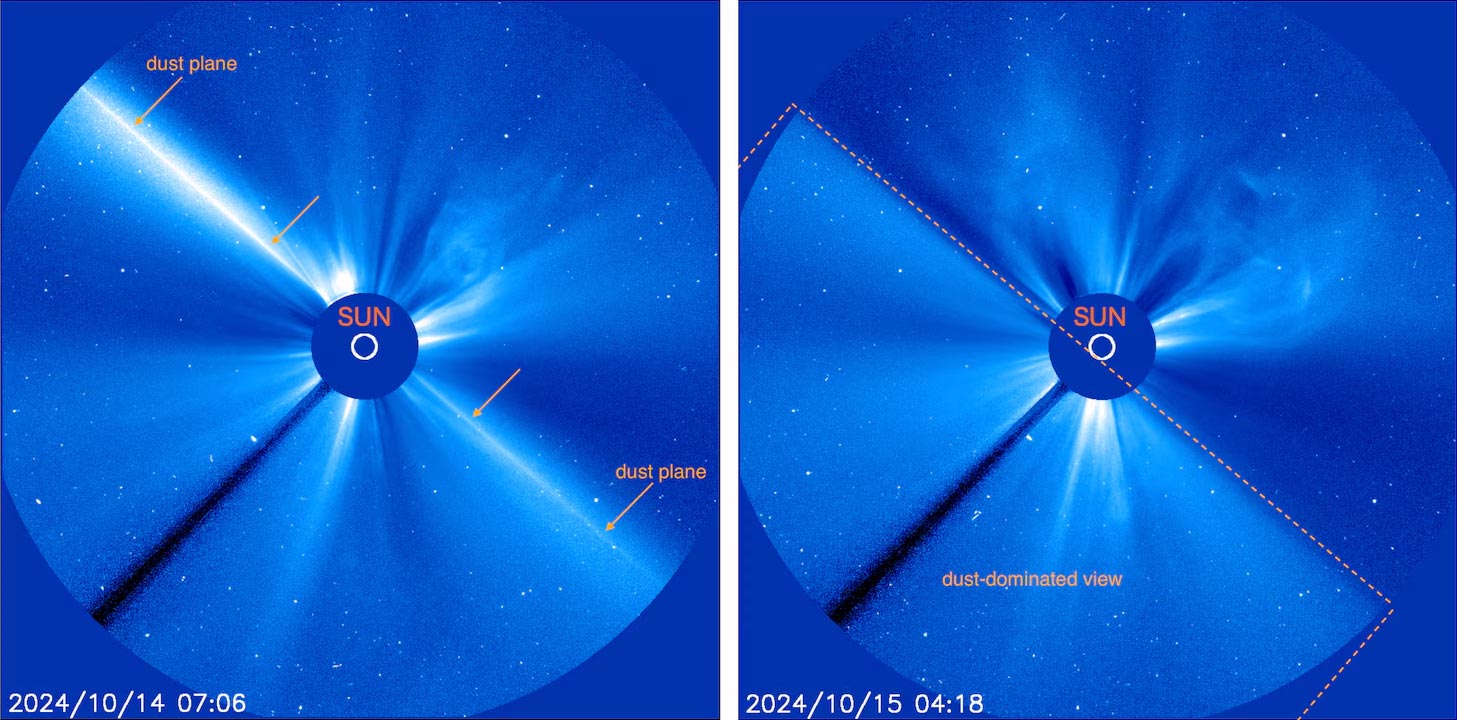
Despite having seen thousands of comets in its almost 29 years of solar observing, comet Tsuchinshan-ATLAS’ passage revealed a rare facet of comet dust that LASCO has never seen before.
For a brief period on October 14, the extensive dusty trail of the comet coalesced into a narrow, dense trail spanning the entire field of view. This unique density enhancement was the result of the SOHO spacecraft crossing the comet’s orbital plane and observing the comet’s vast dust sheet edge-on. The dust plane then moved into the lower half of the data, where it could be seen globally illuminating half of the field of view.
“LASCO has seen many beautiful comet transits during its decades of operations, but seeing a side-on view of a comet’s dust plane absolutely ranks as one of the most spectacular that we have seen,” said NRL scientist and LASCO Principal Investigator Karl Battams, Ph.D.
Comet Tsuchinshan-ATLAS’ Unprecedented Brightness
Scientists were curious if it would be the brightest comet ever observed by LASCO, surpassing Comet McNaught in 2007. It did not quite reach the same peak but did get brighter than a visual magnitude of -4.0, earning it the title of the second brightest comet observed.
“We knew this comet was going to be bright, but the extremely fortuitous viewing geometry here has led to a truly spectacular sequence of images,” added Battams.
The Sungrazer Project and Beyond
LASCO also plays a significant role in the NASA-funded and NRL-based Sungrazer Project. Since 2003, the Sungrazer Project has been a citizen science program that enables the discovery and reporting of previously unknown comets in heliophysics imaging data, primarily the LASCO and NASA Solar Terrestrial Relations Observatory-A (STEREO-A) observations.
The project is responsible for discovering over half of all officially documented comets and has led to numerous scientific publications looking at comet dynamics, evolution, composition, and more. Through these studies of the interaction between comets and the sun, scientists have gained new insights into the nature of the near-sun environment and solar outflows that drive space weather.
A number of CMEs were also observed during this transit, some of which likely interacted with the comet’s dust and gas tails. Observing the reaction of comet tails under such circumstances has historically led to unique insights into the near-Sun environment.
Additional Observations and Comet Trajectory
LASCO was not the only NRL instrumentation to observe the comet. NRL’s HI-1 heliospheric imager, operating on the NASA STEREO-A spacecraft since 2006, also observed it from October 4-9, as did the recently-launched Compact Coronagraph (CCOR-1) instrument on National Oceanic and Atmospheric Administration (NOAA) GOES-19.
Comet Tsuchinshan is now moving into the early evening skies for northern hemisphere observers and is currently visible to the naked eye shortly after sunset for observers with a clear view of the horizon. As it moves higher into the evening skies it will gradually fade but should still be a binocular object for several weeks. It will ultimately return to the Oort Cloud – a vast and distant reservoir of comets at the farthest reaches of our solar system – following a trajectory that will likely eventually see it ejected from our solar system entirely.
Never miss a breakthrough: Join the SciTechDaily newsletter.
Follow us on Google and Google News.