
Close Menu
    Facebook X (Twitter) Instagram
    SciTechDaily
    • Biology
    • Chemistry
    • Earth
    • Health
    • Physics
    • Science
    • Space
    • Technology
    Facebook X (Twitter) Pinterest YouTube RSS
    SciTechDaily
    Home»Space»Galactic Bowling
    Space

    Galactic Bowling

    By ESA/HubbleJanuary 23, 20221 Comment2 Mins Read
    Facebook Twitter Pinterest Telegram LinkedIn WhatsApp Email Reddit
    Share
    Facebook Twitter LinkedIn Pinterest Telegram Email Reddit
    NGC 7764A
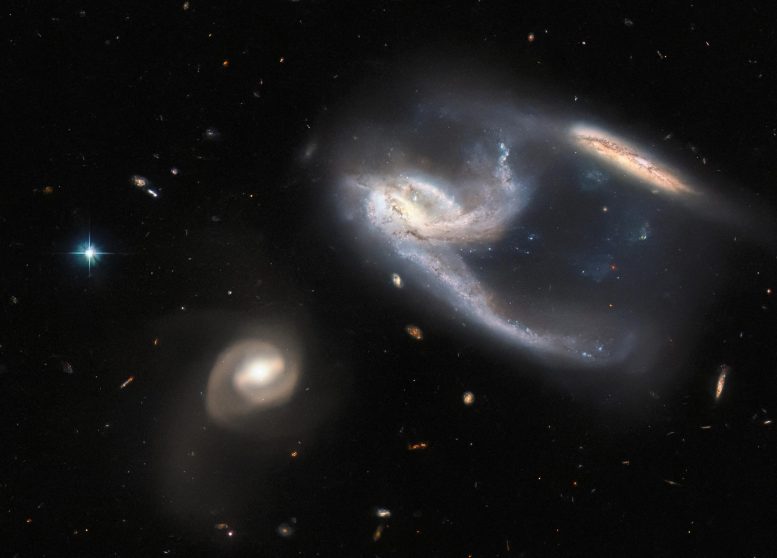
    This image shows a group of three galaxies, collectively known as NGC 7764A, located about 425 million light-years from Earth in the constellation Phoenix. Credit: ESA/Hubble & NASA, J. Dalcanton, Dark Energy Survey, DOE, FNAL, DECam, CTIO, NOIRLab/NSF/AURA, ESO
    Acknowledgment: J. Schmidt

    Hubble Space Telescope captured an image of the galaxy trio NGC 7764A, located 425 million light-years away in the constellation Phoenix. 

    The subject of this image is a group of three galaxies, collectively known as NGC 7764A. They were imaged by the NASA/ESA Hubble Space Telescope, using both its Advanced Camera for Surveys (ACS) and Wide Field Camera 3 (WFC3). The two galaxies in the upper right of the image appear to be interacting with one another — indeed, the long trails of stars and gas extending from them both give the impression that they have both just been struck at great speed, thrown into disarray by the bowling-ball-shaped galaxy to the lower left of the image.

    In reality, however, interactions between galaxies happen over very long time periods, and galaxies rarely collide head-on with one another. It is also unclear whether the galaxy to the lower left is actually interacting with the other two, although they are so relatively close in space that it seems possible that they are. By happy coincidence, the collective interaction between these galaxies have caused the two on the upper right to form a shape, which from our Solar System’s perspective, resembles the starship known as the USS Enterprise from Star Trek!

    NGC 7764A, which lies about 425 million light years from Earth in the constellation Phoenix, is a fascinating example of just how awkward astronomical nomenclature can be. The three galaxies are individually referred to as NGC 7764A1, NGC 7764A2 and NGC 7764A3, and just to be really difficult, an entirely separate galaxy, named NGC 7764, sits in the skies about a Moon’s distance (as seen from Earth) away. This rather haphazard naming makes more sense when we consider that many of the catalogues for keeping track of celestial bodies were compiled well over 100 years ago, long before modern technology made standardizing scientific terminology much easier. As it is, many astronomical objects have several different names, or might have names that are so similar to other objects’ names that they cause confusion.

    Never miss a breakthrough: Join the SciTechDaily newsletter.
    Follow us on Google and Google News.

    Astronomy European Space Agency Hubble Space Telescope NASA
    Share. Facebook Twitter Pinterest LinkedIn Email Reddit

    Related Articles

    Hubble’s Newest Discovery Isn’t a Star, It’s a Window Into the Dark Universe

    This Nearby Galaxy Shows How Frozen Clouds Ignite Into Stars

    This Chaotic Spiral Galaxy Is Still Recovering From a Cosmic Collision

    This Strange Spiral Galaxy Is Hiding a Massive Black Hole

    Hubble Zooms In on a Galaxy That Maps the Universe’s Expansion

    Hubble Captures a Dazzling Spiral Galaxy Alive With Birth and Destruction

    Hubble Spots a Glowing “Ring of Fire” in a Distant Spiral Galaxy

    Dust, Light & Ancient Collisions: The Sombrero Galaxy Like You’ve Never Seen It

    Star Formation in Motion: Hubble Reveals Spiraling Stars and Sculpted Nebulae

    1 Comment

    1. kamir bouchareb st on January 23, 2022 11:43 pm

      goooooooooood

      Reply
    Leave A Reply Cancel Reply

    • Facebook
    • Twitter
    • Pinterest
    • YouTube

    Don't Miss a Discovery

    Subscribe for the Latest in Science & Tech!

    Trending News

    Scientists Discover 132-Million-Year-Old Dinosaur Tracks on South Africa’s Coast

    Scientists Uncover the Secret Ingredient Behind the Spark That May Have Started Life on Earth

    Physicists Observe Matter in Two Places at Once in Mind-Bending Quantum Experiment

    Stanford Scientists Discover Hidden Brain Circuit That Fuels Chronic Pain

    New Study Reveals Why Ozempic Works Better for Some People Than Others

    Climate Change Is Altering a Key Greenhouse Gas in a Way Scientists Didn’t Expect

    New Study Suggests Gravitational Waves May Have Created Dark Matter

    Scientists Discover Why the Brain Gets Stuck in Schizophrenia

    Follow SciTechDaily
    • Facebook
    • Twitter
    • YouTube
    • Pinterest
    • Newsletter
    • RSS
    SciTech News
    • Biology News
    • Chemistry News
    • Earth News
    • Health News
    • Physics News
    • Science News
    • Space News
    • Technology News
    Recent Posts
    • Researchers Discover Long-Lost Words of Ancient Greek Philosopher After 2,000 Years
    • New Study Warns: Asia’s Lifeline Water Source Is Rapidly Draining
    • 100 Times Worse? Thawing Permafrost May Be More Dangerous Than Previously Thought
    • “Pretty Close to Home”: The Hidden Earthquake Threat Beneath Seattle
    • The Surprising Reason You Might Want To Sleep Without a Pillow
    Copyright © 1998 - 2026 SciTechDaily. All Rights Reserved.
    • Science News
    • About
    • Contact
    • Editorial Board
    • Privacy Policy
    • Terms of Use

    Type above and press Enter to search. Press Esc to cancel.