
Close Menu
    Facebook X (Twitter) Instagram
    SciTechDaily
    • Biology
    • Chemistry
    • Earth
    • Health
    • Physics
    • Science
    • Space
    • Technology
    Facebook X (Twitter) Pinterest YouTube RSS
    SciTechDaily
    Home»Space»How Planet-Smashing Collisions Stole Earth’s Life-Essential Elements
    Space

    How Planet-Smashing Collisions Stole Earth’s Life-Essential Elements

    By Arizona State UniversityApril 26, 2025No Comments3 Mins Read
    Facebook Twitter Pinterest Telegram LinkedIn WhatsApp Email Reddit
    Share
    Facebook Twitter LinkedIn Pinterest Telegram Email Reddit
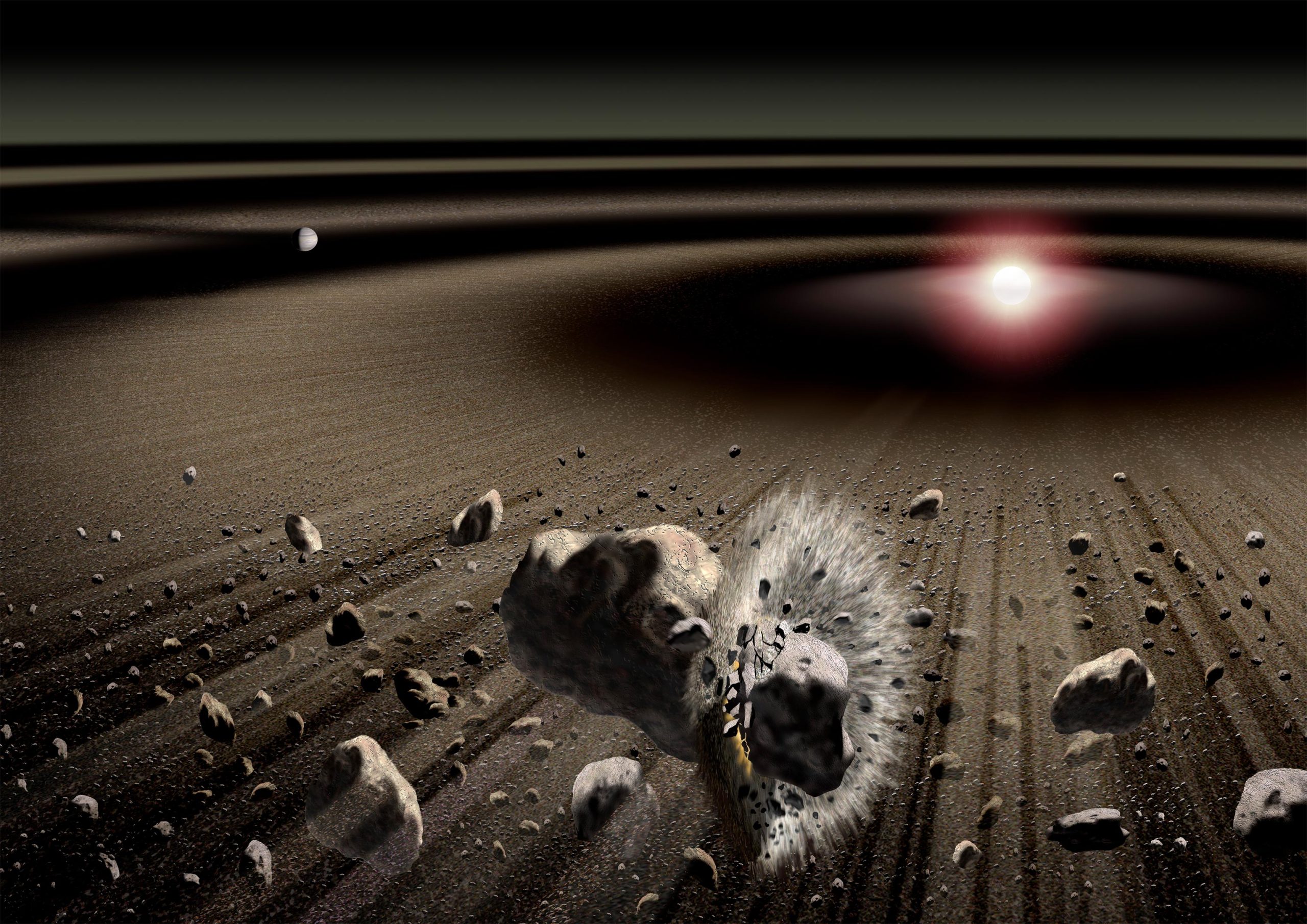
    Planetesimal Collisions During Planet Formation in the Early Solar System
    Planetesimal collisions during planet formation in the early solar system. Credit: Kouji Kanba

    Earth and Mars are mysteriously low in elements like copper and zinc, which are crucial for planetary chemistry and potentially life.

    A new study overturns old theories by showing that these elements were once abundant in the early building blocks of planets. The real loss likely occurred later through epic space collisions, not during early formation as once thought. This discovery radically shifts our understanding of how habitable planets like Earth came to be.

    Mystery of Missing Elements on Earth and Mars

    For decades, scientists have tried to solve a fundamental mystery: where did Earth’s key elements come from—and why are some of them missing? A new study offers an unexpected answer that reshapes our understanding of how Earth formed.

    Led by Assistant Professor Damanveer Grewal of Arizona State University, in collaboration with researchers from Caltech, Rice University, and MIT, the study challenges long-held beliefs about why Earth and Mars are deficient in moderately volatile elements (MVEs). These elements, such as copper and zinc, are crucial for planetary chemistry and often occur alongside life-supporting ingredients like water, carbon, and nitrogen. Tracing their origin is essential to understanding how Earth became habitable.

    Laser-Driven Magnetized Collisionless Shock Experiments
    Laser-driven magnetized collisionless shock experiments. Credit: Hui-bo Tang et al.

    Meteorites Reveal Hidden Clues

    Published in Science Advances, the research takes a novel approach by studying iron meteorites. These are the metal-rich remnants of ancient planetary building blocks, or planetesimals, that formed in the early inner solar system.

    “We found conclusive evidence that first-generation planetesimals in the inner solar system were unexpectedly rich in these elements,” said Grewal. “This discovery reshapes our understanding of how planets acquired their ingredients.”

    Cosmic Collisions as the Culprit

    Until now, scientists believed that MVEs were lost either because they never fully condensed in the early solar system or escaped during planetesimal differentiation. However, this study reveals a different story: many of the first planetesimals held onto their MVEs, suggesting that the building blocks of Earth and Mars lost theirs later, during a period of violent cosmic collisions that shaped their formation.

    Ion Velocity Spectra in Experiments and 1D PIC Simulations
    Ion velocity spectra in experiments and 1D PIC simulations. Credit: Hui-bo Tang et al.

    Redefining Planetary Chemistry

    Surprisingly, the team found that many inner solar system planetesimals retained chondrite-like MVE abundances, showing that they accreted and preserved MVEs despite undergoing differentiation. This suggests that the progenitors of Earth and Mars did not start out depleted in these elements, but instead, their loss occurred over a prolonged history of collisional growth rather than incomplete condensation in the solar nebula or planetesimal differentiation.

    Rewriting Earth and Mars’ Origins

    “Our work redefines how we understand the chemical evolution of planets,” Grewal explained. “It shows that the building blocks of Earth and Mars were originally rich in these life-essential elements, but intense collisions during planetary growth caused their depletion.”

    Reference: “Enrichment of moderately volatile elements in first-generation planetesimals of the inner Solar System” by Damanveer S. Grewal, Surjyendu Bhattacharjee, Bidong Zhang, Nicole X. Nie and Yoshinori Miyazaki, 5 February 2025, Science Advances.
    DOI: 10.1126/sciadv.adq7848

    Never miss a breakthrough: Join the SciTechDaily newsletter.
    Follow us on Google and Google News.

    Arizona State University Astrobiology Astrophysics Elements Meteorites Popular
    Share. Facebook Twitter Pinterest LinkedIn Email Reddit

    Related Articles

    Cracking the Magnetic Code: Distant Radio Signals Reveal Earth-Like Exoplanets’ Hidden Force

    Webb Space Telescope Shocks Astronomers With Surprising Exoplanet Atmospheric Composition

    Scientists Discover Vast Diversity of Organic Compounds in Martian Meteorite

    “Building Blocks of Life” Discovered in Meteorite That Crash Landed in England

    Discovery of Laughing Gas in Space Could Mean Alien Life

    Key Building Blocks for Life Discovered in Cloud Near Center of Our Galaxy

    In a Flash: Weird Star Produces the Fastest Nova on Record

    New Targets in Search for Extraterrestrial Life: Planets of Binary Stars As Homes for Alien Life

    Experiments Measure Freezing Point of Extraterrestrial Oceans To Aid Search for Alien Life

    Leave A Reply Cancel Reply

    • Facebook
    • Twitter
    • Pinterest
    • YouTube

    Don't Miss a Discovery

    Subscribe for the Latest in Science & Tech!

    Trending News

    Your Blood Pressure Reading Could Be Wrong Because of One Simple Mistake

    Astronomers Stunned by Ancient Galaxy With No Spin

    Physicists May Be on the Verge of Discovering “New Physics” at CERN

    Scientists Solve 320-Million-Year Mystery of Reptile Skin Armor

    Scientists Say This Daily Walking Habit May Be the Secret to Keeping Weight Off After Dieting

    New Therapy Rewires the Brain To Restore Joy in Depression Patients

    Giant Squid Detected off Western Australia in Stunning Deep-Sea Discovery

    Popular Sugar-Free Sweetener Linked to Liver Disease, Study Warns

    Follow SciTechDaily
    • Facebook
    • Twitter
    • YouTube
    • Pinterest
    • Newsletter
    • RSS
    SciTech News
    • Biology News
    • Chemistry News
    • Earth News
    • Health News
    • Physics News
    • Science News
    • Space News
    • Technology News
    Recent Posts
    • Mixing Edible Cannabis and Alcohol May Impair Driving More Than Scientists Expected
    • Scientists Reverse Stroke Damage Using Stem Cells in Breakthrough Study
    • Eating One Egg a Day Could Cut Alzheimer’s Risk by 27%
    • Hidden Warm Water Beneath Antarctica Could Rapidly Raise Global Sea Levels
    • Scientists Revive Ancient Chemistry Trick To Engineer Next-Generation Glass
    Copyright © 1998 - 2026 SciTechDaily. All Rights Reserved.
    • Science News
    • About
    • Contact
    • Editorial Board
    • Privacy Policy
    • Terms of Use

    Type above and press Enter to search. Press Esc to cancel.