
Close Menu
    Facebook X (Twitter) Instagram
    SciTechDaily
    • Biology
    • Chemistry
    • Earth
    • Health
    • Physics
    • Science
    • Space
    • Technology
    Facebook X (Twitter) Pinterest YouTube RSS
    SciTechDaily
    Home»Space»Hubble Captures a Dwarf Spiral Galaxy With Multiple Mysteries
    Space

    Hubble Captures a Dwarf Spiral Galaxy With Multiple Mysteries

    By NASA's Goddard Space Flight CenterMay 11, 2022No Comments3 Mins Read
    Facebook Twitter Pinterest Telegram LinkedIn WhatsApp Email Reddit
    Share
    Facebook Twitter LinkedIn Pinterest Telegram Email Reddit
    Spiral Galaxy NGC 247
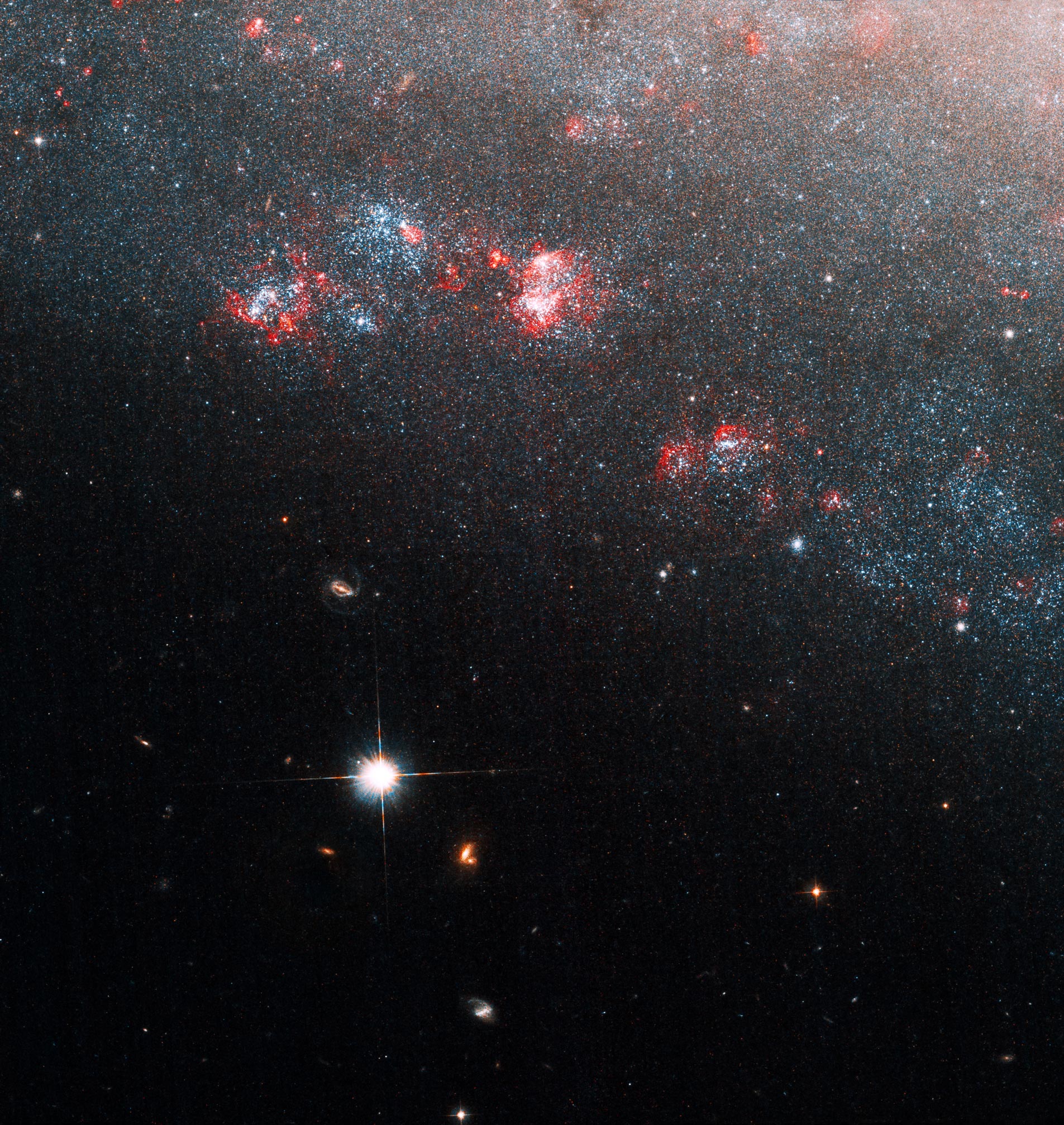
    Hubble Space Telescope image of the spiral galaxy NGC 247 (Caldwell 62), which has the nickname the Needle’s Eye. Credit: NASA, ESA, and H. Feng (Tsinghua University); Image processing: G. Kober (NASA Goddard/Catholic University of America)

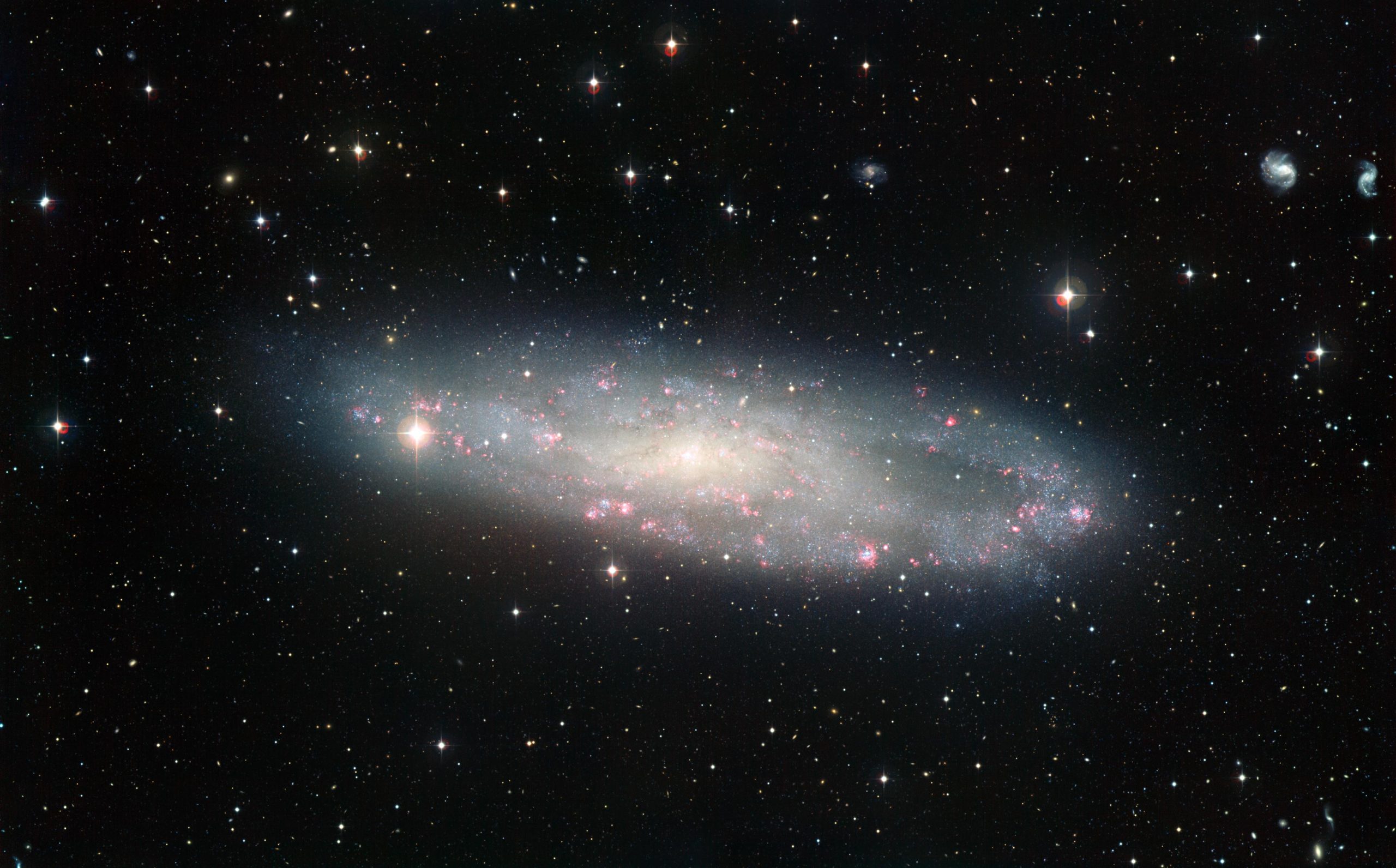
    This NASA Hubble Space Telescope image shows a section of the spiral galaxy nicknamed the Needle’s Eye – an appropriately diminutive name for a dwarf spiral galaxy. The Needle’s Eye, also known as NGC 247 and Caldwell 62, is located about 11 million light-years away in the Sculptor Group, which is the closest group of galaxies to our own (the Local Group). The galaxy was given its nickname because one end of it features a strange void of stars (not seen in this Hubble close-up, but visible in the wide field view below from ESO’s La Silla Observatory).

    This Hubble image zooms into the very edge of the galaxy, on the opposite side of the void. Below the edge of the galaxy’s disk, smaller and more distant galaxies are visible, as well as a very bright foreground star that lies between us and NGC 247. Bright red indicates areas of high-density gas and dust, and vigorous star formation rather close to the edge of the galaxy.
    Spiral Galaxy NGC 247 ESO
    This picture of the spiral galaxy NGC 247 was taken using the Wide Field Imager (WFI) at ESO’s La Silla Observatory in Chile. NGC 247 is thought to lie about 11 million light-years away in the constellation of Cetus (The Whale). It is one of the closest galaxies to the Milky Way and a member of the Sculptor Group. Credit: ESO

    The “hole” in Caldwell 62 on the other side of the galaxy is a puzzling mystery. There is a shortage of gas in that part of the galaxy, which means there isn’t much material from which new stars can form. Since star formation has halted in this area, old, faint stars populate the void. Scientists still don’t know how this strange feature formed, but studies hint toward past gravitational interactions with another galaxy.

    Caldwell 62 is also home to an object known as an ultraluminous X-ray source. Scientists have long debated the nature of these super-bright X-ray sources. Are they stellar-mass black holes gorging on unusually large amounts of gas? Or are they long-sought “intermediate-mass” black holes, dozens of times more massive than their stellar counterparts but smaller than the monster black holes in the centers of most galaxies? By studying NGC 247 in multiple forms of light (visible and infrared using Hubble, and X-rays using the Chandra X-ray Observatory), astronomers have found signs that the X-rays are coming from a disk around an intermediate-mass black hole.

    Never miss a breakthrough: Join the SciTechDaily newsletter.
    Follow us on Google and Google News.

    Astronomy Hubble Space Telescope NASA NASA Goddard Space Flight Center
    Share. Facebook Twitter Pinterest LinkedIn Email Reddit

    Related Articles

    Astronomers Finally Solve Betelgeuse’s Biggest Mystery

    The Andromeda Mystery: Hubble Discovers Strange Galactic Behavior

    3.7 Billion Miles Away: Hubble Uncovers a Hidden Trio That Could Rewrite Kuiper Belt History

    Historic Discovery: Twin Titans Clash As NASA Unveils Closest Supermassive Black Hole Duo

    The Great Escape: NASA’s Hubble and MAVEN Help Solve Mystery of Mars’ Vanishing Water

    Into the Rosy Depths: Hubble’s Journey Through Andromeda

    Hubble Observes a Lonely Beacon in the Cosmic Dark

    What Lies Within? Hubble’s Deep Dive Into the Structured Chaos of Leo A

    Hubble Spots Billowing Bubbles of Stellar Floss Across 1,000 Light-Year Expanse

    Leave A Reply Cancel Reply

    • Facebook
    • Twitter
    • Pinterest
    • YouTube

    Don't Miss a Discovery

    Subscribe for the Latest in Science & Tech!

    Trending News

    Scientists Discover How Coffee Impacts Memory, Mood, and Gut Health

    Why Did the Neanderthals Disappear? Scientists Reveal Humans Had a Hidden Advantage

    Physicists Propose Strange Experiment Where Time Goes Quantum

    Magnesium Magic: New Drug Melts Fat Even on a High-Fat, High-Sugar Diet

    Weight-Loss Drugs Like Ozempic May Come With an Unexpected Cost

    Mezcal “Worm” in a Bottle Mystery: DNA Testing Reveals a Surprise

    New Research Reveals That Your Morning Coffee Activates an Ancient Longevity Switch

    This Is What Makes You Irresistible to Mosquitoes

    Follow SciTechDaily
    • Facebook
    • Twitter
    • YouTube
    • Pinterest
    • Newsletter
    • RSS
    SciTech News
    • Biology News
    • Chemistry News
    • Earth News
    • Health News
    • Physics News
    • Science News
    • Space News
    • Technology News
    Recent Posts
    • This New Memory Technology Could Make Devices Last Months on One Charge
    • Scientists Turn Cancer’s Own Bacteria Against It in Breakthrough Therapy
    • Cannabis Can Make You Remember Things That Never Happened
    • Doctors Are Surprised by What This Vaccine Is Doing to the Heart
    • Quantum Breakthrough Turns Simple Forces Into Powerful New Interactions
    Copyright © 1998 - 2026 SciTechDaily. All Rights Reserved.
    • Science News
    • About
    • Contact
    • Editorial Board
    • Privacy Policy
    • Terms of Use

    Type above and press Enter to search. Press Esc to cancel.