
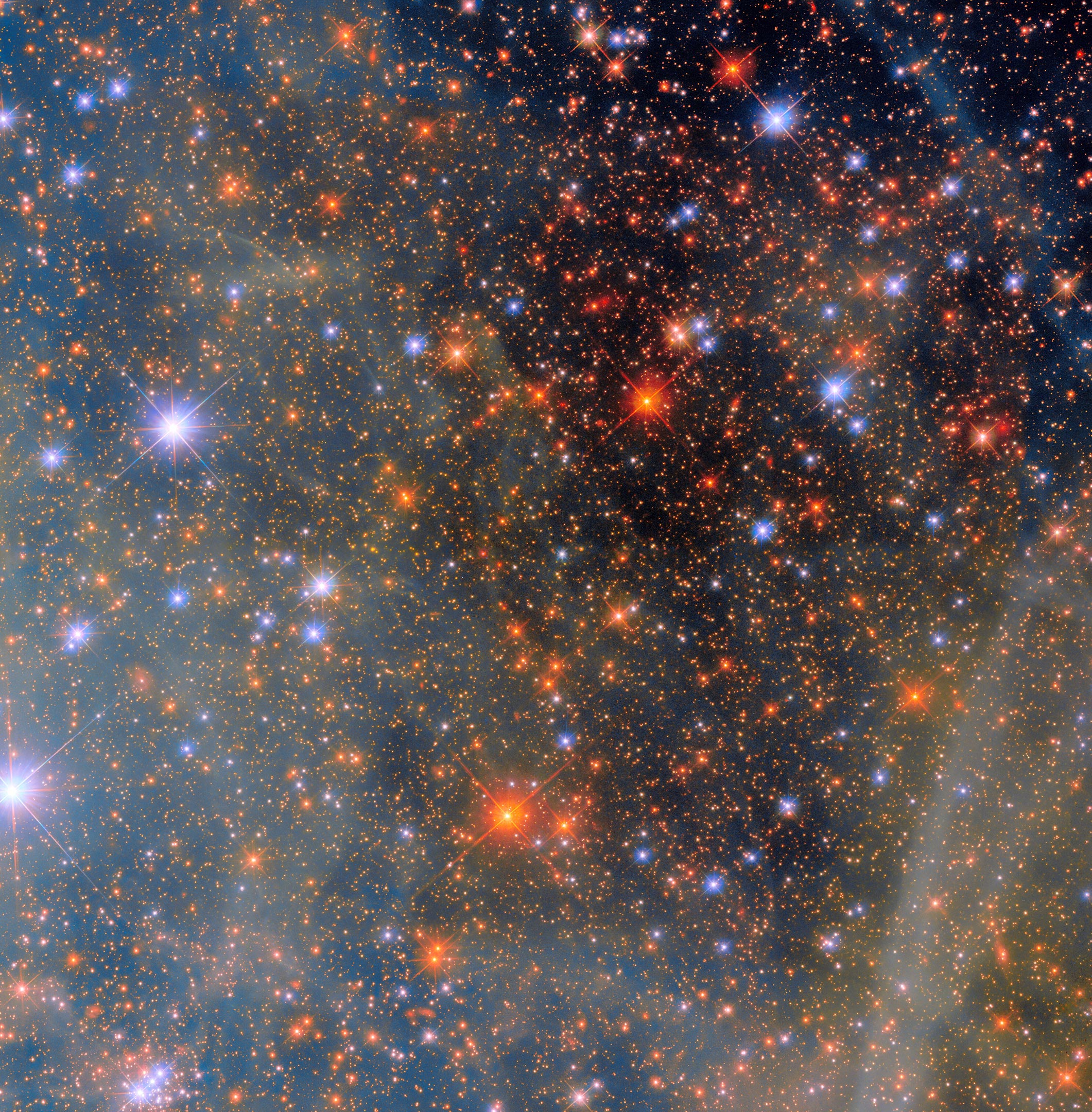
Hubble’s latest image reveals the Small Magellanic Cloud (SMC), a nearby dwarf galaxy visible from Earth without a telescope. Though it appears as a faint smudge in the sky, Hubble’s high-powered lenses capture an astonishing level of detail, showcasing a stunning interplay of stars and dust.
Meet one of the Milky Way’s closest neighbors! This new Hubble Space Telescope image highlights the Small Magellanic Cloud (SMC), a nearby dwarf galaxy located about 200,000 light-years from Earth. Most of the SMC lies in the constellation Tucana, with a small portion extending into the neighboring constellation Hydrus.
Because of its proximity, the SMC is one of the few galaxies visible to the naked eye. Observers in the southern hemisphere and some northern latitudes can spot it in the night sky, where it appears as a faint, detached piece of the Milky Way. In reality, however, it is far beyond the reach of our own galaxy.
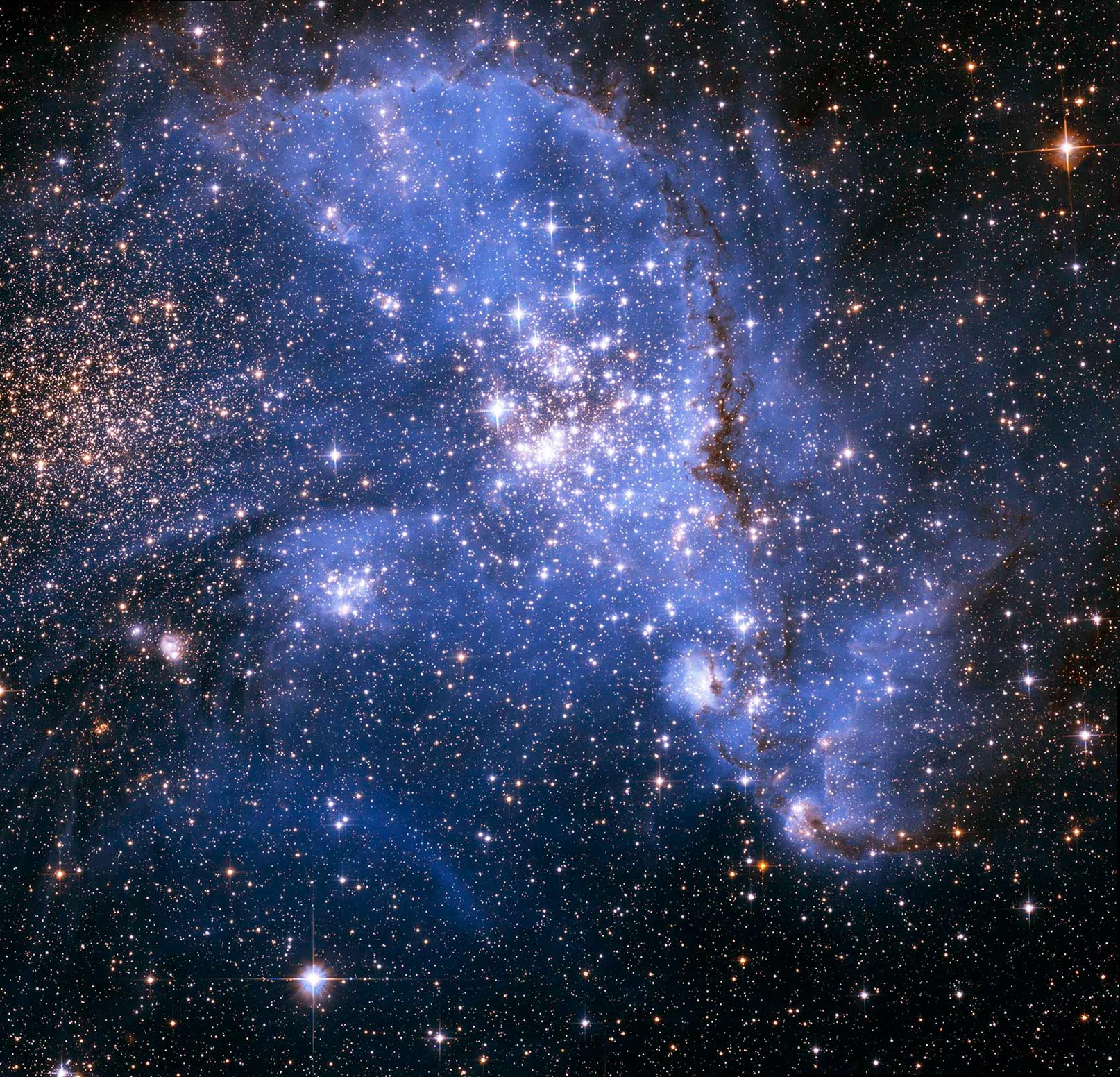
With its 2.4-meter ‘eye’ and sensitive instruments, Hubble’s view of the SMC is far more detailed and vivid than what humans can see. Researchers used Hubble’s Wide Field Camera 3 (WFC3) instrument to observe this scene through four different filters. Each filter admits different wavelengths of light, creating a multicolored view of dust clouds drifting across a field of stars. Hubble’s view, however, is much more zoomed-in than our eyes, the better for it to observe very distant objects. This image captures a small region of the SMC near the center of NGC 346, a star cluster that is home to dozens of massive young stars (see image above).
Never miss a breakthrough: Join the SciTechDaily newsletter.
Follow us on Google and Google News.
2 Comments
How can a star form out of atoms of hydrogen that are vigorously expanding away from one another, with only the infinitely weak gravity each one possesses?
The expansion from one another is proportional to intervening distance. This expansion is not vigorous for nearby objects. Even Andromeda and Milky Way are nearby in this context – they are moving towards each other.