
Close Menu
    Facebook X (Twitter) Instagram
    SciTechDaily
    • Biology
    • Chemistry
    • Earth
    • Health
    • Physics
    • Science
    • Space
    • Technology
    Facebook X (Twitter) Pinterest YouTube RSS
    SciTechDaily
    Home»Space»Hubble Reveals the “Lost Galaxy” Glowing With Newborn Stars
    Space

    Hubble Reveals the “Lost Galaxy” Glowing With Newborn Stars

    By ESA/HubbleDecember 31, 2025No Comments3 Mins Read
    Facebook Twitter Pinterest Telegram LinkedIn WhatsApp Email Reddit
    Share
    Facebook Twitter LinkedIn Pinterest Telegram Email Reddit
    Spiral Galaxy NGC 4535
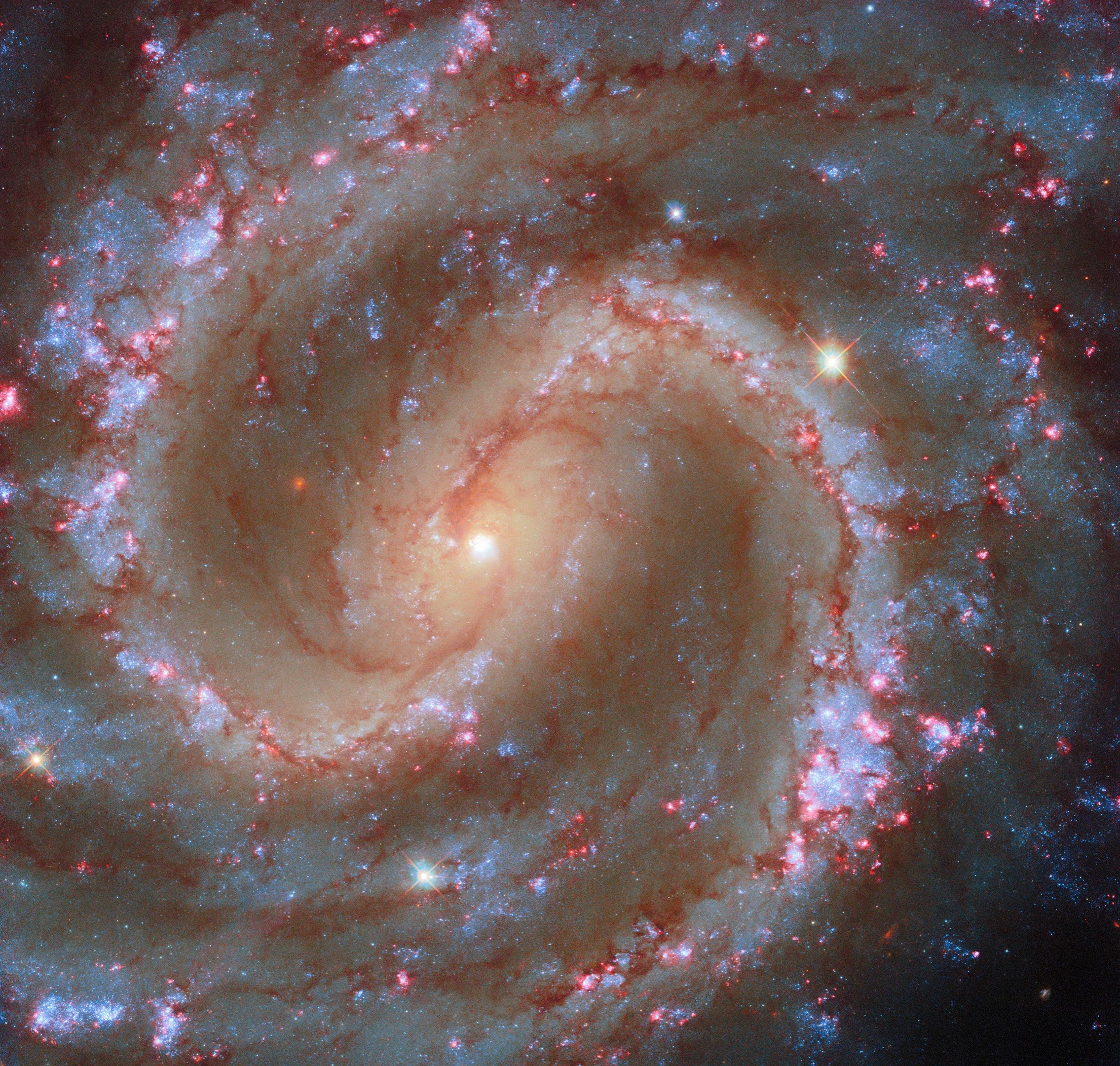
    Once nearly invisible from Earth, NGC 4535 comes alive in Hubble’s view with swirling arms filled with young, blue stars and glowing pink nebulae. Credit: ESA/Hubble & NASA, F. Belfiore, J. Lee and the PHANGS-HST Team

    Hubble unveils the “Lost Galaxy” as a vibrant spiral alive with newborn stars and glowing clouds of cosmic energy.

    This Hubble Space Telescope image highlights the spiral galaxy NGC 4535, a vast system of stars located about 50 million light-years from Earth in the constellation Virgo (The Maiden). While that distance is far beyond anything in our own galaxy, it places NGC 4535 in what astronomers consider the nearby universe. NGC 4535 has earned the nickname the ‘Lost Galaxy’ because it appears extremely faint when viewed through small backyard telescopes, making it difficult to study from the ground.

    NASA’s Hubble Space Telescope is uniquely suited for observing galaxies like this one. Its primary mirror measures 2.4 meters across, allowing it to collect far more light than smaller instruments. This capability lets Hubble detect dim objects and reveal fine details, including the galaxy’s sweeping spiral arms and its central bar, a dense, elongated region packed with stars that helps shape the galaxy’s structure.

    Young Star Clusters and Glowing Gas Clouds

    One of the most striking features in this image is the abundance of young star clusters scattered along NGC 4535’s spiral arms. Star clusters are groups of stars that formed together from the same cloud of gas and dust. Many of these clusters shine with a bright blue color, which indicates that their stars are very hot and relatively young.

    Surrounding many of these blue stars are glowing pink clouds known as H II (‘H-two’) regions. These clouds are made of hydrogen gas that has been energized by intense radiation from nearby massive stars. When this radiation heats the gas, it causes the clouds to glow, making them visible across vast distances. The presence of H II regions signals active star formation, meaning new stars are still being born within the galaxy.

    Massive stars play a dramatic role in shaping their environment. They flood nearby space with high-energy radiation, drive powerful stellar winds that push surrounding material outward, and eventually end their lives in explosive supernova events. Each of these processes stirs and reshapes the gas around them, influencing when and where the next generation of stars will form.

    Mapping Star Formation Across Nearby Galaxies

    The image also draws on data from a large observing effort aimed at cataloging roughly 50,000 H II regions in nearby galaxies where stars are actively forming. By studying so many regions across different galaxies, astronomers can compare how star formation unfolds in a wide range of environments.

    NGC 4535 was previously featured in a Hubble image released in 2021. Both that earlier image and the new one include observations from the PHANGS program, a major research project focused on understanding how young stars interact with cold gas, the raw material for future star formation. The latest image adds important new information by capturing the intense red glow of nebulae surrounding massive stars during their first few million years of life. This added detail helps scientists build a clearer picture of how galaxies like NGC 4535 evolve over time.

    Never miss a breakthrough: Join the SciTechDaily newsletter.
    Follow us on Google and Google News.

    Astronomy European Space Agency Hubble Space Telescope
    Share. Facebook Twitter Pinterest LinkedIn Email Reddit

    Related Articles

    A Diamond Necklace of Cosmic Proportions

    Hubble Snaps a Stunning Close-Up of a Magnificent Spiral Galaxy

    Extraordinary Hubble Image: Light Bends From the Beyond

    Hubble Space Telescope Sees Volcanic Activity Reforming the Atmosphere on a Rocky Exoplanet

    Hubble Spies a Luminous Heart With Dark Tendrils

    Spectacular Return to the Veil Nebula

    Hubble Spots a Peculiar Sight: Unusual Spiral Galaxy With a Heavy Arm

    A Flash of Life: Hubble Spies an Unusual Planetary Nebula

    Through the Cosmic Clouds: Hubble Spots a Beautiful Stellar Nursery

    Leave A Reply Cancel Reply

    • Facebook
    • Twitter
    • Pinterest
    • YouTube

    Don't Miss a Discovery

    Subscribe for the Latest in Science & Tech!

    Trending News

    Breakthrough Bowel Cancer Trial Leaves Patients Cancer-Free for Nearly 3 Years

    Natural Compound Shows Powerful Potential Against Rheumatoid Arthritis

    100,000-Year-Old Neanderthal Fossils in Poland Reveal Unexpected Genetic Connections

    Simple “Gut Reset” May Prevent Weight Gain After Ozempic or Wegovy

    2.8 Days to Disaster: Scientists Warn Low Earth Orbit Could Suddenly Collapse

    Common Food Compound Shows Surprising Power Against Superbugs

    5 Simple Ways To Remember More and Forget Less

    The Atomic Gap That Could Cost the Semiconductor Industry Billions

    Follow SciTechDaily
    • Facebook
    • Twitter
    • YouTube
    • Pinterest
    • Newsletter
    • RSS
    SciTech News
    • Biology News
    • Chemistry News
    • Earth News
    • Health News
    • Physics News
    • Science News
    • Space News
    • Technology News
    Recent Posts
    • Harvard Breakthrough Brings Powerful UV Light Sources Onto a Chip
    • This Strange Quantum “Dance” Could Rewrite Superconductivity
    • Scientists Make Breakthrough in Turning Plastic Trash Into Clean Fuel Using Sunlight
    • Scientists Complete Largest 3D Map of the Universe to Probe Dark Energy
    • Hidden Parasite Found in Popular Portuguese Lake Raises Health Concerns
    Copyright © 1998 - 2026 SciTechDaily. All Rights Reserved.
    • Science News
    • About
    • Contact
    • Editorial Board
    • Privacy Policy
    • Terms of Use

    Type above and press Enter to search. Press Esc to cancel.