
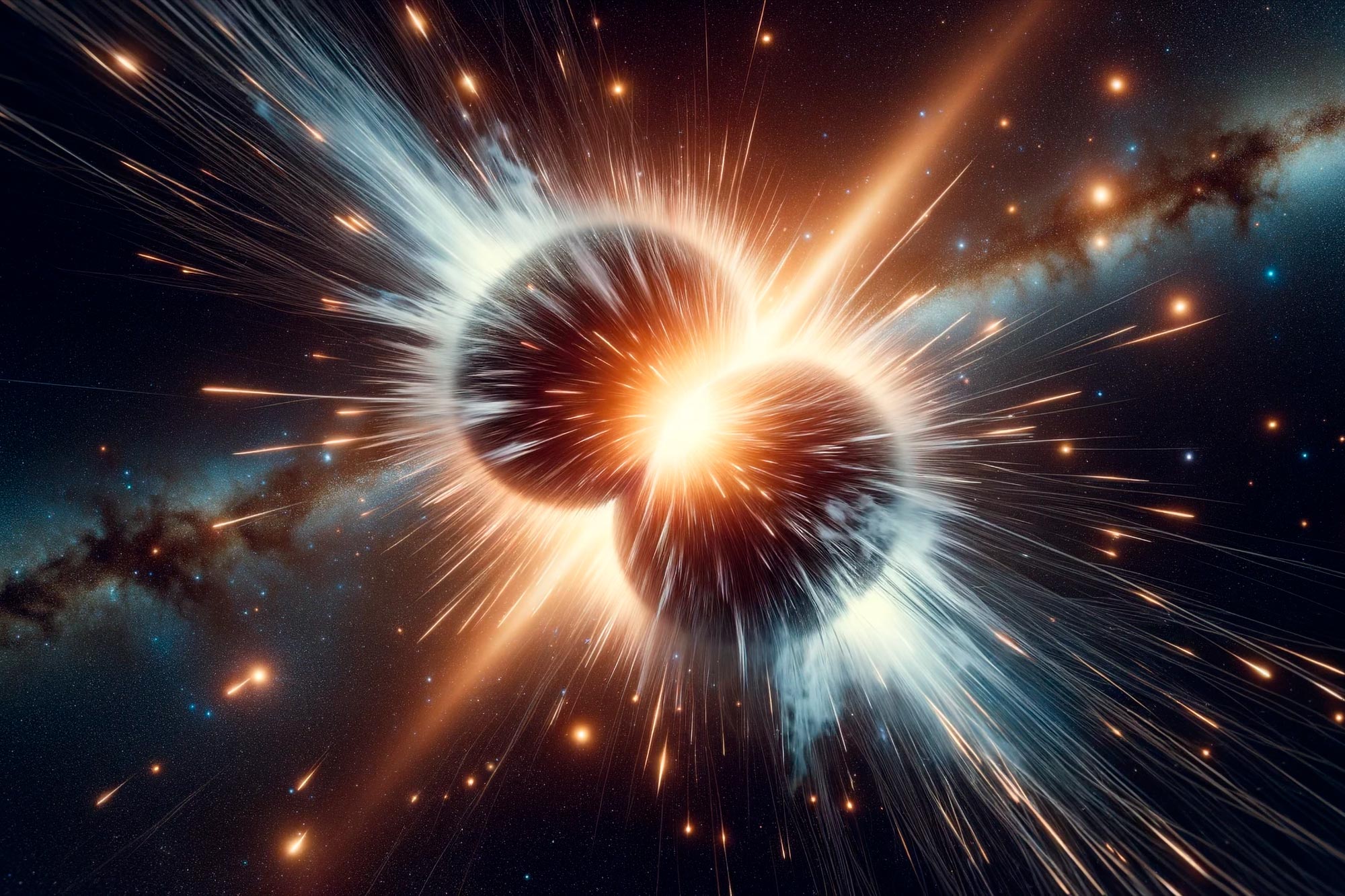
Scientists are using advanced simulations to explore the aftermath of neutron star collisions, where remnants might form and avoid collapsing into black holes.
This research not only sheds light on the dynamics and cooling of these remnants through neutrino emissions but also provides crucial insights into the behavior of nuclear matter under extreme conditions. The findings contribute to our understanding of astronomical events and the conditions that may or may not lead to black hole formation.
Mysterious Aftermath of Neutron Star Collisions
In the aftermath of a collision of neutron stars, a new celestial object called a remnant emerges, shrouded in mystery. Scientists are still unraveling its secrets, including whether it collapses into a black hole and how quickly this might happen.
Through advanced supercomputer simulations, scientists have delved into the internal structure of these remnants and explored their cooling process, primarily through neutrino emissions. These findings reveal a central object surrounded by a rapidly rotating ring of hot matter. If these remnants avoid collapse, scientists expect that they release the majority of their internal energy within seconds of when they form.

Exploring the Evolution of Neutron Stars
By observing when neutron stars merge in space, scientists gain insights into how nuclear matter behaves under extreme conditions that cannot be replicated on Earth. Nuclear matter is a hypothetical substance made up of protons and neutrons held together by the strong force. Of particular interest to scientists is whether the pressure from the strong force can stop black holes from forming.
In this study, scientists focused on what happens after neutron stars merge but don’t become black holes. The research explored neutron stars’ early evolution, just moments after they were created. This research is a starting point for identifying the astronomical signals that could help answer questions about neutron stars and black hole formation.
Advanced Simulations Reveal Neutron Star Dynamics
Scientists at Pennsylvania State University have used supercomputer simulations with general-relativistic neutrino-radiation hydrodynamics to understand the internal structure of neutron star merger remnants. They also studied how the remnant cools down by emitting neutrinos.
This work used the computational resources available through the Department of Energy’s National Energy Research Scientific Computing Center, the Leibniz Supercomputing Centre in (Germany), and the Institute for Computational and Data Science at Pennsylvania State University.
Unique Cooling Properties of Neutron Star Remnants
The research found that neutron star merger remnants consist of a central object endowed with most of the mass of the system, surrounded by a ring of hot matter in fast rotation that contains a small fraction of the mass but a large fraction of the angular momentum. Unlike most stars, the inner remnant has a higher temperature on its surface than in its core, so convective plumes are not expected to form as the remnant cools down by emitting neutrinos.
Reference: “Ab-initio General-relativistic Neutrino-radiation Hydrodynamics Simulations of Long-lived Neutron Star Merger Remnants to Neutrino Cooling Timescales” by David Radice and Sebastiano Bernuzzi, 5 December 2023, The Astrophysical Journal.
DOI: 10.3847/1538-4357/ad0235
This research was primarily funded by the Department of Energy Office of Science, Nuclear Physics program. Additional funding was provided by the National Science Foundation and the European Union.
Never miss a breakthrough: Join the SciTechDaily newsletter.
Follow us on Google and Google News.
2 Comments
The research found that neutron star merger remnants consist of a central object endowed with most of the mass of the system, surrounded by a ring of hot matter in fast rotation that contains a small fraction of the mass but a large fraction of the angular momentum.
Please ask researchers to think deeply:
What is the natural essence of spin in cosmic matter?
Scientific research guided by correct theories can help people avoid detours, failures, and exaggeration. The physical phenomena observed by researchers in experiments are always appearances, never the natural essence of things. The natural essence of things needs to be extracted and sublimated based on mathematical theories via appearances , rather than being imagined arbitrarily.
Everytime scientific revolution, the scientific research space brought by the new paradigm expands exponentially. Physics should not ignore the analyzable physical properties of topological vortices.
(1) Traditional physics: based on mathematical formalism, experimental verification and arbitrary imagination.
(2) Topological Vortex Theory: Although also based on mathematics (such as topology), it focuses more on non intuitive geometry and topological structures, challenging traditional physical intuition.
Extension of the Standard Model: Topological Vortex Theory points out the limitations of the Standard Model in describing the large-scale structure of the universe, proposes the need to consider non-standard model components such as dark matter and dark energy, and suggests that topological vortex fields may be key to understanding these phenomena.
Topological vortex theory heralds innovative technologies such as topological electronics, topological smart batteries, topological quantum computing, etc., which may bring low-energy electronic components, almost inexhaustible currents, and revolutionary computing platforms, etc.
Topology tells us that topological vortices and antivortices can form new spacetime structures via the synchronous effect of superposition, deflection, or twisting of them. In fact, mathematics does not tell us that there must be God particles, ghost particles, fermions, or bosons present. When physics and mathematics diverge, arbitrary imagination will make physics no different from theology. Topological vortex research reflections on the philosophy and methodology of science help us understand the nature essence of science and the limitations of scientific methods. This not only has guiding significance for scientific research itself, but also has important implications for science education and popularization.
Today, so-called official (such as PRL, Nature, Science, PNAS, etc.) in physics stubbornly believes that two sets of cobalt-60 rotating in opposite directions can become two sets of objects that mirror each other, is a typical case that pseudoscience is rampant and domineering. Please witness the exemplary collaboration between theoretical physicists and experimentalists (https://scitechdaily.com/microscope-spacecrafts-most-precise-test-of-key-component-of-the-theory-of-general-relativity/#comment-854286).
Let us continue to witness together the dirtiest and ugliest era in the scientific and humanistic history of human society. The laws of nature will not change due to misleading of so-called academic publications.
Well said. Imagine funding actual physics and proving by experiment, rather than imagined theories leading to rabbit holes and Alice in Wonderland papers on essentially nothing in this universe.
Well put, a good read.