
Close Menu
    Facebook X (Twitter) Instagram
    SciTechDaily
    • Biology
    • Chemistry
    • Earth
    • Health
    • Physics
    • Science
    • Space
    • Technology
    Facebook X (Twitter) Pinterest YouTube RSS
    SciTechDaily
    Home»Space»NOAA’s GOES-T “Earth in High Definition” Satellite Preparing for Liftoff From Cape Canaveral Space Force Station
    Space

    NOAA’s GOES-T “Earth in High Definition” Satellite Preparing for Liftoff From Cape Canaveral Space Force Station

    By NASA's Kennedy Space CenterJanuary 28, 2022No Comments2 Mins Read
    Facebook Twitter Pinterest Telegram LinkedIn WhatsApp Email Reddit
    Share
    Facebook Twitter LinkedIn Pinterest Telegram Email Reddit
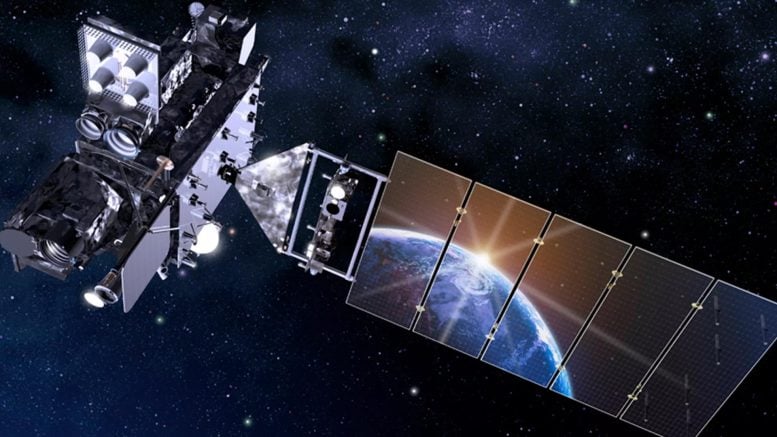
    NOAA GOES-T Satellite
    NOAA’s GOES-T is the third satellite in the Geostationary Operational Environmental Satellites (GOES) – R Series, the Western Hemisphere’s most sophisticated weather-observing and environmental-monitoring system. The GOES-R Series provides advanced imagery and atmospheric measurements, real-time mapping of lightning activity, and monitoring of space weather. Credit: NOAA

    The GOES-T satellite, part of NOAA’s GOES-R series, is scheduled for launch on March 1, 2022.

    An activity completed at Astrotech’s Space Operations facility in Titusville yesterday brings NOAA’s Geostationary Operational Environmental Satellite T (GOES-T) mission one significant step closer to its March 1, 2022, liftoff from Cape Canaveral Space Force Station in Florida in just over a month.

    On January 27, 2022, the spacecraft was lifted and mated to the payload adapter – a piece of hardware that interfaces mechanically between the rocket and the spacecraft. The payload adapter also has the capability built into it to allow the spacecraft to separate from the rocket when it gets on orbit.

    “It is the start of integrated operations, which is now the satellite and the rocket are starting to come together,” said GOES-T Mission Manager Rex Engelhardt. “We’ve been doing a lot of analysis, but this is the first piece of rocket hardware that we’re putting together with the satellite.”

    Next week, the first stage of the United Launch Alliance (ULA) Atlas V 541 rocket for GOES-T will be erected. ULA also will be cleaning each half of the payload fairing during this timeframe. Upcoming important February activities include encapsulation, where the two pieces of the payload fairing come together to secure the satellite inside, hoist to the transporter, and transport and mate to the launch vehicle. GOES-T is targeted to roll to the launch pad on February 28.

    The third satellite in NOAA’s GOES-R series, GOES-T’s launch is managed by NASA’s Launch Services Program based at the agency’s Kennedy Space Center in Florida, America’s multi-user spaceport. The GOES satellite network helps meteorologists observe and predict local weather events that affect public safety, including thunderstorms, tornadoes, fog, hurricanes, flash floods, and other severe weather. GOES-T will provide critical data for the U.S. West Coast, Alaska, Hawaii, Mexico, Central America, and the Pacific Ocean.

    Never miss a breakthrough: Join the SciTechDaily newsletter.
    Follow us on Google and Google News.

    Environment Kennedy Space Center NASA NOAA
    Share. Facebook Twitter Pinterest LinkedIn Email Reddit

    Related Articles

    NOAA’s GOES-T Rolled Out to the Pad for Today’s Launch

    NASA’s SpaceX Demo-2 Cleared to Proceed Toward May 27 Launch

    Searching With Sasquatch: Recovering NASA’s Orion Spacecraft

    NASA’s Mars Helicopter Undergoes Final Testing – Will Be First Aircraft to Fly on Another Planet

    Orion Spacecraft Returns to Kennedy Space Center for Final Preparations Before Artemis I Launch

    NOAA’s GOES-S Satellite is Ready for Today’s Launch, Watch It Live

    Microgravity Mimics Aging in Immune Cells

    NOAA Solar Eruption Classifications

    Construction Begins on Space Shuttle Atlantis Exhibit at Kennedy Space Center Visitor Complex

    Leave A Reply Cancel Reply

    • Facebook
    • Twitter
    • Pinterest
    • YouTube

    Don't Miss a Discovery

    Subscribe for the Latest in Science & Tech!

    Trending News

    Scientists Discover 132-Million-Year-Old Dinosaur Tracks on South Africa’s Coast

    Scientists Uncover the Secret Ingredient Behind the Spark That May Have Started Life on Earth

    Physicists Observe Matter in Two Places at Once in Mind-Bending Quantum Experiment

    Stanford Scientists Discover Hidden Brain Circuit That Fuels Chronic Pain

    New Study Reveals Why Ozempic Works Better for Some People Than Others

    Climate Change Is Altering a Key Greenhouse Gas in a Way Scientists Didn’t Expect

    New Study Suggests Gravitational Waves May Have Created Dark Matter

    Scientists Discover Why the Brain Gets Stuck in Schizophrenia

    Follow SciTechDaily
    • Facebook
    • Twitter
    • YouTube
    • Pinterest
    • Newsletter
    • RSS
    SciTech News
    • Biology News
    • Chemistry News
    • Earth News
    • Health News
    • Physics News
    • Science News
    • Space News
    • Technology News
    Recent Posts
    • Scientists Uncover Strange New State of Matter Inside Uranus and Neptune
    • The Crown Jewel of Dentistry? Breakthrough Tech Could Transform Tooth Repair
    • The Surprising Non-Medical Factor That Determines Cancer Survival
    • Python Blood Could Hold the Secret to Weight Loss Without Side Effects
    • Naturally Occurring Bacteria Completely Eradicate Tumors in Mice With a Single Dose
    Copyright © 1998 - 2026 SciTechDaily. All Rights Reserved.
    • Science News
    • About
    • Contact
    • Editorial Board
    • Privacy Policy
    • Terms of Use

    Type above and press Enter to search. Press Esc to cancel.