
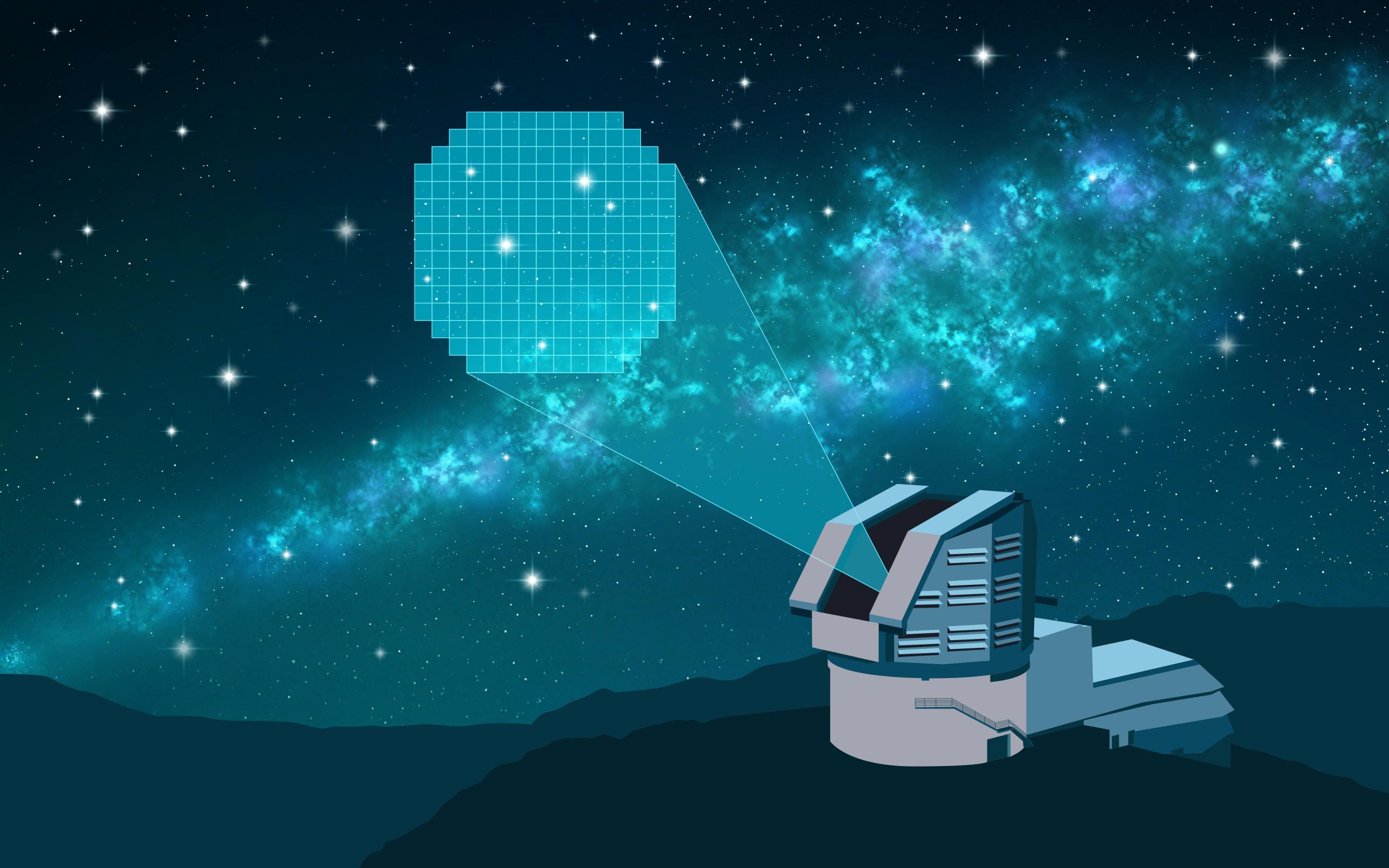
The Vera C. Rubin Observatory is set to revolutionize our understanding of the cosmos by detecting millions of exploding stars — Type Ia supernovae — over the next decade.
These brilliant explosions act as cosmic yardsticks, helping scientists measure the Universe’s expansion and refine our grasp on dark energy, the mysterious force driving this expansion. With its nightly sky surveys, Rubin will provide an unprecedented flood of data, requiring cutting-edge machine-learning tools to process and analyze these celestial events in real time. The insights gained could rewrite what we know about the Universe’s formation, evolution, and ultimate fate.
A New Era for Supernova Discovery
The Vera C. Rubin Observatory is about to witness millions of stars exploding in space. These dying stars, known as Type Ia supernovae, help scientists measure cosmic distances and study how dark energy affects the Universe’s expansion. Over its 10-year Legacy Survey of Space and Time (LSST), Rubin could transform our understanding of when and how the Universe formed.
Measuring distances in space is far more challenging than on Earth. A star may appear brighter, but is it actually closer, or is it just emitting more light? To accurately measure cosmic distances, scientists rely on objects with a known brightness, like Type Ia supernovae.
Supernovae: The Universe’s Measuring Sticks
These spectacular explosions, among the brightest to ever be recorded in the night sky, result from the violent deaths of white dwarf stars and provide scientists with a reliable cosmic yardstick. Their brightness and color, combined with information about their host galaxies, allow scientists to calculate their distance and how much the Universe expanded while their light made its journey to us. With enough Type Ia supernovae observations, scientists can measure the Universe’s expansion rate and whether it changes over time.
Although we’ve caught thousands of Type Ia supernovae to date, seeing them once or twice is not enough — there is a goldmine of information in how their fleeting light varies over time. NSF–DOE Vera C. Rubin Observatory will soon begin scanning the southern hemisphere sky every night for ten years, covering the entire hemisphere approximately every few nights. Every time Rubin detects an object changing brightness or position it will send an alert to the science community. With such rapid detection Rubin will be our most powerful tool yet for spotting Type Ia supernovae before they fade away.
Rubin Observatory is jointly funded by the U.S. National Science Foundation and the U.S. Department of Energy’s Office of Science. Rubin is a joint Program of NSF NOIRLab and DOE’s SLAC National Accelerator Laboratory, who will cooperatively operate Rubin.
Dark Energy and the Universe’s Expansion
Scientists like Anais Möller, a member of the Rubin/LSST Dark Energy Science Collaboration, look forward to Rubin’s decade-long Legacy Survey of Space and Time (LSST), during which it’s expected to detect millions of Type Ia supernovae. “The large volume of data from Rubin will give us a sample of all kinds of Type Ia supernovae at a range of distances and in many different types of galaxies,” says Möller.
In fact, Rubin will discover many more Type Ia supernovae in the first few months of the LSST than were used in the initial discovery of dark energy — the mysterious force causing the Universe to expand faster than expected based on gravitational theory. Current measurements hint that dark energy might change over time, which if confirmed could help refine our understanding of the Universe’s age and evolution. That in turn would impact what we understand about how the Universe formed, including how quickly stars and galaxies formed in the early Universe.
Refining Our Cosmic Map
With a much larger set of Type Ia supernovae from across the Universe scientists will be able to refine our existing map of space and time, getting a fuller picture of dark energy’s influence. “The Universe expanding is like a rubber band being stretched. If dark energy is not constant, that would be like stretching the rubber band by different amounts at different points,” says Möller. “I think in the next decade we will be able to constrain whether dark energy is constant or evolving with cosmic time. Rubin will allow us to do that with Type Ia supernovae.”
Every night Rubin Observatory will produce about 20 terabytes of data and generate up to 10 million alerts — no other telescope in history has produced a firehose of data quite like this. It has required scientists to rethink the way they manage rapid alerts and to develop methods and systems to handle the large incoming datasets.
Building the Future of Astronomy
Rubin’s deluge of nightly alerts will be managed and made available to scientists through seven community software systems that will ingest and process these alerts before serving them up to scientists around the world. Möller, together with a large collaboration of scientists across expertises, is developing one of these systems, called Fink.
The software systems collect the alerts from Rubin each night, merge Rubin data with other datasets, and, using machine learning, classify them according to their type, such as kilonovae, variable stars, or Type Ia supernovae, among others. Scientists using one of Rubin’s community systems, like Fink, will be able to sort the massive dataset of alerts according to selected filters, allowing them to quickly home in on the data that are useful for their research.
“Because of the large volumes of data, we can’t do science the same way we did before,” says Möller. “Rubin is a generational shift. And our responsibility is developing the methods that will be used by the next generation.”
Never miss a breakthrough: Join the SciTechDaily newsletter.
Follow us on Google and Google News.
2 Comments
So, the Big Bang model ain’t all that after all. Who knew…
Hello, the expansion of the universe has nothing to do with the Big Bang. Dark matter is the same electrons that are subjected to the magnetic force of the cores of galaxies and stars. I already said that stars rarely explode. These are the planets that in old galaxies collide with the stars that collide with the arm branches of the galaxy. Our solar system is one of the hundreds of thousands of stars that collided with other arm systems in the Milky Way. The dark clouds in all the local galaxies are due to the collision of the planets with the big stars. The reason for the presence of different metals and stones in different colors is the collapse of the planets and stars of the Milky Way, which collided with the Sun and after the collapse, they settled on the entire surface of the Earth’s crust at a height of several hundred and thousand meters, and the life of the dinosaurs that lived with intelligent humans was destroyed. The impact of a meteorite did not destroy their lives