
Close Menu
    Facebook X (Twitter) Instagram
    SciTechDaily
    • Biology
    • Chemistry
    • Earth
    • Health
    • Physics
    • Science
    • Space
    • Technology
    Facebook X (Twitter) Pinterest YouTube RSS
    SciTechDaily
    Home»Space»This Supernova Explosion Still Looks Breathtaking 11,000 Years Later
    Space

    This Supernova Explosion Still Looks Breathtaking 11,000 Years Later

    By European Southern Observatory (ESO)February 13, 2025No Comments2 Mins Read
    Facebook Twitter Pinterest Telegram LinkedIn WhatsApp Email Reddit
    Share
    Facebook Twitter LinkedIn Pinterest Telegram Email Reddit
    Vela Supernova Remnant VST
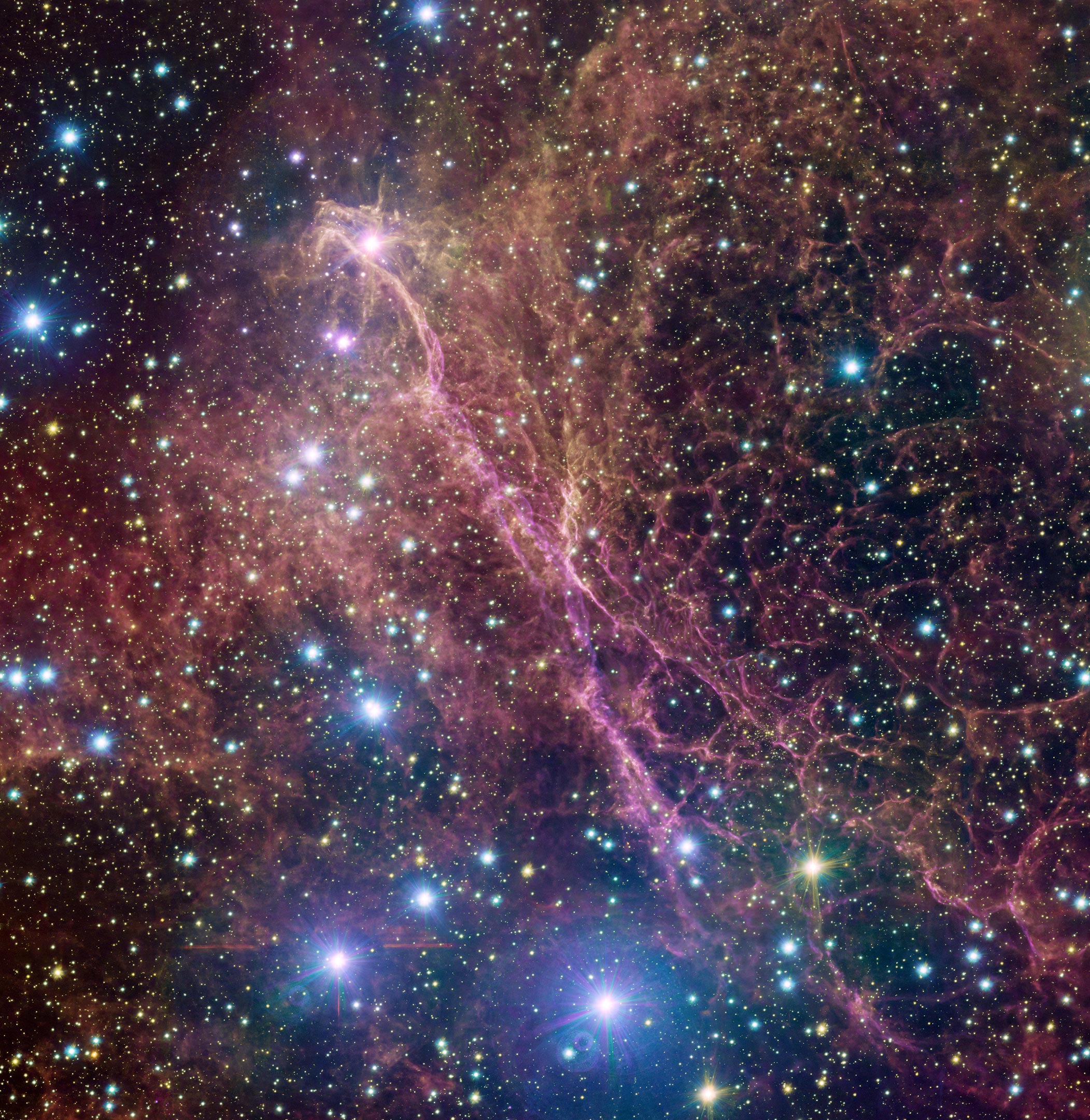
    Hidden within the southern sky, the Vela constellation holds a cosmic masterpiece — the stunning remnants of a supernova explosion from 11,000 years ago. This mesmerizing scene, captured in exquisite detail by the VLT Survey Telescope, showcases a swirling dance of pink and orange filaments, resembling a celestial bird frozen in time. Credit: ESO/VPHAS+ team. Acknowledgment: CASU

    A vast cosmic explosion left behind an intricate masterpiece in the sky — delicate pink and orange filaments dancing in the wake of a dying star. Captured in breathtaking detail, this celestial artwork tells the story of destruction and rebirth, as shock waves shape the interstellar gas into luminous patterns.

    The Vela constellation is easy to spot in the southern sky with the naked eye, but much of its hidden beauty remains unseen. One of its most breathtaking features is the Vela supernova remnant — a vast, intricate structure formed by the explosion of a massive star 11,000 years ago. This image captures a small section of that remnant, part of a larger, highly detailed mosaic taken by the VLT Survey Telescope (VST) at ESO’s Paranal Observatory in the Chilean desert.

    Swirling filaments of pink and orange gas weave through the scene, creating the ghostly outline of a celestial bird with wide, fiery wings and a glowing pinkish star as its eye. Countless stars are scattered across the background, adding to the mesmerizing cosmic landscape.

    When massive stars reach the end of their life they explode as supernovae, expelling their outer layers. These explosions send out shock waves that move through the surrounding gas, compressing and reshaping it. This is what creates the intricate structure of filaments seen here, which shine brightly because of the energy released during the explosion.

    Never miss a breakthrough: Join the SciTechDaily newsletter.
    Follow us on Google and Google News.

    Astronomy European Southern Observatory Supernova
    Share. Facebook Twitter Pinterest LinkedIn Email Reddit

    Related Articles

    Astronomers Captured a Star’s Final Explosion in Stunning Detail

    Star Explodes Twice: Astronomers Capture Stunning Supernova Remains

    A Spooky Ghost of a Giant Star: What Remains After the Explosive Death of a Massive Star

    When Stars Explode – Spiral Galaxy NGC 4981

    A New Class of Magnetar-Powered Supernova

    Two Merging Stars Destined to Ignite a Vast Supernova Explosion

    ALMA Views the Remains of Supernova 1987A

    PESSTO Survey Views Spiral Galaxy Messier 74

    Astronomers View the Aftermath of Supernova SN 1999em and Its Host Galaxy

    Leave A Reply Cancel Reply

    • Facebook
    • Twitter
    • Pinterest
    • YouTube

    Don't Miss a Discovery

    Subscribe for the Latest in Science & Tech!

    Trending News

    Largest-Ever Study Finds Medicinal Cannabis Ineffective for Anxiety, Depression, PTSD

    250-Million-Year-Old Egg Solves One of Evolution’s Biggest Mysteries

    Living With Roommates Might Be Changing Your Gut Microbiome Without You Knowing

    Century-Old Cleaning Chemical Linked to 500% Increased Risk of Parkinson’s Disease

    What if Your Memories Never Happened? Physicists Take a New Look at the Boltzmann Brain Paradox

    One of the Universe’s Largest Stars May Be Getting Ready To Explode

    Scientists Discover Enzyme That Could Supercharge Ozempic-Like Weight Loss Drugs

    Popular Sweetener Linked to DNA Damage – “It’s Something You Should Not Be Eating”

    Follow SciTechDaily
    • Facebook
    • Twitter
    • YouTube
    • Pinterest
    • Newsletter
    • RSS
    SciTech News
    • Biology News
    • Chemistry News
    • Earth News
    • Health News
    • Physics News
    • Science News
    • Space News
    • Technology News
    Recent Posts
    • The Most Elusive Number in Physics Just Got Even More Mysterious
    • Scientists Uncover Hidden Trigger Behind Stem Cell Aging
    • Scientists Discover Coral Reefs Are Teeming With Previously Unknown Life
    • Scientists Find Way to Reverse Fatty Liver Disease Without Changing Diet
    • Could Humans Regrow Limbs? New Study Reveals Promising Genetic Pathway
    Copyright © 1998 - 2026 SciTechDaily. All Rights Reserved.
    • Science News
    • About
    • Contact
    • Editorial Board
    • Privacy Policy
    • Terms of Use

    Type above and press Enter to search. Press Esc to cancel.