

Astronomers using the James Webb Space Telescope have made significant discoveries within the Spiderweb protocluster, revealing the formation of new galaxies and challenging previous theories about gravitational interactions.
The infrared capabilities of Webb allowed for the observation of previously obscured galaxies, enhancing our understanding of galaxy assembly in one of the largest structures of the universe during its adolescent phase.
Understanding Galaxy Formation in Early Universe
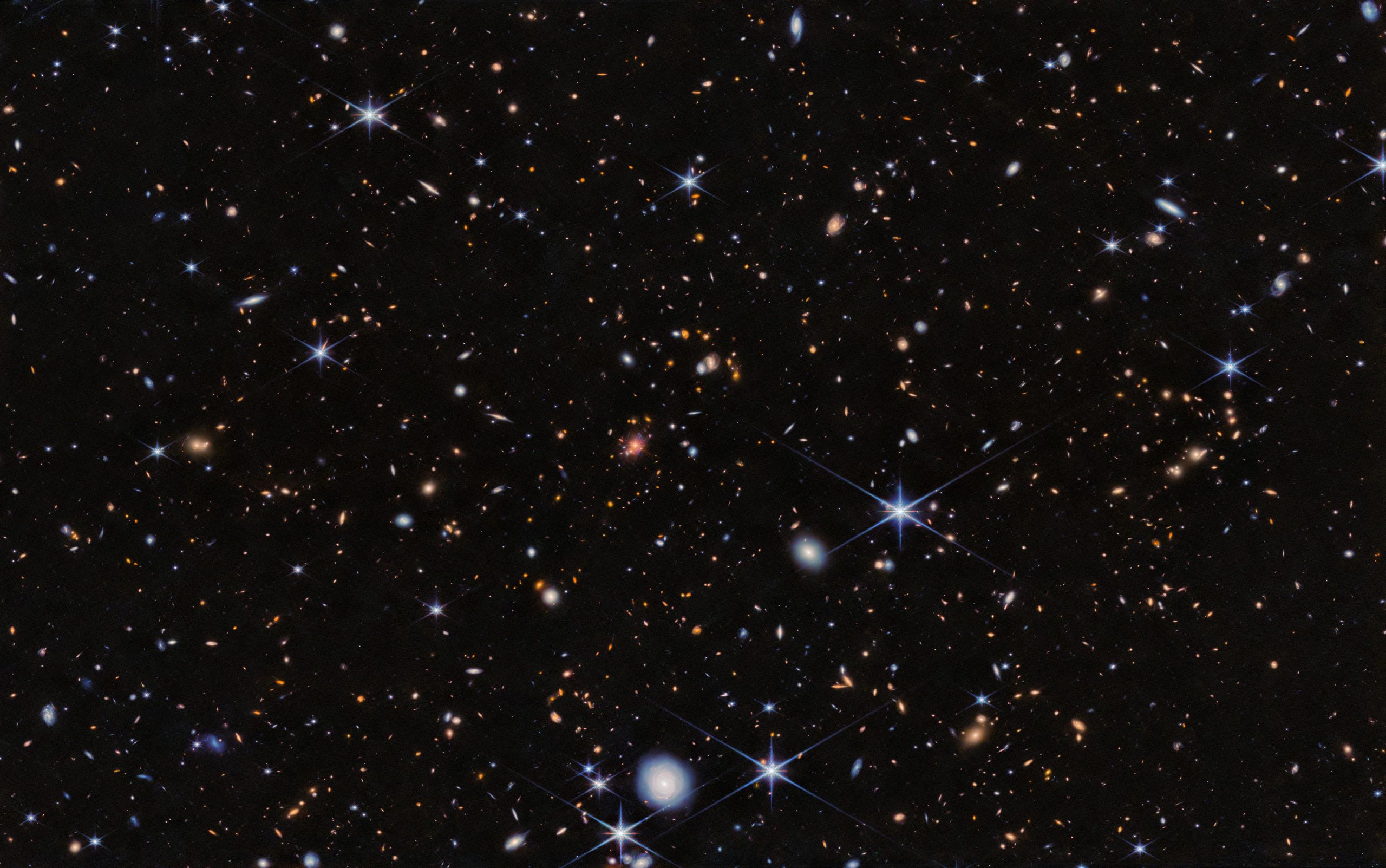
Using the James Webb Space Telescope, an international team of astronomers has discovered new galaxies within the Spiderweb protocluster. These galaxies provide fresh insights into cosmic evolution, suggesting that gravitational interactions play a less significant role in dense regions than previously believed.
Astronomers explore galaxy populations and their physical traits across large-scale cosmic structures to understand how galaxies form and evolve within their environments. The Spiderweb protocluster, a well-studied region of the early Universe, offers a glimpse into a galaxy cluster in the making. Its light has traveled over 10 billion years to reach us, revealing more than a hundred known galaxies in various stages of development.
Advancements in Infrared Astronomy
With the use of Webb’s capabilities, astronomers have now sought to better understand this protocluster and to reveal new galaxies inside it. Infrared light passes more freely through cosmic dust than visible light, which is scattered by the dust. Because Webb can see well in the infrared, scientists used it to observe regions of the Spiderweb that were previously hidden to us by cosmic dust, and to find out to what degree this dust obscures them.
“We are observing the build-up of one the largest structures in the Universe, a city of galaxies in construction,” explained Jose M. Pérez-Martínez of the Instituto de Astrofísica de Canarias and the Universidad de La Laguna in Spain. “We know that most galaxies in local galaxy clusters (the biggest metropolises of the Universe) are old and not very active, whereas in this work we are looking at these objects during their adolescence. As this city in construction grows, its physical properties will also be affected. Now, Webb is giving us new insights into the build-up of such structures for the first time.”
Discoveries of Obscured Galaxies
With Webb, the team studied the hydrogen gas to reveal new, strongly obscured galaxies belonging to the cluster and to study how much they were obscured. This was accomplished using only about 3.5 hours of Webb’s observing time.
“As expected, we found new galaxy cluster members, but we were surprised to find more than expected,” explained Rhythm Shimakawa of Waseda University in Japan. “We found that previously-known galaxy members (similar to the typical star-forming galaxies like our Milky Way galaxy) are not as obscured or dust-filled as previously expected, which also came as a surprise.”
“This can be explained by the fact that the growth of these typical galaxies is not triggered primarily by galaxy interactions or mergers that induce star-formation,” added Helmut Dannerbauer of the Instituto de Astrofísica de Canarias in Spain. “We now figure this can instead be explained by star formation that is fueled through gas accumulating at different locations all across the object’s large-scale structure.”
Future Research Directions
The team is planning to study the (new) galaxy cluster members in more detail and confirm their existance with spectroscopic observations using Webb.
The new results used Webb’s NIRCam observations (Cycle 1 program #1572, PIs: H. Dannerbauer and Y. Koyama) and are featured in two papers that were published on December 4 in the Astrophysical Journal.
References:
“JWST/NIRCam Narrowband Survey of Paβ Emitters in the Spiderweb Protocluster at z = 2.16” by Rhythm Shimakawa, J. M. Pérez-Martínez, Helmut Dannerbauer, Yusei Koyama, Tadayuki Kodama, Pablo G. Pérez-González, Chiara D’Eugenio, Yuheng Zhang, Abdurrahman Naufal and Kazuki Daikuhara, 4 December 2024, The Astrophysical Journal.
DOI: 10.3847/1538-4357/ad8155
“JWST/NIRCam Paβ Narrowband Imaging Reveals Ordinary Dust Extinction for Hα Emitters within the Spiderweb Protocluster at z = 2.16” by Jose Manuel Pérez-Martínez, Helmut Dannerbauer, Yusei Koyama, Pablo G. Pérez-González, Rhythm Shimakawa, Tadayuki Kodama, Yuheng Zhang, Kazuki Daikuhara, Chiara D’Eugenio and Abdurrahman Naufal, 4 December 2024, The Astrophysical Journal.
DOI: 10.3847/1538-4357/ad8156
More information
Webb is the largest, most powerful telescope ever launched into space. Under an international collaboration agreement, ESA provided the telescope’s launch service, using the Ariane 5 launch vehicle. Working with partners, ESA was responsible for the development and qualification of Ariane 5 adaptations for the Webb mission and for the procurement of the launch service by Arianespace. ESA also provided the workhorse spectrograph NIRSpec and 50% of the mid-infrared instrument MIRI, which was designed and built by a consortium of nationally funded European Institutes (The MIRI European Consortium) in partnership with JPL and the University of Arizona.
Webb is an international partnership between NASA, ESA, and the Canadian Space Agency (CSA).
Never miss a breakthrough: Join the SciTechDaily newsletter.
Follow us on Google and Google News.
4 Comments
Hypocrisy is the most vibrant banner of pseudoscience.
Deleting comments is a hypocritical behavior. Since you dare to share your ideas with the world, don’t be afraid of being repeatedly commented upon.
Keep Crying with crocodile tears boy….
Scientific research guided by correct theories can help people avoid detours, failures, and exaggeration. The physical phenomena observed by researchers in experiments are always appearances, never the natural essence of things. The natural essence of things needs to be extracted and sublimated based on mathematical theories via appearances , rather than being imagined arbitrarily.
Everytime scientific revolution, the scientific research space brought by the new paradigm expands exponentially. Physics should not ignore the analyzable physical properties of topological vortices.
(1) Traditional physics: based on mathematical formalism, experimental verification and arbitrary imagination.
(2) Topological Vortex Theory (TVT): Although also based on mathematics (such as topology), it focuses more on non intuitive geometry and topological structures, challenging traditional physical intuition.
Topological Vortex Theory (TVT) points out the limitations of the Standard Model in describing the large-scale structure of the universe, proposes the need to consider non-standard model components such as dark matter and dark energy, and suggests that topological vortex fields may be key to understanding these phenomena. Topological vortex theory (TVT) heralds innovative technologies such as topological electronics, topological smart batteries, topological quantum computing, etc., which may bring low-energy electronic components, almost inexhaustible currents, and revolutionary computing platforms, etc.
Topology tells us that topological vortices and antivortices can form new spacetime structures via the synchronous effect of superposition, deflection, or twisting of them. Mathematics does not tell us that there must be God particles, Devil particles, Fermions, or Bosons present. When physics and mathematics diverge, arbitrary imagination will make physics no different from theology. Topological vortex research reflections on the philosophy and methodology of science help us understand the nature essence of science and the limitations of scientific methods. This not only has guiding significance for scientific research itself, but also has important implications for science education and popularization.
All things follow certain laws, which can be revealed through observation and research ( such as topological structures ). Today, so-called academic publications (such as PRL, Nature, Science, etc.) obstinately believe that two sets of cobalt 60 rotating in opposite directions can become two mirror images of each other. This is a public humiliation to the normal intelligence of the public. They conducted extensive pseudo scientific research based on CP violations, published countless pseudo scientific papers, and received various awards. The so-called scientific evaluation system constructed based on these so-called academic publications opened the dirtiest, ugliest, and most evil era in the history of modern science. They hardly know what shame is.
Please witness the exemplary collaboration between theoretical physicists and experimentalists (https://scitechdaily.com/microscope-spacecrafts-most-precise-test-of-key-component-of-the-theory-of-general-relativity/#comment-854286). It is normal to make mistakes in scientific research, but what is abnormal is to stubbornly adhere to erroneous positions and not repent.
Let us continue to witness via facts the dirtiest and ugliest era in the history of sciences and humanities in human society. The laws of nature will not change due to misleading of certain so-called academic publications or endorsements from certain so-called scientific awards.
As some comments have stated ( https://scitechdaily.com/super-photons-unveiled-sculpting-light-into-unbreakable-communication-networks/#comment-861546 ): Fortunately, we have enough pieces to put the puzzle together properly, and there are folks who have chosen to forego today’s societal structures in order to do exactly that.
Additionally, some comments have stated ( https://scitechdaily.com/science-made-simple-what-is-nuclear-fission/#comment-862083 ): You have been spewing this type of nonsensical word salad for several years now. Outrage doesn’t equal competence. If anything, your inability to convince anyone is a sign of your incompetence. Ask the commenter:Today, so-called official (such as PRL, Nature, Science, etc.) in physics stubbornly believes that two sets of cobalt-60 rotating in opposite directions can become two sets of objects that mirror each other, and it even won awards. These so-called academic publications have the audacity to blatantly talk nonsense in public. Do you think this is personal misfortune or misfortune of humanity?
My repetition may make some people feel disgusted ( https://scitechdaily.com/spooky-action-at-ultra-short-distances-unlocking-the-quantum-core-of-matter/#comment-866750 ). Nevertheless, in order to oppose rampant pseudoscience, I can only do so.
Isn’t this the evil consequence of the Physics Review family misleading science? Academic circle is not Entertainment industry. Have some people really never know what shame is?
Since anyone dare to share your ideas with the world, don’t be afraid of being repeatedly commented upon.