
Close Menu
    Facebook X (Twitter) Instagram
    SciTechDaily
    • Biology
    • Chemistry
    • Earth
    • Health
    • Physics
    • Science
    • Space
    • Technology
    Facebook X (Twitter) Pinterest YouTube RSS
    SciTechDaily
    Home»Space»NASA’s Mars Odyssey Orbiter Out of Precautionary ‘Safe Mode’
    Space

    NASA’s Mars Odyssey Orbiter Out of Precautionary ‘Safe Mode’

    By Guy Webster, Jet Propulsion LaboratoryJune 20, 2012No Comments3 Mins Read
    Facebook Twitter Pinterest Telegram LinkedIn WhatsApp Email Reddit
    Share
    Facebook Twitter LinkedIn Pinterest Telegram Email Reddit
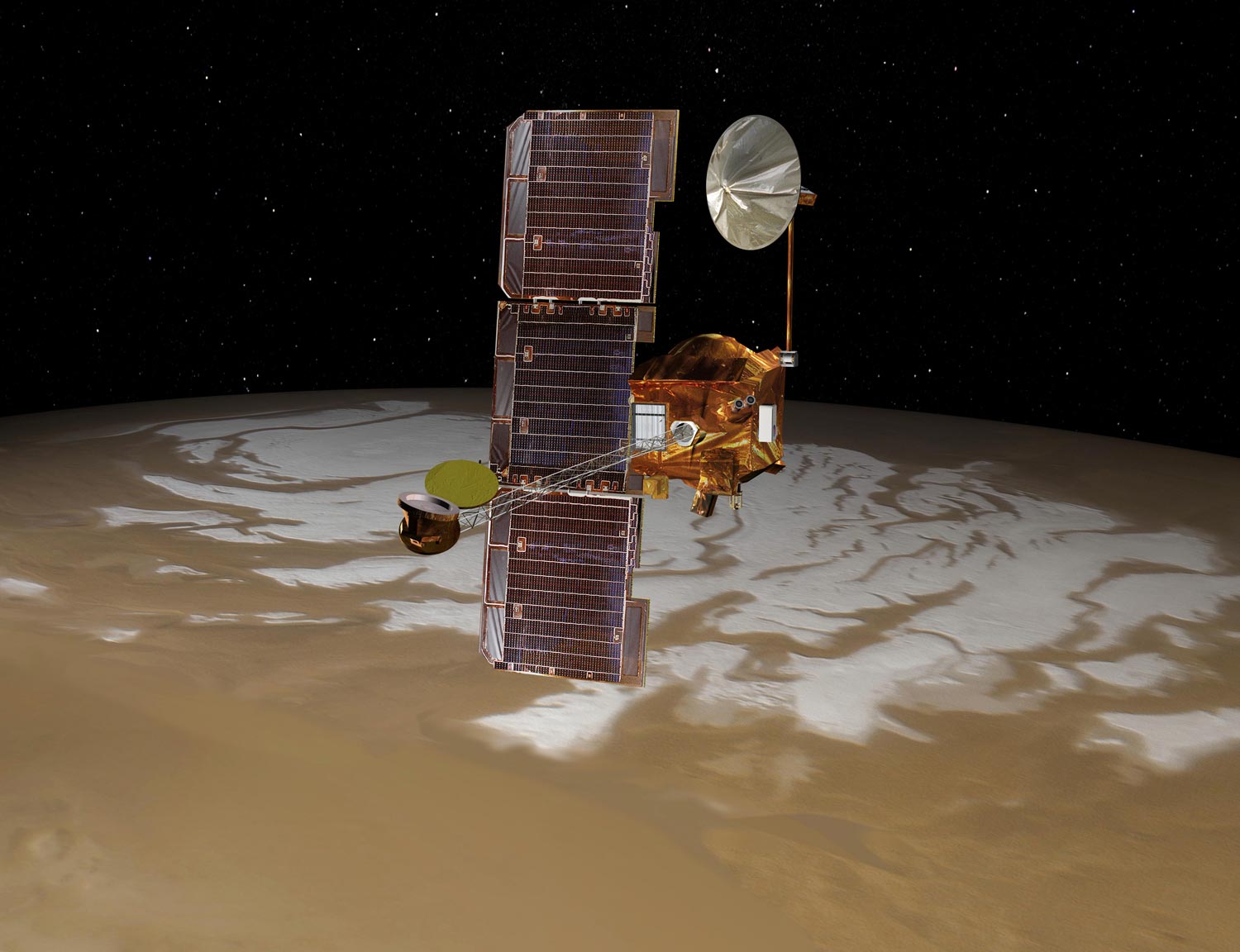
    Odyssey Spacecraft Over Mars' South Pole
    NASA’s Mars Odyssey spacecraft passes above Mars’ south pole in this artist’s concept illustration. The spacecraft has been orbiting Mars since October 24, 2001. Credit: NASA/JPL-Caltech

    After experiencing an issue with one of its primary reaction wheels on June 8, NASA’s Mars Odyssey orbiter has now been taken out of “safe mode” and should resume its communication relay function for NASA’s Mars Exploration Rover Opportunity and its own scientific observations of Mars next week.

    NASA’s Mars Odyssey orbiter has been taken out of a protective status called safe mode. Remaining steps toward resuming all normal spacecraft activities will probably be completed by next week.

    Odyssey resumed pointing downward toward Mars on Saturday, June 16, leaving the Earth-pointed “safe mode” status that was triggered when one of its three primary reaction wheels stuck for a few minutes on June 8, Universal Time (June 7, Pacific Time). Mission controllers put the orbiter’s spare reaction wheel into use in control of Odyssey’s orientation while pointed downward, or nadir.

    “Attitude control in nadir pointing is being maintained with the use of the replacement wheel, and the suspect wheel has been taken out of use,” said Odyssey Project Manager Gaylon McSmith of NASA’s Jet Propulsion Laboratory, Pasadena, California.

    Controllers will continue characterizing the performance of the replacement wheel in the coming days while assessing which other activities of the spacecraft, besides nadir pointing, can be performed reliably with reaction-wheel control of attitude. The spacecraft can also use thrusters for attitude control, though that method draws on the limited supply of propellant rather than on electricity from the spacecraft’s solar array.

    In returning to full service, Odyssey will first resume its communication relay function for NASA’s Mars Exploration Rover Opportunity, and then will resume the orbiter’s own scientific observations of Mars. As a priority, activities will resume for preparing Odyssey to serve as a communications relay for NASA Mars Science Laboratory mission.

    Like many other spacecraft, Odyssey uses a set of three reaction wheels to control its attitude, or which way it is facing relative to the sun, Earth, or Mars. Increasing the rotation rate of a reaction wheel inside the spacecraft causes the spacecraft itself to rotate in the opposite direction. The configuration in use from launch in 2001 until three days ago combined the effects of three wheels at right angles to each other to provide control in all directions. The replacement wheel is skewed at angles to all three others so that it could be used as a substitute for any one of them.

    Odyssey has worked at Mars for more than 10 years, which is longer than any other Mars mission in history. Besides conducting its own scientific observations, it serves as a communication relay for robots on the Martian surface. NASA plans to use Odyssey and the newer Mars Reconnaissance Orbiter as communication relays for the Mars Science Laboratory mission during the landing and Mars-surface operations of that mission’s Curiosity rover.

    Never miss a breakthrough: Join the SciTechDaily newsletter.
    Follow us on Google and Google News.

    Astronomy JPL Mars Odyssey Orbiter NASA
    Share. Facebook Twitter Pinterest LinkedIn Email Reddit

    Related Articles

    NASA’s Roman Telescope Unlocks New Chapter in the Search for Alien Worlds

    Don’t Miss November’s Celestial Spectacles: Rare Occultations, Planetary Alignments, and Hidden Stars Await

    NASA’s SPHEREx: Exploring the Universe in 102 Infrared Colors

    Cosmic Horror Unveiled: NASA Reveals “Blood-Soaked Eyes” Staring From Deep Space [Video]

    Euclid’s Extraordinary 208-Gigapixel View: Uncovering the Universe’s Hidden Forces

    NASA Finds Signs of an Io-Like Volcanic Exomoon Just 635 Light-Years Away

    Skywatching Magic: October’s Spectacular Comet Lights Up the Night Sky

    Don’t Miss September’s Stunning Supermoon Eclipse

    Don’t Miss: Meteor Shower Peak, Star Forge, Mars and Jupiter Converge

    Leave A Reply Cancel Reply

    • Facebook
    • Twitter
    • Pinterest
    • YouTube

    Don't Miss a Discovery

    Subscribe for the Latest in Science & Tech!

    Trending News

    First-of-Its-Kind Discovery: Homer’s Iliad Found Embedded in a 1,600-Year-Old Egyptian Mummy

    Beyond Inflammation: Scientists Uncover New Cause of Persistent Rheumatoid Arthritis

    A Simple Molecule Could Unlock Safer, Easier Weight Loss

    Scientists Just Built a Quantum Battery That Charges Almost Instantly

    Researchers Unveil Groundbreaking Sustainable Solution to Vitamin B12 Deficiency

    Millions of People Have Osteopenia Without Realizing It – Here’s What You Need To Know

    Researchers Discover Boosting a Single Protein Helps the Brain Fight Alzheimer’s

    World-First Study Reveals Human Hearts Can Regenerate After a Heart Attack

    Follow SciTechDaily
    • Facebook
    • Twitter
    • YouTube
    • Pinterest
    • Newsletter
    • RSS
    SciTech News
    • Biology News
    • Chemistry News
    • Earth News
    • Health News
    • Physics News
    • Science News
    • Space News
    • Technology News
    Recent Posts
    • How Cells Copy DNA Might Matter More Than We Ever Realized
    • Scientists Just Solved the Mystery of the Twelve Apostles
    • Stone Age Mystery: DNA Reveals Ancient Population Wipeout in France
    • Why Did the Neanderthals Disappear? Scientists Reveal Humans Had a Hidden Advantage
    • Unusually Warm Water Detected Creeping Toward Antarctica – and Scientists Are Alarmed
    Copyright © 1998 - 2026 SciTechDaily. All Rights Reserved.
    • Science News
    • About
    • Contact
    • Editorial Board
    • Privacy Policy
    • Terms of Use

    Type above and press Enter to search. Press Esc to cancel.