

Jurassic-era blue-stain fungi fossils found in China push their origin back 80 million years. These fungi pierced wood using mechanical structures and likely relied on non-beetle insects for spore dispersal.
Blue-stain fungi are a distinct group of wood-colonizing fungi that do not have the ability to break down wood lignocellulose. Despite this, they can cause noticeable discoloration in wood.
Although they are generally not fatal to trees, their presence, especially when combined with wood-boring insects, can accelerate tree mortality.
Fossil timeline and recent discovery
Molecular phylogenetic studies suggest that blue-stain fungi belong to an ancient fungal lineage, possibly originating in the Late Paleozoic or early Mesozoic eras. However, very little is known about their presence in the fossil record. “Not until 2022, the first credible fossil record of blue-stain fungi was reported from the Cretaceous in South Africa with an age of approximately 80 million years,” says Dr. Ning Tian from Shenyang Normal University in Shenyang, China.
A Chinese research team led by Dr. Ning Tian and Dr. Yongdong Wang from the Nanjing Institute of Geology and Palaeontology (CAS) discovered well-preserved fossil fungal hyphae inside a piece of Jurassic petrified wood from northeastern China, dated to 160 million years ago.
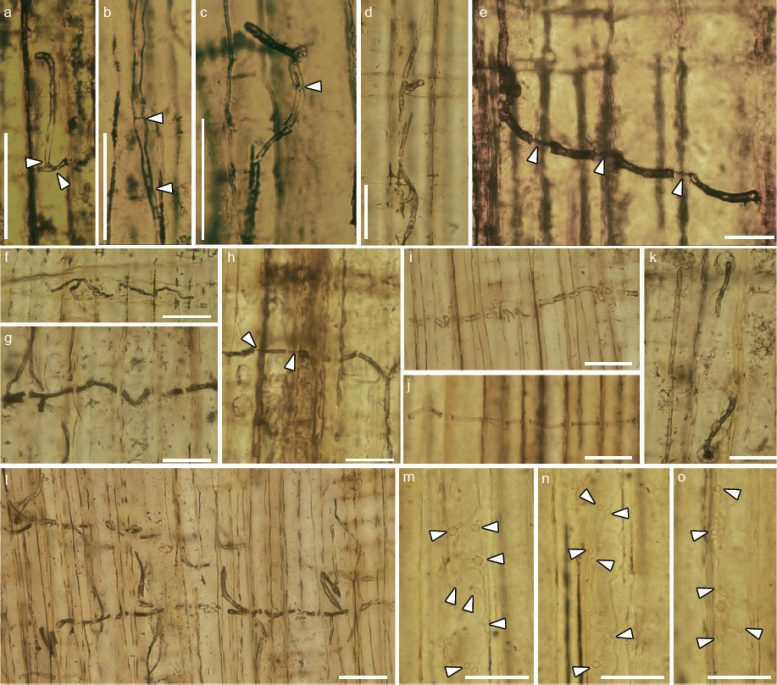
Microscopic analysis shows that the fossil hyphae are dark in color, indicating the presence of pigmentation, a key feature of modern blue-stain fungi responsible for wood discoloration.
Notably, the hyphae often form a specialized structure known as a “penetration peg” when entering the wood cell walls. In other words, the hyphae narrow in size to push through the rigid cell walls more easily. The presence of penetration pegs allowed the researchers to confirm that the fossil fungus belongs to the blue-stain group.
“Unlike wood-decay fungi, which degrade wood cell walls through enzymatic secretion, the blue-stain fungi lack the enzymatic capacity to decompose wood structures. Instead, their hyphae mechanically breach wood cell walls via the penetration pegs,” Dr. Tian explains.
Evolutionary implications and dispersal
“The finding of Jurassic blue-stain fungi from China, represents the second report of the blue-stain fangi and the earliest fossil record of this fungal group in the world, pushes back the earliest known fossil record of this fungal group by approximately 80 million years, providing crucial fossil evidence for further understanding the origin and early evolution of blue-stain fungi. Additionally, it offers fresh insights into understanding the ecological relationships between the blue-stain fungi, plants, and insects during the Jurassic period,” says Dr. Wang.
The bark beetle subfamily Scolytinae is considered as one of the major spore dispersal agents for extant blue-stain. However, both molecular biological and fossil evidence proposed that the origin time of Scolytinae dates back no earlier than the Early Cretaceous. Given the Jurassic age of present fossil fungus, it is hypothesized that its spore dispersal vector was not Scolytinae but rather other wood-colonizing insects prevalent during that period.
Reference: “Blue-stain fungus from the Jurassic provides new insights into early evolution and ecological interactions” by Ning Tian, Yongdong Wang, Fangyu Li, Zikun Jiang and Xiao Tan, 26 April 2025, National Science Review.
DOI: 10.1093/nsr/nwaf160
Funding: National Natural Science Foundation of China, Liaoning Revitalization Talents Program
Never miss a breakthrough: Join the SciTechDaily newsletter.
Follow us on Google and Google News.