
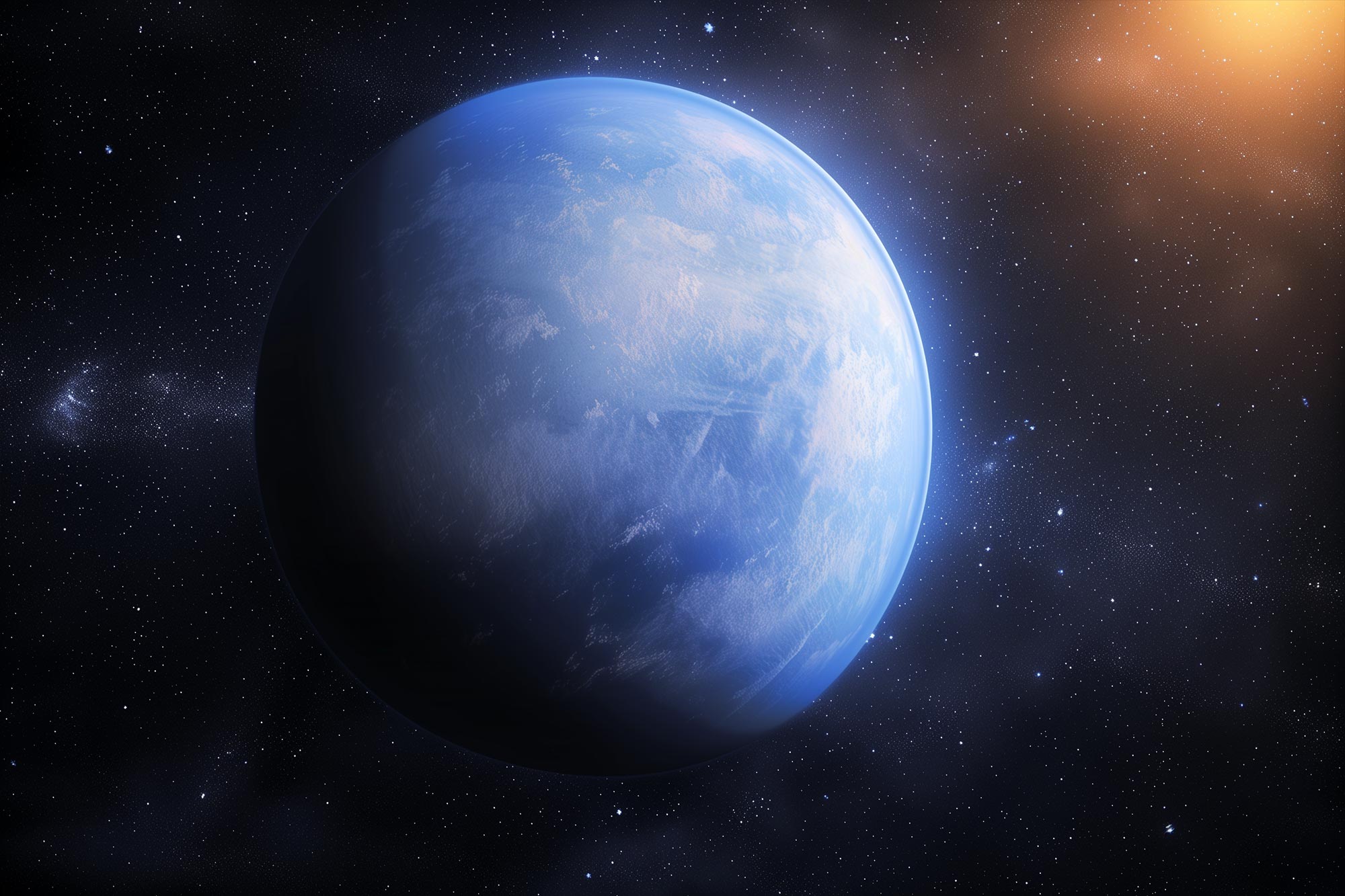
An international research group, including scientists from UNIGE, UNIBE, and PlanetS, has demonstrated that sub-Neptunes belong to two separate populations, resolving a debate in the scientific community.
Most stars in our galaxy host planets, with sub-Neptunes—planets sized between Earth and Neptune—being the most common. However, calculating their density presents a challenge for scientists. Depending on the method used to measure their mass, two distinct groups emerge: one of denser planets and another of less dense ones.
Is this due to an observational bias or the physical existence of two distinct populations of sub-Neptunes? Recent work by the NCCR PlanetS, the University of Geneva (UNIGE), and the University of Bern (UNIBE) argues for the latter. Find out more in the journal Astronomy & Astrophysics.
Exoplanets are abundant in our galaxy. The most common are those between the radius of the Earth (around 6,400 km) and Neptune (around 25,000 km), known as “sub-Neptunes.” It is estimated that 30% to 50% of sun-like stars contain at least one of these.
Calculating the density of these planets is a scientific challenge. To estimate their density, we must first measure their mass and radius. Problem: planets whose mass is measured by the TTV (Transit-Timing Variation) method are less dense than planets whose mass has been measured by the radial velocity method, the other possible measurement method.
“The TTV method involves measuring variations in transit timing. Gravitational interactions between planets in the same system will slightly modify the moment at which the planets pass in front of their star,” explains Jean-Baptiste Delisle, scientific collaborator in the Astronomy Department of the UNIGE Faculty of Science and co-author of the study. ‘‘The radial velocity method, on the other hand, involves measuring the variations in the star’s velocity induced by the presence of the planet around it.”
Eliminating any bias
An international team led by scientists from NCCR PlanetS, UNIGE, and UNIBE has published a study explaining this phenomenon. It is due not to selection or observational biases, but to physical reasons. “The majority of systems measured by the TTV method are in resonance,” explains Adrien Leleu, assistant professor in the Astronomy Department of the UNIGE Faculty of Science and principal author of the study.
Two planets are in resonance when the ratio between their orbital periods is a rational number. For example, when a planet makes two orbits around its star, another planet makes exactly one. If several planets are in resonance, it forms a chain of Laplace resonances. “We, therefore, wondered whether there was an intrinsic connection between density and the resonant orbital configuration of a planetary system,” continues the researcher.
To establish the link between density and resonance, astronomers first had to rule out any bias in the data by rigorously selecting planetary systems for statistical analysis. For example, a large, low-mass planet detected in transit requires more time to be detected in radial velocities. This increases the risk of observations being interrupted before the planet is visible in the radial velocity data, and therefore before its mass is estimated.
“This selection process would lead to a bias in the literature in favor of higher masses and densities for planets characterized with the radial velocity method. As we have no measurement of their masses, the less dense planets would be excluded from our analyses,” explains Adrien Leleu.
Once this data cleaning had been carried out, the astronomers were able to determine, using statistical tests, that the density of sub-Neptunes is lower in resonant systems than their counterparts in non-resonant systems, regardless of the method used to determine their mass.
A question of resonance
The scientists suggest several possible explanations for this link, including the processes involved in the formation of planetary systems. The study’s main hypothesis is that all planetary systems converge towards a resonance chain state in the first few moments of their existence, but only 5% remain stable. The other 95% become unstable. The resonance chain then breaks down, generating a series of “catastrophes,” such as collisions between planets. The planets fuse together, increasing their density and then stabilizing in non-resonant orbits.
This process generates two very distinct populations of Sub-Neptunes: dense and less dense. “The numerical models of planetary system formation and evolution that we have developed at Bern over the last two decades reproduce exactly this trend: planets in resonance are less dense. This study, moreover, confirms that most planetary systems have been the site of giant collisions, similar or even more violent than the one that gave rise to our Moon,” concludes Yann Alibert, professor at UNIBE’s Space Research and Planetary Sciences Division (WP) and co-director of the Center for Space and Habitability and co-author of the study.
Reference: “Resonant sub-Neptunes are puffier” by Adrien Leleu, Jean-Baptiste Delisle, Remo Burn, André Izidoro, Stéphane Udry, Xavier Dumusque, Christophe Lovis, Sarah Millholland, Léna Parc, François Bouchy, Vincent Bourrier, Yann Alibert, João Faria, Christoph Mordasini and Damien Ségransan, 27 June 2024, Astronomy & Astrophysics.
DOI: 10.1051/0004-6361/202450587
Never miss a breakthrough: Join the SciTechDaily newsletter.
Follow us on Google and Google News.