
Close Menu
    Facebook X (Twitter) Instagram
    SciTechDaily
    • Biology
    • Chemistry
    • Earth
    • Health
    • Physics
    • Science
    • Space
    • Technology
    Facebook X (Twitter) Pinterest YouTube RSS
    SciTechDaily
    Home»Space»Herschel Discovers Water Vapor in a Molecular Cloud on the Verge of Star Formation
    Space

    Herschel Discovers Water Vapor in a Molecular Cloud on the Verge of Star Formation

    By European Space AgencyOctober 9, 2012No Comments5 Mins Read
    Facebook Twitter Pinterest Telegram LinkedIn WhatsApp Email Reddit
    Share
    Facebook Twitter LinkedIn Pinterest Telegram Email Reddit
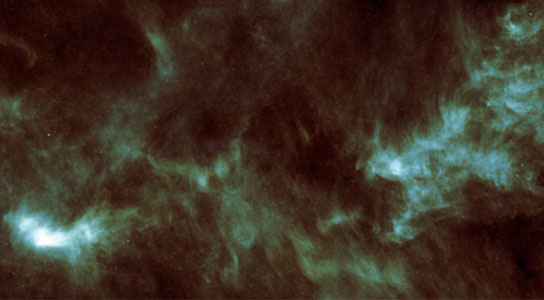
    Taurus molecular cloud
    Herschel’s infrared view of part of the Taurus Molecular Cloud, within which the bright, cold pre-stellar cloud L1544 can be seen at the lower left. It is surrounded by many other clouds of gas and dust of varying density. The Taurus Molecular Cloud is about 450 light-years from Earth and is the nearest large region of star formation. The image covers a field of view of approximately 1 x 2 arcminutes. Credit: ESA/Herschel/SPIRE

    The Herschel space observatory has discovered water vapor in a pre-stellar core in the constellation of Taurus known as Lynds 1544. This is the first detection of water vapor in a molecular cloud on the verge of star formation.

    ESA’s Herschel space observatory has discovered enough water vapor to fill Earth’s oceans more than 2000 times over, in a gas and dust cloud that is on the verge of collapsing into a new Sun-like star.

    Stars form within cold, dark clouds of gas and dust – ‘pre-stellar cores’ – that contain all the ingredients to make solar systems like our own.

    Water, essential to life on Earth, has previously been detected outside of our Solar System as gas and ice coated onto tiny dust grains near sites of active star formation, and in proto-planetary discs capable of forming alien planetary systems.

    The new Herschel observations of a cold pre-stellar core in the constellation of Taurus known as Lynds 1544 are the first detection of water vapor in a molecular cloud on the verge of star formation.

    More than 2000 Earth oceans-worth of water vapor were detected, liberated from icy dust grains by high-energy cosmic rays passing through the cloud.

    “To produce that amount of vapor, there must be a lot of water ice in the cloud, more than three million frozen Earth oceans’ worth,” says Paola Caselli from the University of Leeds, UK, lead author of the paper reporting the results in Astrophysical Journal Letters.

    “Before our observations, the understanding was that all the water was frozen onto dust grains because it was too cold to be in the gas phase and so we could not measure it.
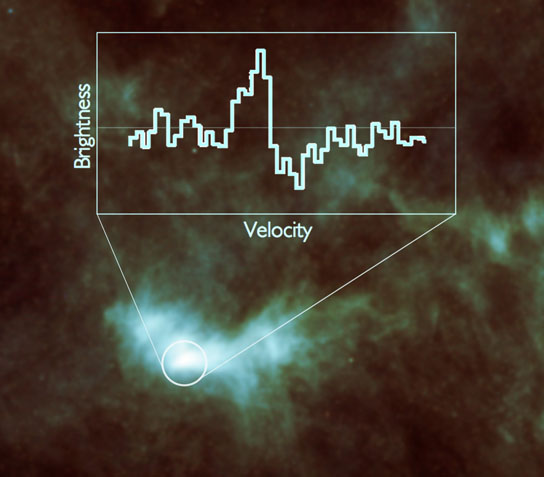
    Close-up of L1544 with the water spectrum seen by Herschel
    Close-up of L1544 with the water spectrum seen by Herschel, taken from the center of the pre-stellar core. The peak of the graph shows an excess in brightness, or emission, while the trough shows a deficit, or absorption. These characteristics are used to indicate the density and motions of the water molecules within the cloud. Emission arises from molecules that are approaching the center where the new star will form, from the back of the cloud from Herschel’s viewpoint. The amount of emission indicates that these molecules are moving within the densest part of the core, which spans about 1000 Astronomical Units. The absorption signature is due to water molecules in front of the cloud flowing away from the observer towards the center. These water molecules are in less dense regions much further away from the center. Together, the emission and absorption signatures indicate that the cloud is undergoing gravitational contraction, that is, it is collapsing to form a new star. Herschel detected enough water vapor in L1544 to fill Earth’s oceans more than 2000 times over. Credit: ESA/Herschel/SPIRE/HIFI/Caselli et al.

    “Now we will need to review our understanding of the chemical processes in this dense region and, in particular, the importance of cosmic rays to maintain some amount of water vapor.”

    The observations also revealed that the water molecules are flowing toward the heart of the cloud where a new star will probably form, indicating that gravitational collapse has just started.

    “There is absolutely no sign of stars in this dark cloud today, but by looking at the water molecules, we can see evidence of motion inside the region that can be understood as collapse of the whole cloud towards the center,” says Dr. Caselli.

    “There is enough material to form a star at least as massive as our Sun, which means it could also be forming a planetary system, possibly one like ours.”

    Some of the water vapor detected in L1544 will go into forming the star, but the rest will be incorporated into the surrounding disc, providing a rich water reservoir to feed potential new planets.

    “Thanks to Herschel, we can now follow the ‘water trail’ from a molecular cloud in the interstellar medium, through the star formation process, to a planet like Earth where water is a crucial ingredient for life,” says ESA’s Herschel project scientist, Göran Pilbratt.

    Reference: “First detection of water vapor in a pre-stellar core” by Paola Caselli, Eric Keto, Edwin A. Bergin, Mario Tafalla, Yuri Aikawa, Thomas Douglas, Laurent Pagani, Umut A. Yildiz, Floris F. S. van der Tak, C. Malcolm Walmsley, Claudio Codella, Brunella Nisini, Lars E. Kristensen and Ewine F. van Dishoeck, The Astrophysical Journal Letters.
    DOI: 10.1088/2041-8205/759/2/L37

    Never miss a breakthrough: Join the SciTechDaily newsletter.
    Follow us on Google and Google News.

    Astronomy Astrophysics European Space Agency Star Formation
    Share. Facebook Twitter Pinterest LinkedIn Email Reddit

    Related Articles

    Spitzer Views Star-Forming Region ON2

    Herschel Views Star Factory NGC 7538

    XMM-Newton Study of Zeta Puppis Provides New Details on Stellar Winds

    Herschel and Keck Reveal Previously Unseen Starburst Galaxies

    Planck Spots a Bridge of Hot Gas Connecting Galaxy Clusters

    Hubble Views Abell 2261, An Elliptical Galaxy With an Unusually Large Core

    Satellites Monitor the Colliding Winds of O-Type Stars

    Planck Satellite Observations May Help Solve the Mystery of Dark Matter

    Hubble Captures Image of Compact Blue Dwarf Galaxy UGC 5497

    Leave A Reply Cancel Reply

    • Facebook
    • Twitter
    • Pinterest
    • YouTube

    Don't Miss a Discovery

    Subscribe for the Latest in Science & Tech!

    Trending News

    Largest-Ever Study Finds Medicinal Cannabis Ineffective for Anxiety, Depression, PTSD

    250-Million-Year-Old Egg Solves One of Evolution’s Biggest Mysteries

    Living With Roommates Might Be Changing Your Gut Microbiome Without You Knowing

    Century-Old Cleaning Chemical Linked to 500% Increased Risk of Parkinson’s Disease

    What if Your Memories Never Happened? Physicists Take a New Look at the Boltzmann Brain Paradox

    One of the Universe’s Largest Stars May Be Getting Ready To Explode

    Scientists Discover Enzyme That Could Supercharge Ozempic-Like Weight Loss Drugs

    Popular Sweetener Linked to DNA Damage – “It’s Something You Should Not Be Eating”

    Follow SciTechDaily
    • Facebook
    • Twitter
    • YouTube
    • Pinterest
    • Newsletter
    • RSS
    SciTech News
    • Biology News
    • Chemistry News
    • Earth News
    • Health News
    • Physics News
    • Science News
    • Space News
    • Technology News
    Recent Posts
    • Scientists Discover Coral Reefs Are Teeming With Previously Unknown Life
    • Scientists Find Way to Reverse Fatty Liver Disease Without Changing Diet
    • Could Humans Regrow Limbs? New Study Reveals Promising Genetic Pathway
    • Black Hole Jets Pack Power of 10,000 Suns, Stunning New Study Reveals
    • A Cosmic Crash Turned This Nearby Galaxy Into Chaos
    Copyright © 1998 - 2026 SciTechDaily. All Rights Reserved.
    • Science News
    • About
    • Contact
    • Editorial Board
    • Privacy Policy
    • Terms of Use

    Type above and press Enter to search. Press Esc to cancel.