
Close Menu
    Facebook X (Twitter) Instagram
    SciTechDaily
    • Biology
    • Chemistry
    • Earth
    • Health
    • Physics
    • Science
    • Space
    • Technology
    Facebook X (Twitter) Pinterest YouTube RSS
    SciTechDaily
    Home»Space»Hubble Views Comet Siding Spring Passing Mars
    Space

    Hubble Views Comet Siding Spring Passing Mars

    By Felicia Chou, NASA HeadquartersOctober 24, 2014No Comments3 Mins Read
    Facebook Twitter Pinterest Telegram LinkedIn WhatsApp Email Reddit
    Share
    Facebook Twitter LinkedIn Pinterest Telegram Email Reddit
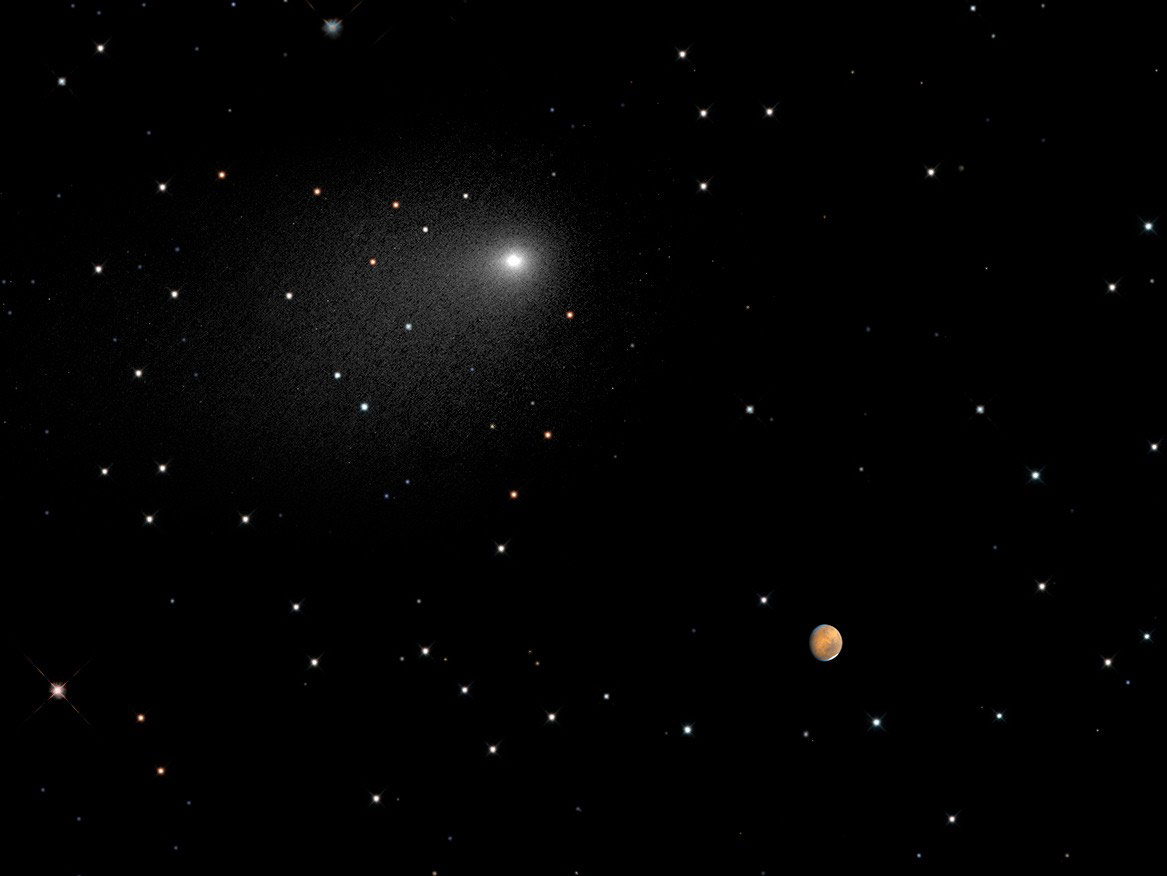
    Hubble Views Comet Siding Spring Next to Mars
    This composite NASA Hubble Space Telescope Image captures the positions of comet Siding Spring and Mars in a never-before-seen close passage of a comet by the Red Planet, which happened at 2:28 p.m. EDT on October 19, 2014. Credit: NASA, ESA, PSI, JHU/APL, STScI/AURA

    This new composite image of comet Siding Spring was captured by NASA’s Hubble Space Telescope as Sliding Spring made its never-before-seen close passage of Mars.

    Siding Spring, officially designated Comet C/2013 A1, made its closest approach to Mars at 2:28 p.m. EDT on October 19, at a distance of approximately 87,000 miles. That is about one-third of the distance between Earth and the moon. At that time, the comet and Mars were about 149 million miles from Earth.

    The comet image is a composite of Hubble exposures taken between October 18, 8:06 a.m. to October 19, 11:17 p.m. Hubble took a separate image of Mars at 10:37 p.m. on October 18.

    The Mars and comet images have been added together to create a single picture to illustrate the angular separation, or distance, between the comet and Mars at closest approach. The separation is approximately 1.5 arc minutes, or one-twentieth of the angular diameter of the full moon. The background star field in this composite image is synthesized from ground-based telescope data provided by the Palomar Digital Sky Survey, which has been reprocessed to approximate Hubble’s resolution.

    The solid icy comet nucleus is too small to be resolved in the Hubble picture. The comet’s bright coma, a diffuse cloud of dust enshrouding the nucleus, and a dusty tail, are clearly visible.

    This is a composite image because a single exposure of the stellar background, comet Siding Spring, and Mars would be problematic. Mars actually is 10,000 times brighter than the comet, so it could not be properly exposed to show detail in the Red Planet. The comet and Mars also were moving with respect to each other and could not be imaged simultaneously in one exposure without one of the objects being motion blurred. Hubble had to be programmed to track on the comet and Mars separately in two different observations.

    NASA used its extensive fleet of science assets, particularly those orbiting and roving Mars, to image and study this once-in-a-lifetime comet flyby. In preparation for the comet flyby, NASA maneuvered its Mars Odyssey orbiter, Mars Reconnaissance Orbiter (MRO), and the newest member of the Mars fleet, Mars Atmosphere and Volatile EvolutioN (MAVEN), in order to reduce the risk of impact with high-velocity dust particles coming off the comet. Other NASA space observatories also joined Hubble in observing the encounter, along with ground-based telescopes on Earth.

    Siding Spring is the first comet from our solar system’s Oort Cloud to be studied up close. The Oort Cloud, well beyond the outer-most planets that surround our sun, is a spherical region of icy objects believed to be material left over from the formation of the solar system.

    Never miss a breakthrough: Join the SciTechDaily newsletter.
    Follow us on Google and Google News.

    Astronomy Hubble Space Telescope Mars
    Share. Facebook Twitter Pinterest LinkedIn Email Reddit

    Related Articles

    The Great Escape: NASA’s Hubble and MAVEN Help Solve Mystery of Mars’ Vanishing Water

    Hubble Views Tiny Moon Phobos Orbiting the Red Planet

    Hubble Telescope Close-up of the Red Planet

    Quasars Acting as Gravitational Lenses Viewed by Hubble

    Atmosphere of Super-Earth GJ1214b Possibly Includes Abundant Water Vapor

    ESA’s Mars Express MARSIS Radar Explores Martian Oceans

    Hubble Discovers NGC 1073, A Barred Spiral Galaxy Similar to Milky Way

    SN Primo Is Farthest Type Ia Supernova Discovered

    Hubble Observes Rare Blue Stars in Andromeda’s Core

    Leave A Reply Cancel Reply

    • Facebook
    • Twitter
    • Pinterest
    • YouTube

    Don't Miss a Discovery

    Subscribe for the Latest in Science & Tech!

    Trending News

    Why Popular Diabetes Drugs Like Ozempic Don’t Work for Everyone: The “Genetic Glitch”

    Scientists Stunned After Finding Plant Thought Extinct for 60 Years

    Scientists Discover Tiny New Spider That Hunts Prey 6x Its Size

    Natural Component From Licorice Shows Promise for Treating Inflammatory Bowel Disease

    Scientists Warn: Popular Sweetener Linked to Dangerous Metabolic Effects

    Monster Storms on Jupiter Unleash Lightning Beyond Anything on Earth

    Scientists Create “Liquid Gears” That Spin Without Touching

    The Simple Habit That Could Help Prevent Cancer

    Follow SciTechDaily
    • Facebook
    • Twitter
    • YouTube
    • Pinterest
    • Newsletter
    • RSS
    SciTech News
    • Biology News
    • Chemistry News
    • Earth News
    • Health News
    • Physics News
    • Science News
    • Space News
    • Technology News
    Recent Posts
    • Breakthrough Crystal Lets Scientists “Write” Nanoscale Patterns With Light
    • Pomegranate Compound Could Help Protect Against Heart Disease
    • Your Blood Test Might Already Show Alzheimer’s Risk
    • Common Pregnancy Medications Linked to Higher Autism Risk in Massive U.S. Study
    • Scientists Teach AI To Think Like a Professional Chemist
    Copyright © 1998 - 2026 SciTechDaily. All Rights Reserved.
    • Science News
    • About
    • Contact
    • Editorial Board
    • Privacy Policy
    • Terms of Use

    Type above and press Enter to search. Press Esc to cancel.