
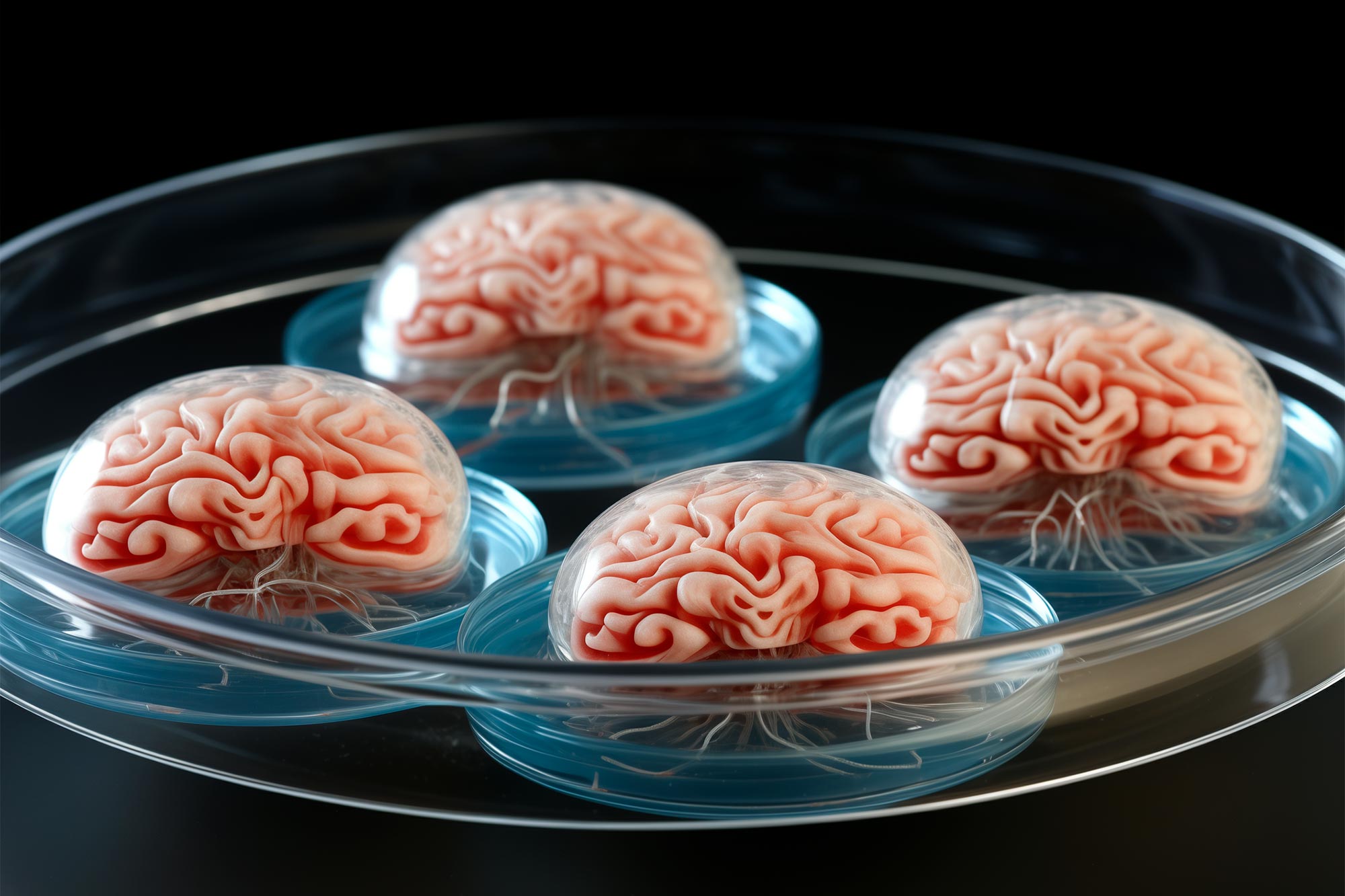
“Mini-brains” developed by Dr. Wenzel using stem cells could transform Alzheimer’s treatment and diagnosis, showing potential for broader medical applications and more efficient healthcare delivery.
Dr. Tyler Wenzel from the University of Saskatchewan (USask) has devised an innovative new method to build miniature brains from stem cells. Wenzel’s “mini-brain” could revolutionize the way Alzheimer’s and other brain-related diseases are diagnosed and treated.
“Never in our wildest dreams did we think that our crazy idea would work,” he said. “These could be used as a diagnostic tool, built from blood.”
Wenzel, a postdoctoral fellow in the College of Medicine’s Department of Psychiatry, developed the idea for the “mini-brain” – or more formally, a one-of-a-kind cerebral organoid model – while working under the supervision of Dr. Darrell Mousseau (PhD).
Unique Capabilities of Stem Cell-Derived Organoids
Human stem cells can be manipulated to develop into practically any other cell in the body. Using stem cells taken from human blood, Wenzel was able to create a tiny artificial organ – roughly three millimeters across and resembling visually what Wenzel described as a piece of chewed gum someone has tried to smooth out again.
These “mini-brains” are built by creating stem cells from a blood sample, and then transforming these stem cells into functioning brain cells. Using small synthetic organoids for research is not a novel concept – but the “mini-brains” developed in Wenzel’s lab are unique. As outlined in Wenzel’s recently published article in Frontiers of Cellular Neuroscience, the brains from Wenzel’s lab are comprised of four different types of brain cells while most brain organoids are comprised of only neurons.
In testing, Wenzel’s “mini-brains” more accurately reflect a fully-fledged adult human brain, so they can be used to more closely examine neurological conditions of adult patients, such as Alzheimer’s disease.
Potential of Mini-Brains in Diagnosing Alzheimer’s
Wenzel determined that the “mini-brains” he created from the stem cells of individuals who have Alzheimer’s also displayed the pathology of Alzheimer’s – just on a smaller scale.
“If stem cells have the capacity to become any cell in the human body, the question then came ‘could we create something that resembles an entire organ?’” Wenzel said. “While we were developing it, I had the crazy idea that if these truly are human brains, if a patient had a disease like Alzheimer’s and we grew their ‘mini-brain,’ in theory that tiny brain would have Alzheimer’s.”
The researcher said this technology has the potential to change the way health services are provided to those with Alzheimer’s, particularly in rural and remote communities. This groundbreaking research has already received support from the Alzheimer Society of Canada.
Expanding Applications and Future Research
If Wenzel and his colleagues can create a consistent way to diagnose and treat neurological conditions like Alzheimer’s using only a small blood sample – which has a relatively long shelf life and can be couriered – instead of requiring patients to travel to hospitals or specialized clinics, it could save the healthcare system a tremendous amount of resources and lift a burden off of patients.
“In theory, if this tool works the way we think it does, we could just get a blood sample shipped from La Loche or La Ronge to the university and diagnose you like that,” he said.
The early proof-of-concept work on the “mini-brains” has been extremely promising – which means the next step for Wenzel is expanding the testing to a larger pool of patients.
The researchers are also interested in trying to expand the scope of the “mini-brain” research. According to Wenzel, if they can confirm the “mini-brains” accurately reflect other brain diseases or neurological conditions, they could potentially be used to speed up diagnoses or test the efficacy of drugs on patients.
As an example, Wenzel pointed to the substantial wait times to see a psychiatrist in Saskatchewan. If the “mini-brains” could be used to test which antidepressant works best on a patient suffering from depression, it could dramatically reduce the time required to see a doctor and receive a prescription.
A former high school science teacher who made a move into the world of research and academia, Wenzel said it’s the “nature of research” to come up with a hypothesis and hit close to the mark in an experiment that excites him his work.
The astounding success of the early “mini-brains,” however, has been so staggering that Wenzel admitted he still struggles to wrap his own brain around it.
“I’m still in disbelief, but it’s also extremely motivating that something like this happened,” Wenzel said. “It gives me something that I think will impact society and have actual relevance and create some change … it has a strong potential to shift the landscape of medicine.”
Reference: “Brain organoids engineered to give rise to glia and neural networks after 90 days in culture exhibit human-specific proteoforms” by Tyler J. Wenzel and Darrell D. Mousseau, 18 April 2024, Frontiers in Cellular Neuroscience.
DOI: 10.3389/fncel.2024.1383688
Never miss a breakthrough: Join the SciTechDaily newsletter.
Follow us on Google and Google News.
4 Comments
Hello. I think this is absolutely a game changer. I am actually excited for y’all, and hopeful. My grandpa had Alzheimer’s, in the end he thought I was just a pretty girl my dad knew. Sad. Anyway, I have been fighting depression for so many years now I’m a total shut in. I don’t have insurance or money to see a Dr. I would be apt to help in clinical trials. (Better than a bridge), if ever you need someone.
With a family history of nearly subclinical non-IgE-mediated food allergies and dementia and a personal history of allergies, allergen avoidance related nutritional deficiencies and temporary short-term memory problems, I think you may have undiagnosed food allergies resulting a medically undiagnosed calcium (minimally; natural tranquilizer; standard blood serum testing is unreliable) deficiency, especially if you’ve had any children. For more of my lay findings: https://odysee.com/@charlesgshaver:d?view=about For some on how to identify food allergies at-home: https://soilandhealth.org/wp-content/uploads/02/0201hyglibcat/020108.coca.pdf Best wishes.
Interested in cell biology, especially anything nano. Getting Ray Kurzweil’s _The Singularity Is Nearer_. Do you approve of Nano or do you think Elon Musk is correct in calling it BS?
“While we were developing it, I had the crazy idea that if these truly are human brains, if a patient had a disease like Alzheimer’s and we grew their ‘mini-brain,’ in theory that tiny brain would have Alzheimer’s.”
It is a crazy idea, since these organoids are not brains. And Alzheimer’s is a disease of the whole person, with the brain inside the head, not in a petri dish.
In reality, the brain is in a skull, and its circulation is affected by gravity. Sleep position has been shown to affect brain pressure and circulation, with a head of bed elevation of 30 degrees considered by NASA to be optimal for brain circulation. NASA studies brain circulation under zero gravity because astronauts experience a fluid shift to the head and brain when in zero gravity, and this causes a host of problems. This problem is simulated on Earth by having people lie flat.
In my research on sleep position and brain function, we discovered that migraines are eliminated by raising the head of the bed. This also is known to help with sleep apnea, stroke, glaucoma, and mental clarity, due to better brain circulation. If you already use a wedge for GERD or acid reflux, then this is the head of elevation I am talking about. See my article, Heads Up! The Way You are Sleeping is Killing You. https://www.academia.edu/1483361/Heads_Up_The_Way_You_Are_Sleeping_May_Be_Killing_You_