
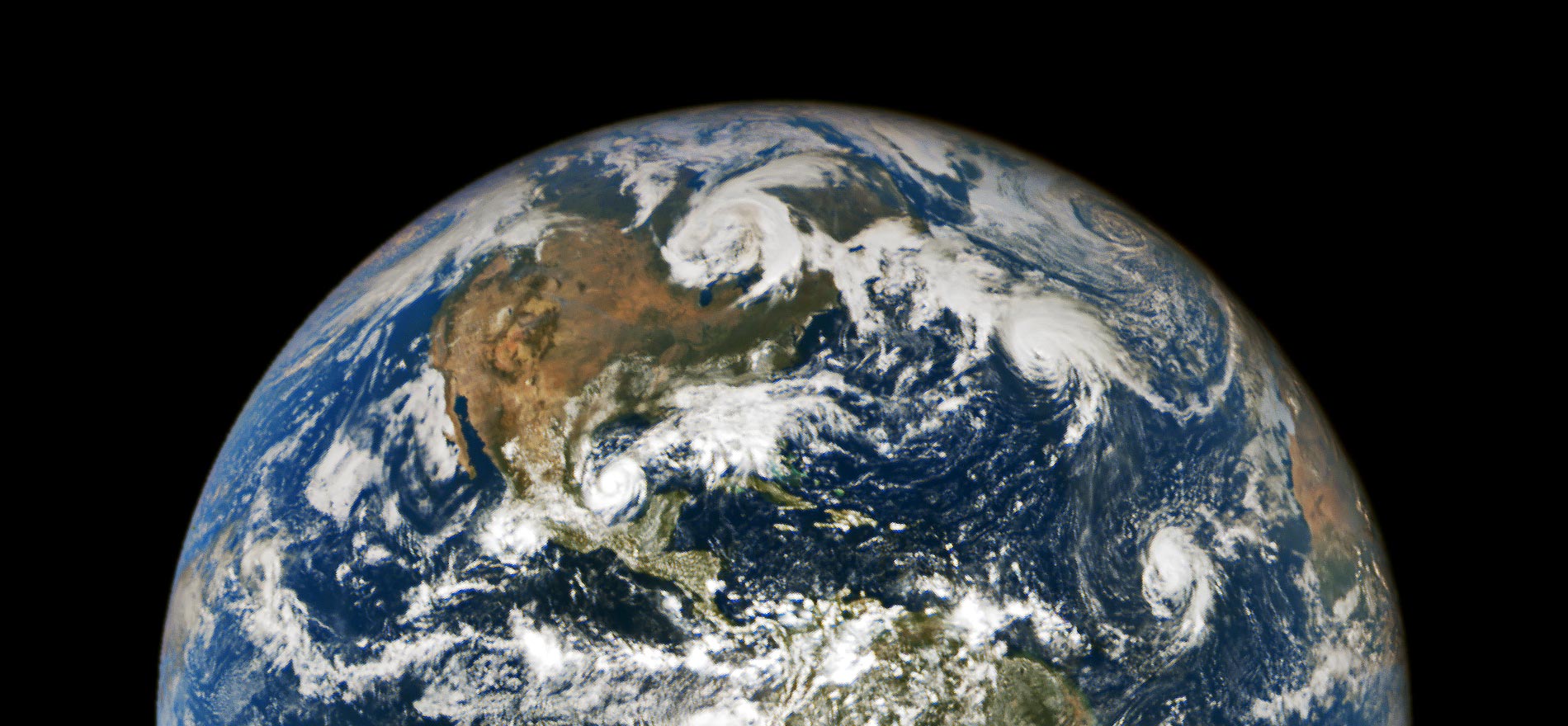
NASA’s EPIC imager on the DSCOVR satellite captured three hurricanes, Milton, Kirk, and Leslie, simultaneously active over the North Atlantic, a first since records began in 1851.
Milton, fueled by record warm Gulf of Mexico waters, rapidly intensified from a Category 1 to a Category 5 storm. Meanwhile, Kirk weakened off western France, and Leslie churned near the Cabo Verde Islands. The hurricane season has been busier than average, with significant impacts on hurricane behavior and intensity.
Overview of EPIC’s Hurricane Observations
From the stable Lagrange point 1, located one million miles above Earth, NASA’s EPIC (Earth Polychromatic Imaging Camera) imager on the DSCOVR (Deep Space Climate Observatory) satellite observed an unusually active Atlantic Basin.
In early October, three hurricanes simultaneously spun over the North Atlantic Ocean. This image shows the three storms—Milton, Kirk, and Leslie—at about 12 p.m. Central Time (17:00 Universal Time) on October 6, 2024. It was captured as Milton was developing in the southwestern Gulf of Mexico, about an hour before it became a hurricane.
Historical Context and Hurricane Milton’s Rapid Intensification
According to Phil Klotzbach, a Colorado State University meteorologist, this is the first-known hurricane season to see three hurricanes simultaneously present in the basin after September. Klotzbach cites the National Hurricane Center’s (NHC) database, which dates back to 1851, but he also noted: “…there are likely underestimates and potentially missed hurricanes prior to the satellite era (1966-onwards).”
Fueled by unusually warm water in the Gulf of Mexico, Hurricane Milton “explosively” intensified from a Category 1 to Category 5 storm in less than 24 hours from October 6-7. The hurricane developed with “light shear and very warm waters in its path,” according to the NHC. As of the afternoon on October 7, Milton had 175 mile (282 kilometer) per hour winds and was forecast by NHC to make landfall on the west coast of the Florida peninsula on the evening of October 9.
Impact of Record Warm Waters on Hurricane Intensity
In an October 6 update of tropical Atlantic activity, University of Miami hurricane researcher Brian McNoldy noted that temperatures in the Gulf of Mexico—both at and below the surface—were record warm. “High ocean heat content provides a hurricane with a constant source of fuel and makes it much harder to upwell cooler water from below which could weaken the storm,” McNoldy wrote in the update. “This will help Milton to rapidly intensify and reach a higher peak intensity.”
To the northeast, Kirk was weakening from a Category 2 to a Category 1 hurricane around the time of this image. Kirk began developing in the eastern tropical Atlantic in late September and reached peak intensity as a Category 4 hurricane on October 4. The major hurricane veered northeast after development and evolved into an extratropical cyclone. NHC forecasts indicate that the storm could reach the shores of western France on October 9.
Meanwhile, Leslie churned as a Category 1 storm when this image was acquired. Leslie developed several hundred miles southwest of the Cabo Verde Islands of western Africa and became a hurricane on October 4. The storm is expected to weaken to a tropical storm by October 8, with no interaction with land.
The hurricane season, which started June 1 and runs through November 30, has been unusually busy so far in 2024, according to Klotzbach. As of October 6, nine hurricanes have developed in the Atlantic compared to the 1991-2020 average of 5.5.
NASA Earth Observatory image by Michala Garrison, using data from DSCOVR EPIC.
Never miss a breakthrough: Join the SciTechDaily newsletter.
Follow us on Google and Google News.
6 Comments
Wonder what HAARP has been up to🌀
Another engineered storm from the Deep State Matrix aimed at MAGA country less than 30 days before a POTUS election.
Dumb statement
Super dumb
Where in the hell is our government and femma. They are to busy giving aid to illegal immagrants. Also where the hell is scammala and dementa joe. If President Trump wasbat the helm things would be different. At least he would put the American people first and aid and financial support would be on its way. MAGA 2024.
The reason for the violent storms is because all the coastlines of this continent are connected to the largest oceans in the world, and the heat of the South American continent causes a temperature difference in the land and sea, and the cold air front moves from the oceans to the warm air front. The autumn season causes severe and destructive storms, and the proximity of the American continent to the North Pole increases the intensity of air movement and leads to violent storms