
Close Menu
    Facebook X (Twitter) Instagram
    SciTechDaily
    • Biology
    • Chemistry
    • Earth
    • Health
    • Physics
    • Science
    • Space
    • Technology
    Facebook X (Twitter) Pinterest YouTube RSS
    SciTechDaily
    Home»Space»U.S. Naval Research Laboratory’s Large Angle Spectrometric Coronagraph Discovers 4000th Comet
    Space

    U.S. Naval Research Laboratory’s Large Angle Spectrometric Coronagraph Discovers 4000th Comet

    By Naval Research LaboratoryJune 28, 2020No Comments3 Mins Read
    Facebook Twitter Pinterest Telegram LinkedIn WhatsApp Email Reddit
    Share
    Facebook Twitter LinkedIn Pinterest Telegram Email Reddit
    SOHO 4000
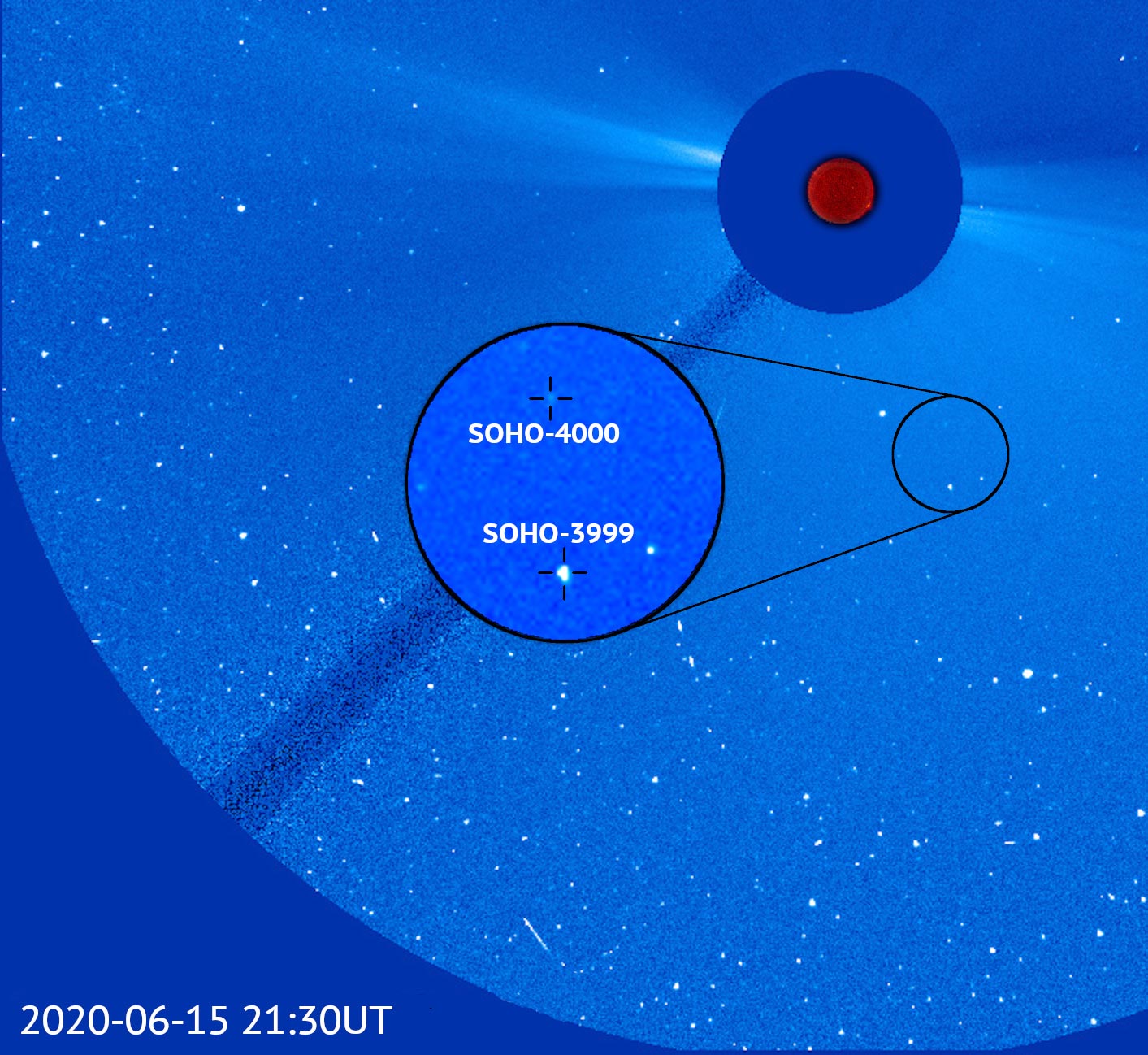
    The 4,000th comet discovered by ESA (European Space Agency) and NASA’s SOHO observatory is seen here in an image from the spacecraft alongside SOHO’s 3,999th comet discovery. The two comets are relatively close at approximately 1 million miles apart, suggesting that they could have been connected together as recently as a few years ago. Credit: ESA/NASA/SOHO/Karl Battams

    The U.S. Naval Research Laboratory’s Large Angle Spectrometric Coronagraph (LASCO) instrument identified the 4000th comet discovered by the Solar and Heliospheric Observatory (SOHO), a joint mission between the European Space Agency and NASA on June 15.

    LASCO, which is aboard SOHO, was developed in 1995 to see the extremely faint emission from the region around the Sun called the corona. Operating in space for nearly 25 years, the telescope has seen much more space action than researchers originally anticipated — discovering well over half of all known comets.

    “In less than 25 years SOHO has added this huge volume to the archives of our comet knowledge, and it comes from a telescope not designed to see comets,” said Karl Battams, NRL computational scientist. “This is exciting for many reasons, but perhaps mostly because LASCO is discovering comets that are otherwise completely unobservable from Earth due to their proximity to the Sun.”


    ESA and NASA’s SOHO has discovered 4,000 comets in nearly 25 years. Karl Battams, who leads the mission’s comet-finding program, talks about four of his favorite comets first spotted by the Sun-watching observatory. Credit: NASA’s Goddard Space Flight Center

    The majority of the comet discoveries were made by amateur astronomers who participated in the NASA-funded and NRL-managed Sungrazer project, which encourages citizen scientists to peruse imagery from SOHO and the Sun-Earth Connection Coronal and Heliospheric Investigation (SECCHI) instrument suite on the NASA Solar Terrestrial Relations Observatory (STEREO) and search for previously unknown comets. New comet findings are reported through the website, and subsequently verified and measured by Battams, who has led this Project since 2003.

    “The people who discovered these comets were not necessarily professional astronomers, they were people at home,” Battams said. “People of all ages, backgrounds, and countries have volunteered their time to be a part of this citizen science project. The 4000th comet is a testament to the invaluable input from so many volunteers all around the world over the past two decades.”

    The Navy has a unique interest in the Sun and near-Sun environment. Much of the Navy’s equipment, and equipment we use every day, such as GPS, is impacted by the Sun. Studying comets traveling near the Sun helps researchers gain a greater understanding of Earth’s closest star, as they observe the comets reacting to its extreme environment.

    Battams is a computational scientist and astrophysicist within the Solar and Heliospheric Physics Branch under the Space Sciences division at NRL. The mission of this Branch is to develop improved heliospace environment understanding, awareness, sensors, forecast capabilities, and monitoring tools that predict operational impacts and enable real-time threat warning; and transition these developments to support the Navy/Marine Corps and other agencies.

    Read The 4,000th Comet Discovery Using Solar and Heliospheric Observatory for more on this discovery.

    Never miss a breakthrough: Join the SciTechDaily newsletter.
    Follow us on Google and Google News.

    Astronomy Comet SOHO U.S. Naval Research Laboratory
    Share. Facebook Twitter Pinterest LinkedIn Email Reddit

    Related Articles

    Epic Comet Pass: Tsuchinshan-ATLAS Outshines Expectations With Brilliant Solar Passage

    Final Glimpse: Comet Disintegrates Shortly After Eclipse Observation

    Rare Glimpse of “Doomed” SOHO Comet During Solar Eclipse

    A Small, Bright Surprise: Two Views of a Sungrazing Comet

    ESA and NASA Satellites Spot the Return of the Comet 96P

    An Unusual Comet Skimmed Past the Sun

    ISON Comet May Become Brightest Object in the Night Skies

    Trajectory Models of Refractory Particles Help Solve Two Solar System Puzzles

    View the Eta Aquarid Meteor Shower From Halley’s Comet

    Leave A Reply Cancel Reply

    • Facebook
    • Twitter
    • Pinterest
    • YouTube

    Don't Miss a Discovery

    Subscribe for the Latest in Science & Tech!

    Trending News

    Breakthrough Bowel Cancer Trial Leaves Patients Cancer-Free for Nearly 3 Years

    Natural Compound Shows Powerful Potential Against Rheumatoid Arthritis

    100,000-Year-Old Neanderthal Fossils in Poland Reveal Unexpected Genetic Connections

    Simple “Gut Reset” May Prevent Weight Gain After Ozempic or Wegovy

    2.8 Days to Disaster: Scientists Warn Low Earth Orbit Could Suddenly Collapse

    Common Food Compound Shows Surprising Power Against Superbugs

    5 Simple Ways To Remember More and Forget Less

    The Atomic Gap That Could Cost the Semiconductor Industry Billions

    Follow SciTechDaily
    • Facebook
    • Twitter
    • YouTube
    • Pinterest
    • Newsletter
    • RSS
    SciTech News
    • Biology News
    • Chemistry News
    • Earth News
    • Health News
    • Physics News
    • Science News
    • Space News
    • Technology News
    Recent Posts
    • Scientists Develop Bioengineered Chewing Gum That Could Help Fight Oral Cancer
    • Popular Weight-Loss Drugs Found To Cut Heart Attack and Stroke Risk
    • After 37 Years, the World’s Longest-Running Soil Warming Experiment Uncovers a Startling Climate Secret
    • NASA Satellite Captures First-Ever High-Res View of Massive Pacific Tsunami
    • ADHD Isn’t Just a Deficit: Study Reveals Powerful Hidden Strengths
    Copyright © 1998 - 2026 SciTechDaily. All Rights Reserved.
    • Science News
    • About
    • Contact
    • Editorial Board
    • Privacy Policy
    • Terms of Use

    Type above and press Enter to search. Press Esc to cancel.