
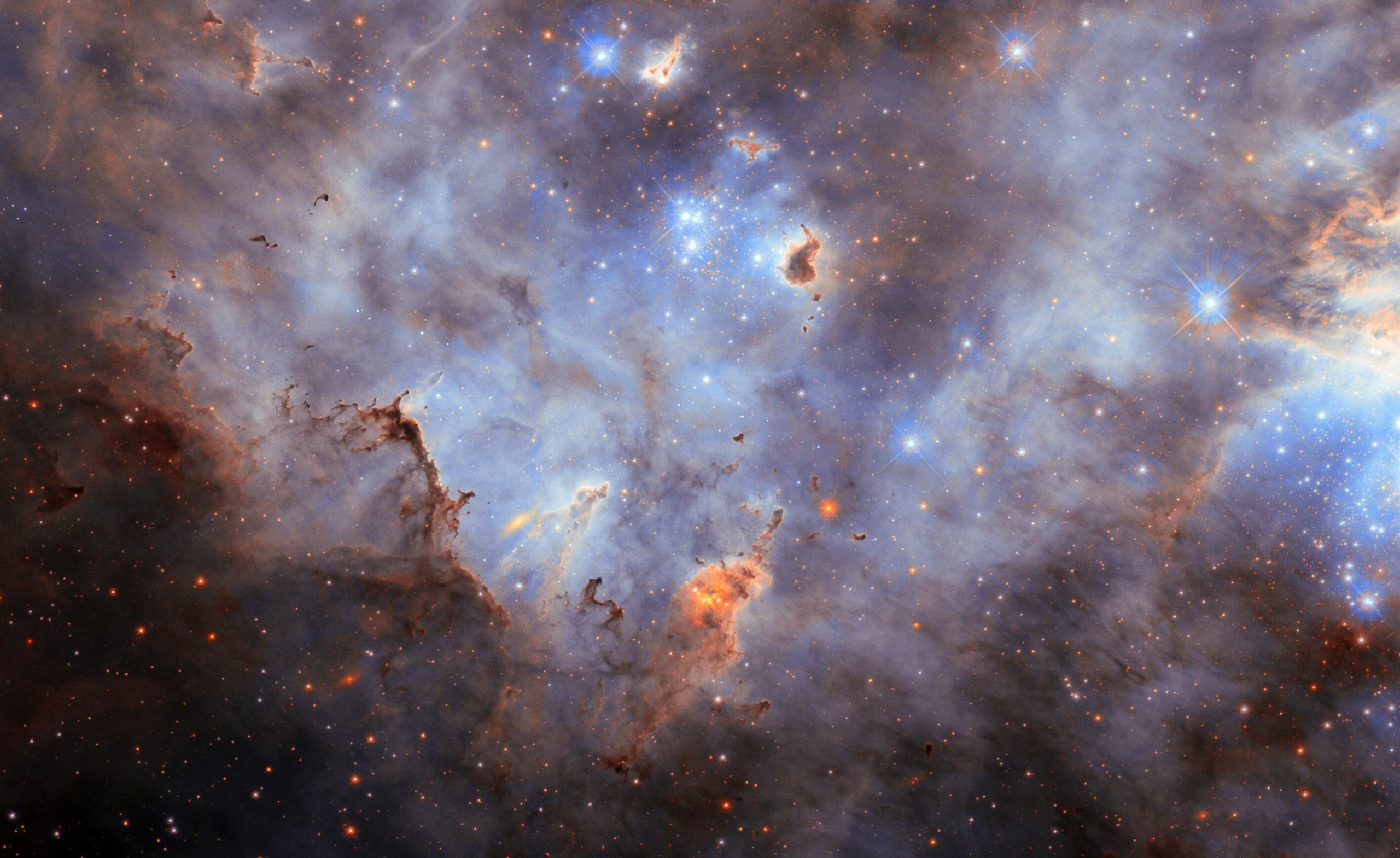
Hubble’s latest view of the Large Magellanic Cloud unveils a dazzling star cluster filled with glowing gas and newborn stars.
A Cosmic Portrait in the Large Magellanic Cloud
This week’s Hubble Space Telescope Picture of the Week showcases a misty panorama of stars within a striking cluster. The view comes from the Large Magellanic Cloud, a dwarf galaxy positioned about 160,000 light-years from Earth in the constellations Dorado and Mensa. Containing a mass estimated at 10-20% that of the Milky Way, the Large Magellanic Cloud is the largest of the many smaller galaxies that orbit our own.
Stellar Nurseries and Star-Birth in N11
Within the Large Magellanic Cloud lie several vast star-forming regions, where giant clouds of gas gather and collapse to create new stars. The image highlights part of N11, the galaxy’s second-largest stellar nursery. (The Tarantula Nebula, which holds the title as the most extensive and active star-forming region in the Large Magellanic Cloud, is another well-known Hubble target.) Here, brilliant young stars illuminate the surrounding gas and reshape nearby dust clouds with intense ultraviolet light.
Hubble’s Longevity and Stellar Cataloging
This image marries observations made roughly 20 years apart, a testament to Hubble’s longevity. The first set of observations, which were carried out in 2002–2003, capitalized on the exquisite sensitivity and resolution of the then-newly-installed Advanced Camera for Surveys (ACS). Astronomers turned Hubble toward the N11 star cluster to do something that had never been done before at the time: catalogue all the stars in a young cluster with masses between 10% of the Sun’s mass and 100 times the Sun’s mass.
The second set of observations came from Hubble’s newest camera, the Wide Field Camera 3 (WFC3). These images focus on the dusty clouds that permeate the cluster, offering a new perspective on cosmic dust.
Never miss a breakthrough: Join the SciTechDaily newsletter.
Follow us on Google and Google News.
1 Comment
Note 2509100420_Source1.Reinterpreting【
Source 1.
https://scitechdaily.com/hubbles-dazzling-portrait-of-baby-stars-lighting-up-a-cosmic-cloud/
1.
Hubble’s Brilliant Portrait of Baby Stars Lighting Up Space Clouds
ESA/Hubble Presented September 8, 2025
Hubble’s impressive photo of the Massachusetts Institute of Technology shows N11’s glowing stars and dust clouds, combining data from two generations of Hubble cameras. Photo courtesy of ESA/Hubble & NASA, C. Murray, J. Mice Apellanis
1-1.
Hubble’s most recent photo of the Large Magellanic Galaxy revealed a stellar cluster filled with glowing gas and newborn stars.
2. Cosmic Portrait of the Great Magellanic Cloud
_This week’s Hubble Space Telescope weekly photo unfolds like a misty panorama of stars in an eye-catching cluster.
_The photo was taken at the Great Magellanic Cloud, a dwarf galaxy located in Storks and Mensa, about 160,000 light years from Earth.
_Estimated to be 10% to 20% of the mass of our galaxy, the Large Magellanic Cloud is the largest of the many small galaxies orbiting our galaxy.
3.N11’s Star Nursery and the Birth of a Star
_Within the Large Magellanic Cloud, there are several vast star-forming areas where huge clouds of gas gather and collapse to create new stars. The image highlights part of N11, the cradle of the galaxy’s second largest star.
_(The Tarantula Nebula, which holds the title of the largest and most active star-forming region of the Massachusetts Institute of Technology, is another of Hubble’s most famous observations.) Here, the brightly shining young stars illuminate the surrounding gas and transform the shape of the surrounding dust cloud with intense UV radiation.
【>>>>>
> In my view of the universe, msbase.galaxy is a collection of massive stars. Stars of these masses were identified as sum in units of qpeoms=0,1,2 (oser.msoss).
>>This qpeoms=0,1,2 (oser.msoss) path equation means that msoss, a dark matter, directly or indirectly influences the appearance of stars.
> Of course, there is evidence that nebular galaxies form accretion disks to produce stars.
>>>If ozer.wimp, a dark matter, creates an action point differentiation in the background, msoss.dark_matter is reversed to msbase.galy.
>So where did the msoss come from? If you interpret it as a guess, it flows like clouds from other distant galaxies. The dark matter msoss dwarf galaxy could be what it is. Hmm.
<<<<<】
3-1. List of life and stars of Hubble
The photo, which combines observations that take place about 20 years apart, proves Hubble's long history. The first observations, conducted between 2002 and 2003, utilized the excellent sensitivity and resolution of the then newly installed Advanced Camera for Surveys (ACS). Astronomers turned Hubble into an N11 cluster, doing something unheard of at the time. It was a catalog of all the stars in a young cluster, with masses between 10 and 100 times the mass of the sun.
The second observations were made with Hubble's latest camera, Wide Field Camera 3 (WFC3). These images offer a new perspective on cosmic dust, focusing on dust clouds penetrating clusters.