
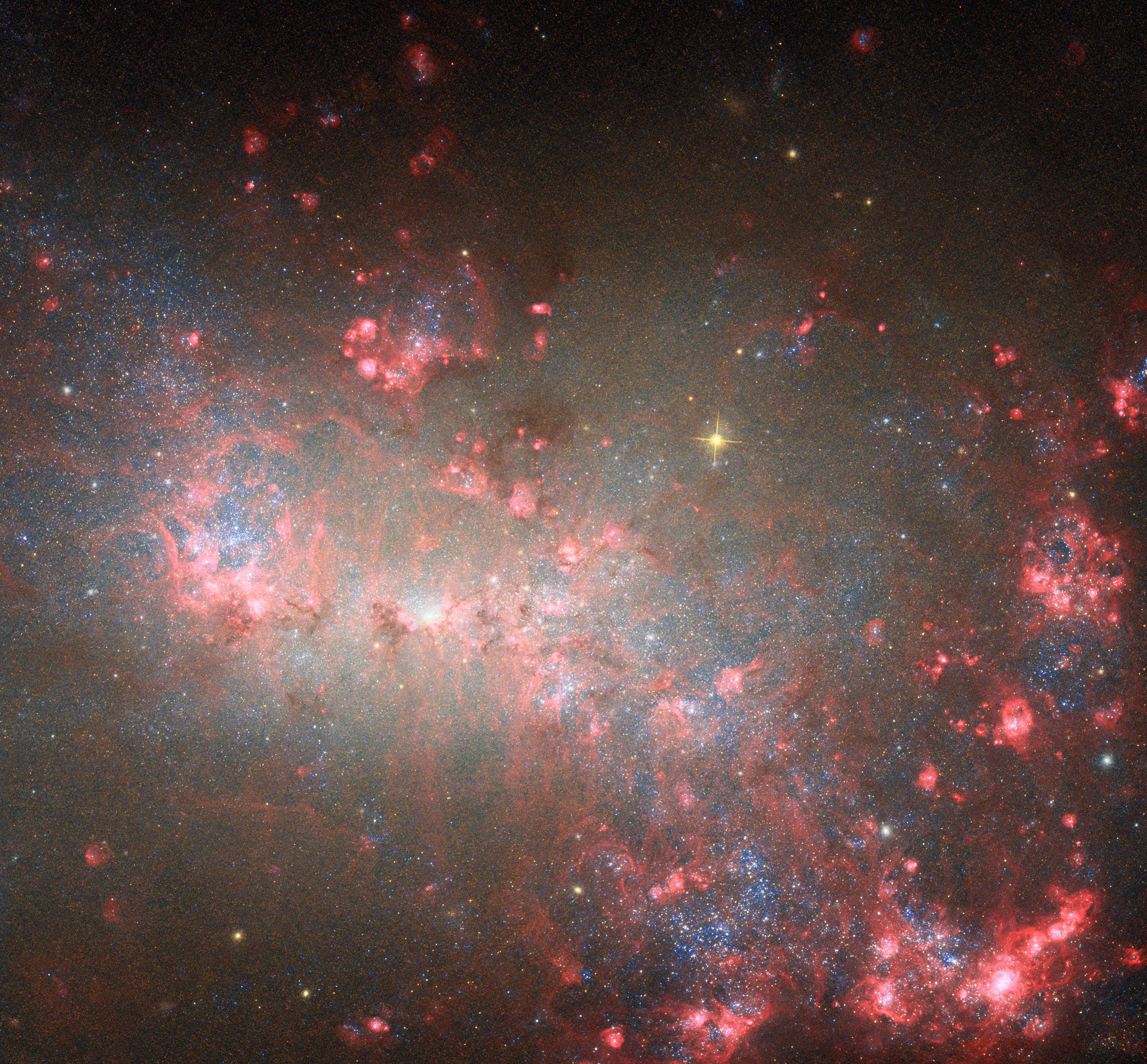
NGC 4449 might be a small galaxy, but it’s making a big splash in the cosmos. Situated just 12.5 million light-years away, this energetic dwarf galaxy is undergoing a stunning starburst phase — lighting up with youthful stellar brilliance far beyond what its size would suggest.
This striking image from the Hubble Space Telescope showcases the nearby galaxy NGC 4449 in remarkable detail. Located just 12.5 million light-years away in the constellation Canes Venatici, also known as The Hunting Dogs, this galaxy belongs to the M94 group, a collection of galaxies not far from our own Local Group, which includes the Milky Way.
The Starburst Power of NGC 4449
NGC 4449 is classified as a dwarf galaxy, meaning it’s much smaller and contains fewer stars than our Milky Way. But don’t be fooled by its size—this galaxy is bursting with energy. NGC 4449 is currently forming new stars at an incredibly rapid pace, far more than expected for a galaxy of its size. That’s why it’s known as a starburst galaxy.
What makes NGC 4449 even more unusual is that its star formation isn’t limited to the center. Instead, bright, young stars are scattered throughout the galaxy. Scientists think this widespread stellar activity was triggered by gravitational interactions with nearby galaxies. Because it’s so close, NGC 4449 offers a rare and valuable chance to study how galaxies influence each other and how stars are born in the process.
Multispectral Imaging of NGC 4449
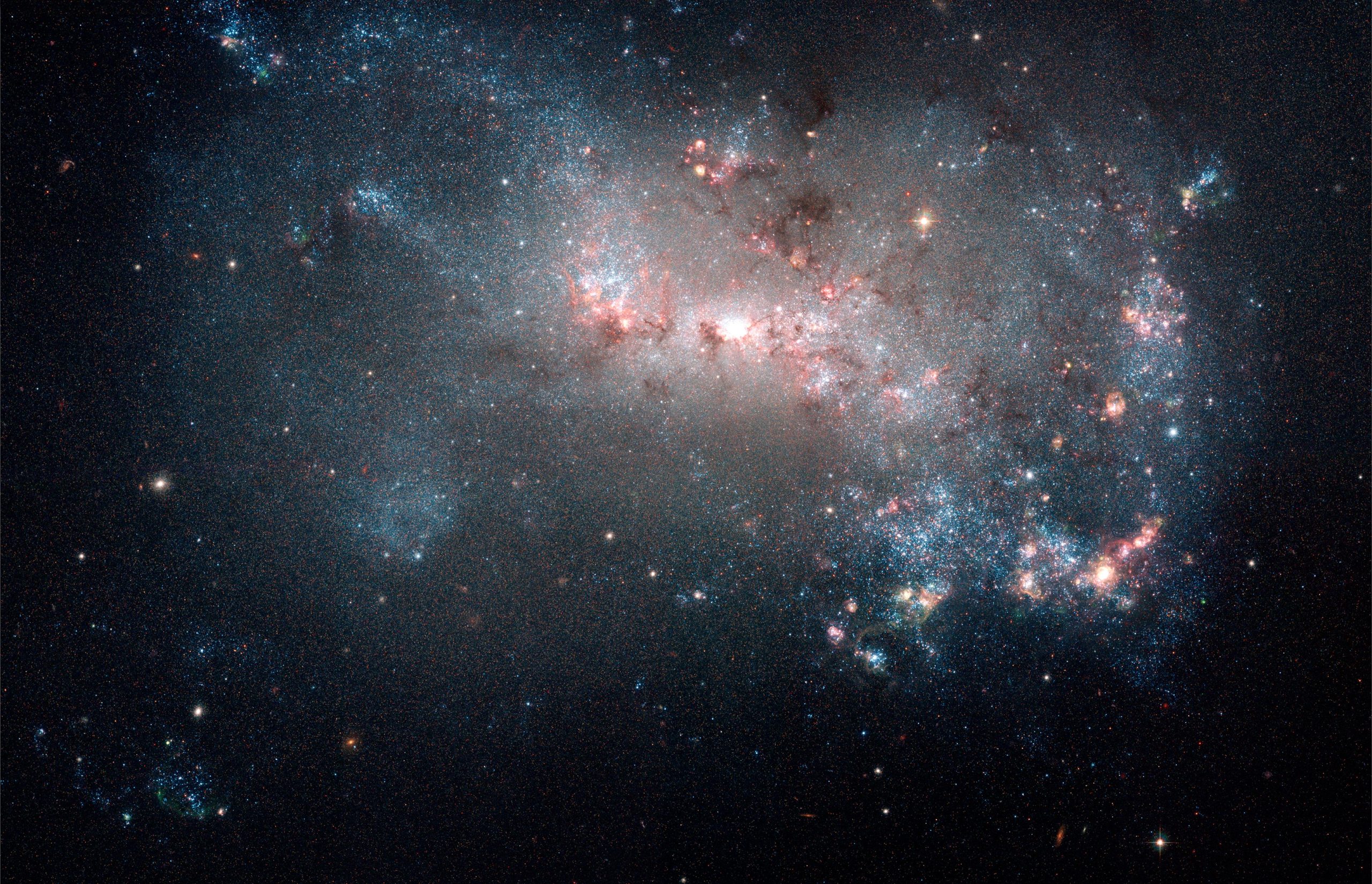
A Hubble image of NGC 4449 was previously released in 2007 (see image above). This new version incorporates several additional wavelengths of light that Hubble collected for multiple observing programmes. These programmes encompass an incredible range of science, from a deep dive into NGC 4449’s star-formation history to the mapping of the brightest, hottest, and most massive stars in more than two dozen nearby galaxies.
A Deeper Look
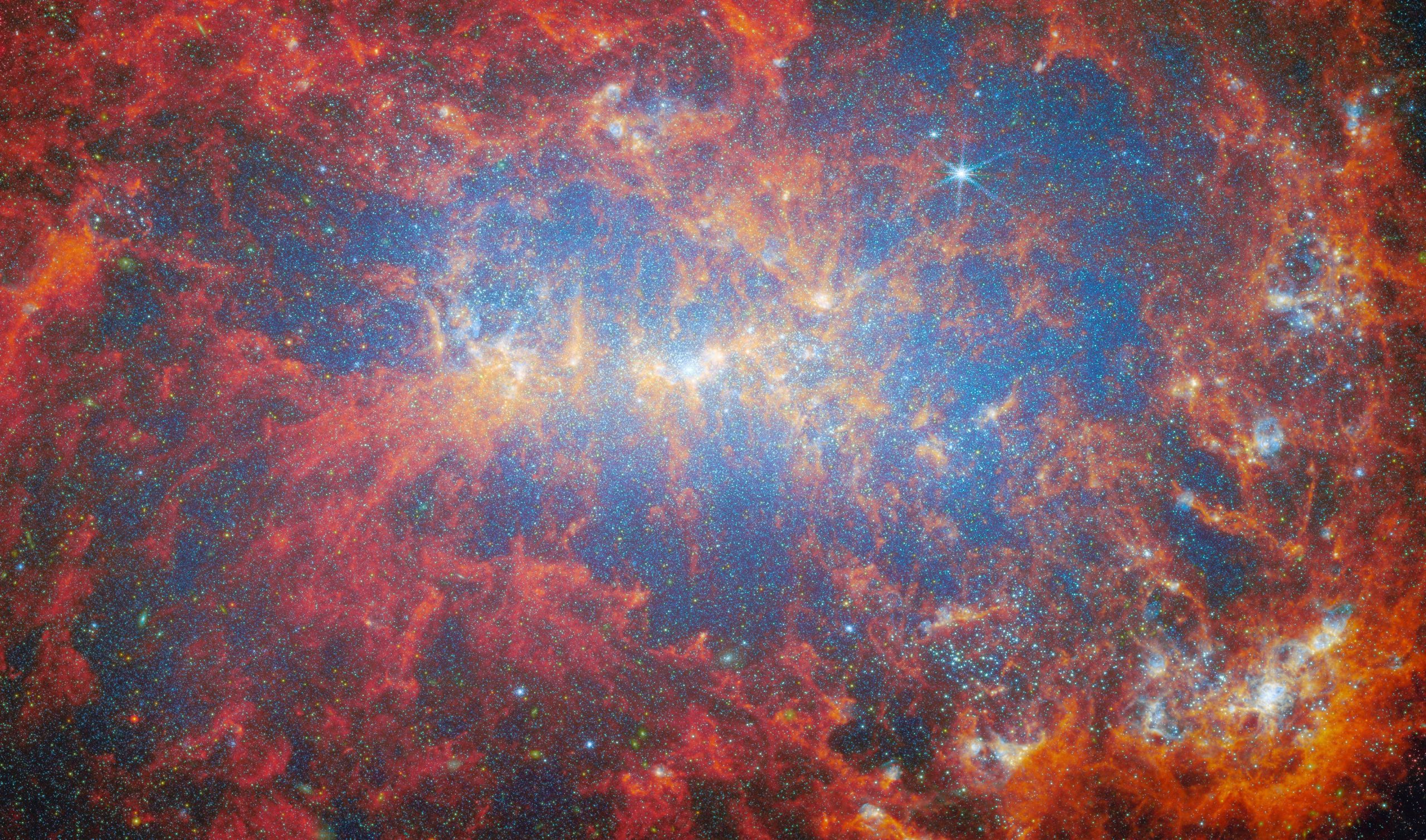
The James Webb Space Telescope has also observed NGC 4449 (see image above), revealing intricate details of the galaxy’s tendrils of dusty gas, which glow from the intense starlight radiated by the flourishing young stars.
Never miss a breakthrough: Join the SciTechDaily newsletter.
Follow us on Google and Google News.
3 Comments
Stellar Fireworks in a Tiny Galaxy: Webb and Hubble Reveal Starburst Secrets.
Neither Webb nor Hubble could have observed the entire evolution of the universe.
Please ask researchers to think deeply:
Does the spatiotemporal motion of Stellar Fireworks come from God, devil and angel, or is it a dynamic evolution of inviscid and incompressible space via topological phase transitions?
If researchers are interested in space, please browse https://zhuanlan.zhihu.com/p/1917878197971816654.
Two sets of cobalt-60, which are manually rotated in opposite directions, are two mirror images of each other, regardless of symmetry. It is a true portrayal of the persistence and dissemination of pseudoscience in contemporary physics and some so-called peer-reviewed publications (including Physical Review Letters, Nature, Science, Proceedings of the National Academy of Sciences, etc.).
Note 2506180454_Source1. Analyzing【
_[1-1]NGC 4449 is a typical dwarf galaxy and banc.nkmsbase.
As shown in Figure 1, banc(i2) is a dwarf galaxy obtained by stopping an ongoing msbase galaxy and reversing into the qpeoms decomposition. Where will the force that stops and pushes back the msbase’s gravitational pull come from? It will be possible because of nk.susqer. It will be the gravitational pull of general relativity with a pause and acceleration change that changes the configuration of the galaxy. Hmm.
Continuing the nkms collapse in example 1, we end up with a huge energy qms.qvix. The force that supports the dwarf galaxy was qcell.nk after all. Uh-huh.
View 1. nk.susqer
04110613-00000009=04110604
14051203 09000000 05051203
15080902 00000900 15080001
01100716 00090000 01010716
04100713-09=04100704
14051203 05041203
15080902 15080102
01110616 01020616
_[2,2-1]NGC 4449 is an almost similarly defined msbase.galaxy. It is believed that the starburst power transfer of stars by the msbase.susqer structure rapidly progressed due to the lack of concentration of nk.stars in the center of the galaxy and the gravitational interaction of nk up to the side extensively, triggering the emergence of nuclei in the nkms.qcell.stars dwarf galaxy.
≈≈========
Source 1.
https://scitechdaily.com/stellar-fireworks-in-a-tiny-galaxy-webb-and-hubble-reveal-starburst-secrets/
1.
Starlight Fireworks in a Small Galaxy: Webb, Hubble, and Starburst Secrets Revealed.
This photo, captured by the Hubble Space Telescope, captured NGC 4449’s explosive neutron star formation. The small galaxy is undergoing a huge star formation surge.
1-1.
Bright and young stars glow throughout their chaotic nuclei and outer arms. It is likely that encounters with galaxies have facilitated this spectacular change.
[NGC 4449 may be a small galaxy, but it’s a big wave in the universe]. Located just 12.5 million light-years away, the energetic dwarf galaxy is going through a remarkable starburst phase and, as you can surmise from its size, is shining with a young and brilliant starlight.
1-2.
This impressive image taken by the Hubble Space Telescope shows the stunning detail of the nearby galaxy NGC 4449.
The galaxy, which is only 12.5 million light years away from Hound, belongs to the M94 galaxy group, a collection of galaxies not far from the local galaxy group that includes our own.
2.NGC 4449 Starburst Power
[NGC 4449 is classified as a dwarf galaxy], which means it is much smaller than our own and has fewer stars. But don’t be fooled by the size. [This galaxy is full of energy.] NGC 4449 is currently forming new stars at an incredible speed in galaxies of the same size, which is much faster than expected. So it is known as an explosive star-generating galaxy.
2-1.
What makes the dwarf galaxy NGC 4449 [even more unusual is that its star formation is not limited to its core]. Bright and young stars are scattered throughout the galaxy. Scientists think that this [extensive stellar activity was triggered by gravitational interactions with nearby galaxies].
2-2.
NGC 4449 is so close that it provides a rare and valuable opportunity to study how galaxies affect each other and how stars are born in the process.
2-3.
Hundreds of thousands of vibrant teal and red stars are visible in this photo from the galaxy NGC 4449 taken by the Hubble Space Telescope in 2007. Giant hot, blue-colored white stars are scattered throughout the galaxy, and dusty red areas where the stars are currently being formed are scattered. Giant gas and dust clouds are silhouetted against the backdrop of the burning starlight.
3.
Multi-spectrum imaging of NGC 4449
The Hubble image of NGC 4449 was released in 2007. The new version additionally includes several wavelengths of light that Hubble has collected for several observation programs. These programs cover a surprisingly wide range of scientific knowledge, from an in-depth analysis of NGC 4449’s star formation history to mapping the brightest, hottest, and heaviest stars in the 20 nearby galaxies.
3-1.
The 2024 photo taken by the James Webb Space Telescope shows the dwarf galaxy NGC 4449. The galaxy, also known as Caldwell 21, is about 12.5 million light years away from Canes Venatici. It is part of the M94 group of galaxies near the Local Group, which houses the Milky Way.
The James Webb Space Telescope has also observed NGC 4449 (see photo above), revealing complex details about dusty gas masses in the galaxy that glow from intense starlight from a thriving young star.